Quarter 2Week 11MondayDay 51 of 180

    Week 11, Monday: Explain why the make-a-ten · Explain how a diagram or picture adds

    Day 51 · 3 lessons · 140 min

    Math

    Students explain why the make-a-ten and decomposition strategies work using place value language and drawings (2.NBT.B.9).

    Standards Addressed

    Activities

    10 min

    Warm-Up

    Spiral from Week 10: say 10 more and 100 less for 462 and 807 (472 and 362, 817 and 707). Then ask your child to solve 38 + 47 any way they like and tell you every step aloud (85).

    paperpencil
    15 min

    Mini-Lesson

    Write 38 + 47 = 85 and ask the week's big question: 'Why does that work?' Model an explanation with straws: '38 is 3 tens and 8 ones. 47 is 4 tens and 7 ones. Tens go with tens: 7 tens. Ones go with ones: 15, which is 1 ten and 5 ones. That makes 8 tens and 5 ones.' Write it as 30 + 40 = 70, 8 + 7 = 15, 70 + 15 = 85. Say, 'This is called decomposing, breaking numbers into their place value parts.'

    straws bundled by tenloose strawspaperpencil
    15 min

    Practice

    Your child solves 56 + 29 and 43 + 38 by decomposing (85, 81), writing the three lines each time (tens sum, ones sum, total). Then they write 2 sentences under each explaining why splitting the numbers into tens and ones does not change the answer.

    paperpencil
    5 min

    Wrap-Up

    Ask, 'If you split 56 into 50 and 6, do you still have 56? How do you know?' Have your child prove it with 5 bundles and 6 straws.

    straws bundled by tenloose straws

    Materials Needed

    paperpencilstraws bundled by tenloose straws

    English Language Arts

    Students explain how a diagram or picture adds to and clarifies the words in a nonfiction text and begin organizing research notes into sections (RI.2.7, W.2.8).

    Standards Addressed

    Activities

    15 min

    Read-Aloud

    Say, 'Last week you figured out why authors write. This week we look at how pictures and words work as a team.' Read the first half of 'The Honey Makers' by Gail Gibbons, through the pages about the hive and the jobs of worker bees. On the labeled diagram of the bee's body, cover the labels and ask what the words tell that the picture alone cannot.

    The Honey Makers by Gail Gibbonssticky notes
    10 min

    Mini-Lesson

    Make a chart with two columns, 'The words tell me' and 'The picture shows me,' and fill it in for the honeycomb diagram (words: cells hold honey and eggs; picture: the cells are six-sided and packed together). Explain that a diagram is a drawing with labels and that it often shows something words alone would take a page to say.

    chart papermarkerThe Honey Makers by Gail Gibbons
    15 min

    Guided Reading

    Reread the page showing the bee's dance. Have your child read the words first with the picture covered and try to draw the dance, then uncover the picture and compare. Ask, 'Which helped you understand more, and why do you think the author used both?'

    The Honey Makers by Gail Gibbonsplain paperpencil
    15 min

    Writing Workshop

    Help your child turn the three question pages in the research folder into three section headings for the All About book ('What It Eats,' 'Where It Lives,' 'How It Grows'). Your child writes each heading on its own page and sorts the fact notes under the right heading by numbering them.

    folderplain paperpencil
    10 min

    Word Study

    Begin fluency word work: reading words instantly so the voice can do the expressing. Practice these words from 'The Honey Makers' until each is read in one look: honey, hive, nectar, pollen, worker, queen, drone, beeswax, comb, swarm. Then read the page about the queen aloud twice, the second time faster and smoother.

    index cardsmarkerThe Honey Makers by Gail Gibbons

    Materials Needed

    The Honey Makers by Gail Gibbonssticky noteschart papermarkerplain paperpencilfolderindex cards

    Science

    Students examine the parts of a flower and explain that pollen must move from flower to flower for seeds to form (2-LS2-2).

    This week's reading: From Flower to Seed

    Standards Addressed

    Activities

    5 min

    Science Question of the Week

    Say, 'Last week seeds traveled by wind, water, and animals. Before a seed exists, a flower needs help too. Our question: How do flowers make seeds, and how can we help pollinators?' Read the first pages of 'The Reason for a Flower' by Ruth Heller.

    The Reason for a Flower by Ruth Hellerindex card
    20 min

    Investigation: Flower Take-Apart

    Buy or pick a large simple flower (an alstroemeria or lily from the grocery store works well). Your child gently pulls off the petals and lays them in a row, then finds the thin stalks with dusty tips (stamens with pollen) and the thicker center stalk (pistil). Touch a cotton swab to the pollen and look at the yellow dust with a hand lens. Tape one petal and one stamen into the notebook.

    fresh flowercotton swabshand lenstapenotebook
    5 min

    Wrap-Up

    Your child draws the flower and labels petals, pollen, and the center. Ask, 'Why might bright petals be useful to a flower?'

    notebookcolored pencils

    Materials Needed

    The Reason for a Flower by Ruth Hellerindex cardfresh flowercotton swabshand lenstapenotebookcolored pencils

    Today's Practice

    One page for your child for each lesson. Answers are for grown-ups.

    Math practice · Week 11 · Monday

    I can add by breaking numbers into tens and ones, and tell why it works.

    Look: 46 + 37

    1. Tens with tens: 40 + 30 = 70.
    2. Ones with ones: 6 + 7 = 13.
    3. Put them together: 70 + 13 = 83.

    Break apart into tens and ones. Write the three lines.

    1. 27 + 45 = ____
    2. 64 + 28 = ____
    3. 36 + 48 = ____

    Explain.

    1. Why does breaking numbers into tens and ones not change the answer?

    Challenge

    • Is 64 the same as 60 + 4? Draw sticks and dots to prove it.
    How did it go? Great Okay Tricky

    ELA practice · Week 11 · Monday

    I can tell what a diagram adds to the words.

    Look: words plus a diagram

    1. Words: An ant has six legs.
    2. Diagram: labels show the ant's head, middle and back part.
    3. The words tell how many legs. The diagram shows where the parts are.

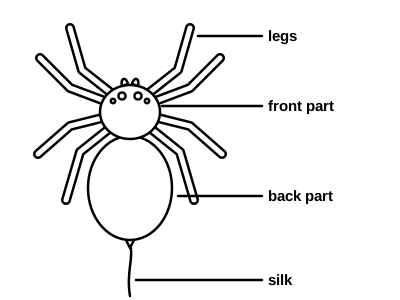
    A Spider's Body

    A spider has two main body parts. All eight of its legs are on the front part. Silk comes out of the back part. A spider uses its silk to spin a web and catch bugs.

    A labeled diagram shows a spider's front part, back part, eight legs and silk.

    Labels show the parts of a spider.

    Use the words and the diagram.

    1. What do the words tell you that the picture does not?
    2. What does the diagram show that the words do not?
    3. How many legs does a spider have?

    Read these words fast, in one look each. Read the list three times.

    1. spider silk web legs body spin
    2. Now read the page above two times. Was the second read smoother?yesno
    How did it go? Great Okay Tricky

    Science practice · Week 11 · Monday

    I can name the parts of a flower.

    Draw your flower. Label the petals, the stamens with pollen and the pistil in the center.

    • petal
    • stamen
    • pollen
    • pistil
    1. My flower
    2. How many petals did your flower have?

    Think and write.

    1. What is the yellow dust on the stamens called?
    2. Why might bright petals be useful to a flower?

    You need: a large flower from the store or yard, a cotton swab, a hand lens if you have one, tape

    How did it go? Great Okay Tricky