Quarter 1Week 7WednesdayDay 33 of 180

    Week 7, Wednesday: Practice adding and subtracting within 100 · Ask and answer questions about a second nonfiction

    Day 33 · 3 lessons · 140 min

    Math

    Students practice adding and subtracting within 100 with the compensation strategy and choose a strategy that fits each problem (2.NBT.B.5).

    Standards Addressed

    Activities

    10 min

    Warm-Up

    Deal 8 index cards with two-digit numbers (23, 41, 59, 17, 36, 68, 74, 85). Your child draws two cards, adds them mentally, then checks with the hundreds chart. Play four rounds.

    index cardsprinted hundreds chart
    15 min

    Mini-Lesson

    Introduce compensation: write 49 + 26. Say, '49 is so close to 50. Let us add 50 + 26 = 76, then take back the 1 we borrowed: 75.' Show it with beans: 49 beans plus 1 bean makes a friendly 50. Repeat with 38 + 45 (40 + 45 = 85, then 85 - 2 = 83) and 71 - 29 (71 - 30 = 41, then add 1 back: 42).

    dried beanspaperpencil
    15 min

    Practice

    Give 6 problems: 59 + 23, 28 + 47, 39 + 36, 82 - 19, 65 - 29, 74 - 38 (answers 82, 75, 75, 63, 36, 36). For each, your child circles the number that is close to a ten and writes the friendly problem first. Support: use only numbers ending in 9 (59 + 23, 82 - 19, 65 - 29). Stretch: try 47 + 28 by rounding both numbers and adjusting twice.

    paperpencil
    5 min

    Wrap-Up

    Ask, 'What makes a number friendly?' Have your child name three friendly numbers (any multiples of ten) and one problem where compensation saved time.

    Materials Needed

    index cardsprinted hundreds chartdried beanspaperpencil

    English Language Arts

    Students ask and answer questions about a second nonfiction text and combine a hook and topic sentence into an informational introduction (RI.2.1, W.2.2).

    Standards Addressed

    Activities

    15 min

    Shared Reading

    Read 'Ants' from the National Geographic Kids Readers series by Melissa Stewart. Before opening it, have your child ask three questions about ants and write them on sticky notes on the cover. Read together, moving each note to the page that answers it.

    National Geographic Kids Readers: Ants by Melissa Stewartsticky notespencil
    10 min

    Mini-Lesson

    Compare the two books: 'From Seed to Plant' uses drawings and 'Ants' uses photographs, but both answer readers' questions. Show how a bold word or a caption often answers a 'what' question fast. Add 'captions' and 'bold words' to the anchor chart as places to look for answers.

    From Seed to Plant by Gail GibbonsNational Geographic Kids Readers: Ants by Melissa Stewartchart papermarker
    15 min

    Independent Reading

    Your child chooses any nonfiction book from the home or library shelf, writes one question before reading, and reads for 12 minutes. At the end they tell you whether the question got answered and read the sentence that answered it.

    library nonfiction booksticky notespencil
    15 min

    Writing Workshop

    Your child copies the hook question and topic sentence onto a clean page as one paragraph and adds one sentence that tells why the topic matters or is interesting ('Cats are great pets because they are quiet and clean.'). Read it aloud together and circle the capital letters and end marks.

    writing notebookpencil
    10 min

    Phonics

    Teach the suffix -ly, which tells how something is done. Read: slowly, quickly, softly, kindly, loudly, safely, bravely, gladly, nearly, sweetly. Have your child say a sentence about an ant using one word ('The ant carried the crumb slowly.') and then act it out.

    index cardsmarker

    Materials Needed

    National Geographic Kids Readers: Ants by Melissa StewartFrom Seed to Plant by Gail Gibbonssticky notespencilchart papermarkerlibrary nonfiction bookwriting notebookindex cards

    Science

    Students observe the four seed bags, record changes, and plant a bean in soil to begin a longer growth test (2-LS2-1).

    This week's reading: What Plants Need

    Standards Addressed

    Activities

    5 min

    Review

    Bring all four bags to the table. Ask your child to read the labels aloud and remind you what each bag is missing. Use a ruler to see if any root or shoot has appeared; most soaked beans show a small root tip by day 2 or 3.

    seed bagsruler
    20 min

    Deeper Investigation: Beans in Soil

    Fill two paper cups with potting soil or garden dirt and plant one soaked bean one finger-deep in each. Water both today, then put Cup 1 in the window and Cup 2 in a closed cupboard. Have your child draw the two cups and write the plan: 'I will water both every day and only Cup 1 gets light.'

    2 paper cupspotting soil2 soaked beanswaternotebook
    5 min

    Data Discussion

    Make a chart with the headings Bag, Water?, Light?, What I See. Fill in today's row for each bag using words like 'root tip,' 'swollen,' 'no change.' Ask, 'Is the dry bag doing anything at all?'

    notebookpencil

    Materials Needed

    seed bagsruler2 paper cupspotting soil2 soaked beanswaternotebookpencil

    Today's Practice

    One page for your child for each lesson. Answers are for grown-ups.

    Math practice · Week 7 · Wednesday

    I can use a friendly number to add or subtract.

    Look: 59 + 34

    1. 59 is close to 60. Borrow 1 to make 60.
    2. Add: 60 + 34 = 94.
    3. Give back the 1: 94 − 1 = 93. So 59 + 34 = 93.

    Circle the number close to a ten. Write the friendly problem first. Then solve.

    1. 69 + 24 = ____
    2. 29 + 58 = ____
    3. 48 + 37 = ____

    Now subtract. Take away the friendly number, then add back.

    1. 73 − 29 = ____
    2. 86 − 39 = ____
    3. 64 − 18 = ____

    Challenge

    • Name three friendly numbers.
    How did it go? Great Okay Tricky

    ELA practice · Week 7 · Wednesday

    I can use bold words and captions to answer questions. I can read words with -ly.

    Look: quiet + ly = quietly

    1. -ly tells how something is done.
    2. quietly means in a quiet way.
    3. The cat crept quietly.

    Ants Work Together

    Ants live in big groups called colonies. Each ant has a job. Some ants dig tunnels. Some ants look for food. The queen ant lays the eggs.

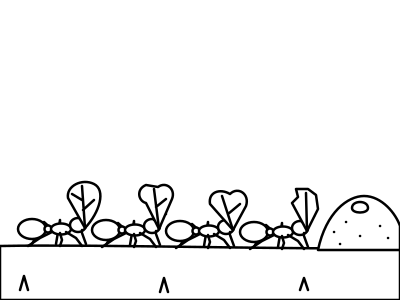
    A line of worker ants carries bits of green leaf back home to their nest.

    Worker ants carry a leaf back home.

    Use the bold word and the caption.

    1. What is a colony?
    2. What does the caption tell you?
    3. Which ant lays the eggs?

    -ly tells how. Circle the word that fits.

    1. The ant carried the crumb ____ up the hill.slowlyloudly
    2. Please talk ____ so the baby can sleep.softlyloudly
    3. We crossed the street ____.safelysweetly
    4. Write a sentence with quickly.
    How did it go? Great Okay Tricky

    Science practice · Week 7 · Wednesday

    I can observe seeds and set up a light test.

    Look at each bag. Write what you see: root tip, swollen or no change.

    BagWater?Light?What I see
    1. Is the dry bag doing anything?

    Plant a bean in each cup. Draw both cups.

    1. My two cups
    2. What is the only thing that is different for the two cups?
    3. Why do both cups get the same water?

    You need: 2 paper cups, potting soil or garden dirt, 2 soaked beans, water, a ruler

    How did it go? Great Okay Tricky