Week 7: Fluently Add and Subtract Within 100 · Asking and Answering Questions in Nonfiction

    Quarter 1 · Detailed day-by-day lesson plans · Days 31–35

    0 of 15 lessons done this week

    Fluently Add and Subtract Within 100 Asking and Answering Questions in Nonfiction

    Print

    Worksheets and answer keys

    Gather this week

    • Shop
    • Shop
    • Shop
    Everyday supplies (11)

    Writing prompt

    • Pick an animal you know about. Describe what it eats, where it lives, and one cool fact.
    Writing prompts (from Week 6)

    Parent note

    This week's parent digest

    Specials this week

    Supplements

    This week at a glance

    Week 7 builds fluency adding and subtracting within 100 using place-value strategies. Readers shift to nonfiction, learning to ask and answer questions about a text.

    Parent tip

    Practice mental math by adding grocery prices to the nearest dollar.

    Materials this week

    Whiteboard, nonfiction picture book, math journal

    Mathematics

    Fluently Add and Subtract Within 100

    Addition & Subtraction Within 100 · 2.NBT.B.5

    Assessment: Solve 20 problems within 100 using strategies; explain one strategy in writing

    ELA

    Asking and Answering Questions in Nonfiction

    Phonics: Suffixes: -ful, -less, -ly, -ness

    Writing: Informational writing

    Science

    Plants, Animals & Habitats

    2-LS2-1, 2-LS2-2, 2-LS4-1, K-2-ETS1-2

    Social Studies

    Maps, Geography & Our World

    Monday — Day 31

    140 minutes of instruction

    Math

    Students add two-digit numbers within 100 using make-a-ten and open number line strategies based on place value (2.NBT.B.5).

    Standards Addressed

    Activities

    10 min

    Warm-Up

    Spiral from Week 6: write 348 and 384 on index cards and ask which is greater and how you know. Then flash 10 make-a-ten facts (7 + 3, 8 + 2, 6 + 4, 9 + 1, 5 + 5) and have your child answer aloud as fast as possible.

    index cardspencil
    15 min

    Mini-Lesson

    Write 38 + 25. Model with straw bundles: 3 tens and 8 ones plus 2 tens and 5 ones. Show how 8 loose straws and 2 of the 5 make a new bundle of ten, leaving 3 loose. Say, 'We made a ten. Now we have 6 tens and 3 ones, 63.' Repeat with 47 + 36 (6 + 3 more makes a ten, total 83).

    straws bundled by tenloose strawsrubber bandspaper
    15 min

    Practice

    Your child solves 29 + 34, 56 + 27, 45 + 38, and 18 + 65 by building each with straws, making a ten when needed, and writing the answer (63, 83, 83, 83). For the last problem, ask them to also draw the bundles as sticks and dots on paper.

    straws bundled by tenloose strawspaperpencil
    5 min

    Wrap-Up

    Ask, 'When do we need to make a new ten?' Listen for 'when the ones add up to 10 or more.' Have your child tell you one problem from today where they made a ten.

    Materials Needed

    index cardsstraws bundled by tenloose strawsrubber bandspaperpencil

    English Language Arts

    Students ask who, what, where, when, why, and how questions before and during a nonfiction read-aloud and begin an informational piece by introducing a topic (RI.2.1, W.2.2).

    Standards Addressed

    Activities

    15 min

    Read-Aloud

    Say, 'Last week we read stories and asked whose point of view we were hearing. This week we read true books, and the reader's job is to ask questions.' Show the cover of 'From Seed to Plant' by Gail Gibbons and write three questions your child wonders about on a chart labeled 'Before Reading' (for example, 'How does a seed know when to grow?'). Read the first half, through the pages that show how seeds travel, pausing whenever a question gets answered to draw a check mark next to it.

    From Seed to Plant by Gail Gibbonschart papermarker
    10 min

    Mini-Lesson

    Make a six-box anchor chart with the words Who, What, Where, When, Why, How. Model turning one page into a question for each box: 'Where does the seed go after the wind carries it?' Explain that good readers ask questions the whole time they read, not just at the start.

    chart papermarker
    15 min

    Guided Reading

    Give your child six sticky notes, one per question word. Reread two pages together and have your child write one question on each note, then hunt for the answer and write the page number on the back. Any question the book does not answer goes on a separate 'Still Wondering' card.

    From Seed to Plant by Gail Gibbonssticky notespencilindex card
    15 min

    Writing Workshop

    Introduce informational writing: 'This kind of writing teaches a reader something true.' Your child picks a topic they already know well (a pet, a sport, a favorite food, a plant in the yard) and writes a topic sentence that names it, such as 'Cats are pets that like to climb and nap.' Draw a quick picture that shows the topic.

    writing notebookpencilcrayons
    10 min

    Phonics

    Teach the suffix -ful, meaning 'full of.' Write these words on index cards and have your child cover the suffix, read the base word, then read the whole word and tell what it means: helpful, careful, hopeful, playful, colorful, thankful, useful, joyful, cheerful, painful. Sort the cards by whether the base word is a thing (color) or an action (help).

    index cardsmarker

    Materials Needed

    From Seed to Plant by Gail Gibbonschart papermarkersticky notesindex cardswriting notebookpencilcrayons

    Science

    Students plan and set up an investigation to find out whether plants need water and sunlight to grow (2-LS2-1).

    This week's reading: What Plants Need

    Standards Addressed

    Activities

    5 min

    Science Question of the Week

    Remind your child that last week we learned big objects are made of small pieces. Say, 'This week we start living things. Our question: What does a plant need to grow?' Write the question on an index card and tape it above the work space.

    index cardtape
    20 min

    Investigation: Seeds in Bags

    Fold four damp paper towels into four zip bags and press two dried beans (pinto or kidney, soaked overnight) into each. Label the bags A: water and light (sunny window), B: water, no light (dark cupboard), C: no water and light (dry towel, sunny window), D: no water, no light. Have your child predict which bag will sprout first and record the prediction on a chart with four rows.

    4 zip bags8 dried beanspaper towelsmarkernotebook
    5 min

    Wrap-Up

    Ask, 'Which bag are you most sure about? Why?' Your child draws all four bags in the science notebook and writes today's date under the drawing.

    science notebookpencil

    Materials Needed

    4 zip bags8 dried beans (soaked overnight)paper towelsmarkerindex cardtapescience notebookpencil
    Open Monday on its own page
    Science

    Reading About Our World: What Plants Need

    Read it aloud first while your child follows along. Then read it together, and let your child read the parts they can. Talk about the words in the word box.

    Plants are living things. Like you, they need certain things to live and grow.

    Plants need light. Most plants get light from the sun. A plant kept in a dark closet turns pale and weak.

    Plants need water. Water travels up from the roots, through the stem, to the leaves.

    Plants need air. Leaves take in a gas from the air called carbon dioxide.

    Plants need nutrients. Nutrients help a plant grow strong. Roots take them in from the soil.

    Plants also need space. If seeds are planted too close together, the plants crowd each other and stay small.

    Plants use light, water and air to make their own food in their leaves. People and animals cannot do that! How could you test whether a bean plant needs light?

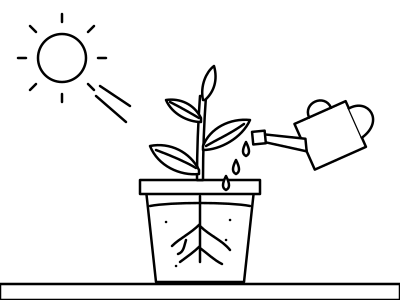
    A bean plant grows in a pot of soil with roots, sunlight shining on it and a watering can giving it water.

    Word box

    roots:
    the plant parts that take in water and nutrients from the soil
    stem:
    the part that holds the plant up and carries water to the leaves
    nutrients:
    things in the soil that help a plant grow
    living thing:
    something that grows and needs food, water and air

    Questions

    1. Where do most plants get light?
    2. What do roots do?
    3. What could happen to a plant kept in a dark closet?

    Weekly check

    Math

    Weekly Check

    • I can add and subtract within 100 using a strategy.
    • I can explain one strategy in words or a drawing.
    1. 36 + 47 = ____
    2. 58 + 35 = ____
    3. 81 − 45 = ____
    4. 70 − 28 = ____
    5. Lin had 64 stickers. She gave away 29. How many are left?
    6. Tell how you solved one problem. Use words or a drawing.

    ELA

    Weekly Check

    • I can ask and answer questions about a nonfiction text.
    • I can read and explain words with -ful, -less, -ly and -ness.

    Snails

    A snail has a hard shell on its back. The shell keeps the snail safe. Snails move slowly on one flat foot. They like wet places.

    1. What keeps a snail safe?
    2. Where do snails like to live?
    3. Write a question the text does not answer.
    4. Hopeless means ____.
    5. Cheerful means ____.
    6. Circle the word that tells how: The snail moved slowly.
    7. Add -ness to sad. Write the word.

    Science

    Weekly Check

    • I can explain what plants need to live and grow.
    • I can plan a test to find out if a plant needs light.
    1. What do seeds need to sprout?watera cupboarda toy
    2. Name two things a plant needs to grow.
    3. You want to test if a plant needs light. What will be different for the two plants?
    4. What should be the same for both plants?
    5. A plant in the dark is pale. A plant in the window is green. What does it need?

    Social Studies

    Weekly Check

    • I can tell the difference between a map and a globe.
    • I can use a map key and a compass rose.
    1. Which is round like Earth?a mapa globe
    2. Which is flat?a mapa globe
    3. What does a map key tell you?
    4. What does a compass rose show?
    5. On most maps, which way is north?updownleft

    Specials

    PE · Throwing, Catching & Hand-Eye Coordination · All Specials

    This Week's Specials Page

    PE · Week 7

    I can toss underhand and catch with two hands.

    Look: Underhand toss

    1. Face your partner. Step with the foot opposite your throwing hand.
    2. Swing your arm low, like a pendulum, and let go at your waist.
    3. To catch, make a basket with two hands and watch the object.

    Partner toss with a beanbag or rolled-up socks. Stand in a clear space away from windows. Make a tally mark for each catch out of 10 tosses.

    DistanceCatches out of 10
    1. Close (3 big steps apart): ____ catches
    2. Middle (5 big steps apart): ____ catches
    3. Far (7 big steps apart): ____ catches

    Think about it.

    1. Which distance was easiest?closemiddlefar
    2. What helps you catch?

    You need: a beanbag or a pair of rolled-up socks, a partner

    How did it go? Great Okay Tricky

    Home Connection

    This week at home

    • Math

      Adding and taking away with smart strategies

    • ELA

      Asking questions helps me learn true facts

    • Science

      Plants need water and light to grow

    • Social Studies

      Maps show places from above

    Three things to celebrate this week

    We did blank of 4 activities.

    Suggested Daily Schedule

    8:30–9:00 AM30 minMorning Meeting / Calendar / Read-Aloud
    9:00–9:30 AM30 minPhonics / Word Study / Spelling
    9:30–10:15 AM45 minReading Workshop
    10:15–10:35 AM20 minSnack and Outdoor Play / Movement Break
    10:35–11:05 AM30 minWriting Workshop
    11:05–11:50 AM45 minMathematics
    11:50 AM–12:35 PM45 minLunch and Free Play
    12:35–1:05 PM30 minScience OR Social Studies (alternating)
    1:05–1:35 PM30 minSpecials: PE / Art / Music / Health (rotating)
    1:35–2:00 PM25 minIndependent Reading / Enrichment