Quarter 2Week 10MondayDay 46 of 180

    Week 10, Monday: Mentally add and subtract 10 from any number · Identify the main purpose of a nonfiction text

    Day 46 · 3 lessons · 140 min

    Math

    Students mentally add and subtract 10 from any number within 1000 by changing only the tens digit (2.NBT.B.8).

    Standards Addressed

    Activities

    10 min

    Warm-Up

    Spiral from Week 9: solve 356 + 428 with a drawing (784). Then on the hundreds chart, put a bean on 47 and slide it down one row to 57 and up one row to 37. Ask what changed and what stayed the same (tens digit changed, ones digit stayed).

    printed hundreds chartdried beanspaperpencil
    15 min

    Mini-Lesson

    Write 346 on an index card with each digit on its own card: 3, 4, 6. Say, 'Ten more means one more stick.' Swap the 4 for a 5: 356. Ten less: swap for a 3: 336. Then the tricky case, 396 + 10: 9 tens plus 1 ten is 10 tens, which regroups to a hundred, so 406. Show it with straw bundles.

    index cardsstraws bundled by tenrubber bands
    15 min

    Practice

    Say each number and your child answers 10 more and 10 less aloud: 234, 571, 809, 450, 693, 385, 902, 197 (answers 244 and 224, 581 and 561, 819 and 799, 460 and 440, 703 and 683, 395 and 375, 912 and 892, 207 and 187). They write only the ones they hesitate on.

    paperpencil
    5 min

    Wrap-Up

    Ask, 'When does adding 10 change the hundreds digit?' Listen for 'when the tens digit is 9.' Have your child give one example.

    Materials Needed

    printed hundreds chartdried beanspaperpencilindex cardsstraws bundled by tenrubber bands

    English Language Arts

    Students identify the main purpose of a nonfiction text, including what the author wants to answer, explain, or describe, and choose a research topic for an All About book (RI.2.6, W.2.7).

    Standards Addressed

    Activities

    15 min

    Read-Aloud

    Say, 'Last week you used headings and captions to find facts. This week we ask a bigger question: why did the author write this book at all?' Read the first half of 'Monarch Butterfly' by Gail Gibbons, through the caterpillar stage. Pause twice to ask, 'What is Gail Gibbons trying to explain on this page?'

    Monarch Butterfly by Gail Gibbons
    10 min

    Mini-Lesson

    Make an anchor chart with three purposes and a picture for each: to answer a question, to explain how something works, to describe what something is like. Write 'Monarch Butterfly' under 'explain' and have your child say why ('It explains how a caterpillar turns into a butterfly').

    chart papermarker
    15 min

    Guided Reading

    Reread the milkweed pages together. Ask, 'What does the author want me to know about milkweed?' and have your child find the sentence that shows it. This links to science this week, where you are learning that animals depend on plants; a monarch cannot live without milkweed.

    Monarch Butterfly by Gail Gibbonssticky notespencil
    15 min

    Writing Workshop

    Launch the research project: an 'All About' book on a plant or animal connected to the science unit. Offer choices (bean plant, sunflower, monarch butterfly, honeybee, ant, earthworm) and have your child pick one and write three questions they want to answer ('What does it eat? Where does it live? How does it grow?'). Set up a research folder with one page per question.

    folderplain paperpencil
    10 min

    Word Study

    Teach that a base word is the root you can build on. Write these word families and have your child circle the base in each: play, replay, playful; help, helper, helpless; read, reread, reader; care, careful, careless. Then your child builds one new word from the base 'hope' and tells what it means.

    whiteboard or papermarker

    Materials Needed

    Monarch Butterfly by Gail Gibbonschart papermarkersticky notespencilfolderplain paperwhiteboard or paper

    Science

    Students explain that animals depend on plants for food and shelter and observe how seeds travel on animals (2-LS2-2).

    Standards Addressed

    Activities

    5 min

    Science Question of the Week

    Say, 'Last week you built a habitat. Every animal in it needed plants somehow. Our question this week: How do animals depend on plants, and how do plants use animals to move their seeds?'

    index cardtape
    20 min

    Investigation: What Did I Eat From a Plant?

    Set out breakfast and lunch items: bread, an apple, peanut butter, cheese, a carrot, cereal. Your child sorts them into From a Plant, From an Animal, and Both, then traces the animal foods back: 'Cheese comes from a cow, and the cow eats grass.' Then walk outside and rub a fuzzy sock or an old mitten across weeds and tall grass; look for seeds that stick, and count them.

    assorted foodsfuzzy sock or mittenhand lensnotebook
    5 min

    Wrap-Up

    Your child writes two sentences: 'Animals need plants for ______.' and 'Seeds stuck to my sock because ______.' Tape a few stuck seeds into the notebook.

    notebookpenciltape

    Materials Needed

    index cardtapeassorted foodsfuzzy sock or mittenhand lensnotebookpencil

    Today's Practice

    One page for your child for each lesson. Answers are for grown-ups.

    Math practice · Week 10 · Monday

    I can find 10 more and 10 less in my head.

    Look: 523

    1. 10 more: the tens digit goes up by 1. 523 → 533.
    2. 10 less: the tens digit goes down by 1. 523 → 513.
    3. If the tens digit is 9, 10 more makes a new hundred: 491 → 501.

    Write 10 less and 10 more. Circle the digit that changed.

    1. 10 less ____ 128 10 more ____
    2. 10 less ____ 462 10 more ____
    3. 10 less ____ 715 10 more ____
    4. 10 less ____ 590 10 more ____
    5. 10 less ____ 897 10 more ____
    6. 10 less ____ 304 10 more ____

    Challenge

    • When does adding 10 change the hundreds digit? Give an example.
    How did it go? Great Okay Tricky

    ELA practice · Week 10 · Monday

    I can tell what an author wants to explain.

    Look: Why did the author write it?

    1. Read: First, mix flour and water. Next, add salt.
    2. The author tells the steps to make something.
    3. So the author wrote it to explain.

    How a Chick Hatches

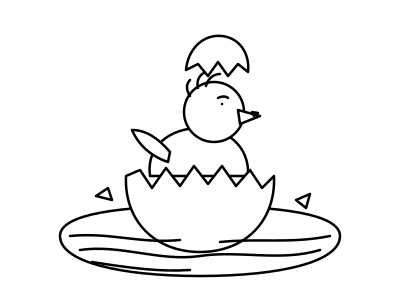
    A hen sits on her eggs to keep them warm. After about three weeks, the chick inside is ready. It pecks a small hole in the shell with a tiny tip on its beak. Then it pushes and wiggles until the shell cracks open. The wet chick rests. Soon its feathers dry and get fluffy.

    A wet baby chick pushes its way out of a cracked egg.

    Use the page above.

    1. Why did the author write this page?to answer a questionto explain how something worksto describe what something is like
    2. Underline the sentence that tells how the chick makes the first hole.
    3. What does the author want you to know?

    Circle the base word.

    1. unlock
    2. painter
    3. thankful
    4. rewrite

    Challenge

    • Build two new words from the base word jump.
    How did it go? Great Okay Tricky

    Science practice · Week 10 · Monday

    I can tell how animals depend on plants.

    Sort the foods you set out today. Write each one in a column.

    From a PlantFrom an AnimalBoth
    1. Pick one food from an animal. Trace it back to a plant.
    2. Animals need plants for ________ and ________.

    Sock walk. Rub a fuzzy sock across weeds and tall grass.

    1. How many seeds stuck to your sock?
    2. Seeds stuck to my sock because ________.

    You need: foods from the kitchen (bread, an apple, cheese, a carrot, cereal), an old fuzzy sock, tape

    How did it go? Great Okay Tricky