Quarter 1Week 9FridayDay 45 of 180

    Week 9, Friday: Use base-ten drawings and straw bundles to add · Use text features to locate information

    Day 45 · 3 lessons · 140 min

    Math

    Students use base-ten drawings and straw bundles to add and subtract within 1000 with regrouping (2.NBT.B.7).

    Standards Addressed

    Activities

    10 min

    Warm-Up

    Regroup or not? Read 6 problems aloud and your child gives a thumbs up if regrouping is needed: 234 + 145 (no), 267 + 158 (yes), 590 - 240 (no), 503 - 168 (yes), 425 + 375 (yes), 681 - 429 (yes).

    15 min

    Review Mini-Lesson

    Solve 467 + 285 (752) and 703 - 358 (345) together, alternating who draws each step. For the subtraction, notice that 703 has 0 tens, so you unbundle a hundred first (6 squares, 10 sticks, 3 dots), then unbundle a ten (6 squares, 9 sticks, 13 dots).

    paperpencil
    15 min

    Weekly Assessment

    Give 6 problems to solve with base-ten drawings: 356 + 428, 279 + 365, 547 + 293, 684 - 237, 815 - 462, 600 - 348. Straws available for checking. Each drawing must show regrouping with circles or cross-outs.

    paperpencilstraws bundled by tenloose straws
    5 min

    Wrap-Up

    Check answers (784, 644, 840, 447, 353, 252). Ask, 'Which was hardest? What would you tell a friend who has never regrouped?' Save the assessment for the Week 12 portfolio.

    Materials Needed

    paperpencilstraws bundled by tenloose straws

    Assessment

    Use base-ten blocks and drawings to solve addition/subtraction within 1000

    English Language Arts

    Students use text features to locate information on an assessment and publish a sequenced narrative (RI.2.5, W.2.3).

    Standards Addressed

    Activities

    10 min

    Reading Celebration

    Your child gives a one-minute 'tour' of the 'Sharks' book to a family member, pointing out the table of contents, a heading, a caption, a bold word, the glossary, and the index and telling what each is for. Connect to last week: 'Which feature tells the main topic of a section fastest?'

    National Geographic Kids Readers: Sharks by Anne Schreiberfamily member as audience
    15 min

    Reading Response or Assessment

    Using a library nonfiction book your child has not read before, give six written tasks: find the page number for a topic using the table of contents, find the meaning of one glossary word, use the index to find a page about one topic, copy one caption, write one bold word and what it means, and write one heading and what that section is about. Score each lookup.

    new library nonfiction bookwriting notebookpencil
    15 min

    Publishing and Author's Chair

    Your child copies the finished narrative onto three pages (First, Next, Last), draws a picture for each with a caption, and adds a title page. Read it aloud from the Author's Chair; the audience retells the three events in order to prove the sequence was clear.

    plain paperpencilcrayonsstapler
    10 min

    Phonics Check

    Dictate ten two-syllable words and have your child divide and read each: rabbit, tiger, cupcake, turtle, magnet, paper, inside, little, picnic, candle. Note which syllable type gave trouble for a Monday warm-up next week.

    writing notebookpencil
    15 min

    Independent Reading

    Your child reads a self-chosen book for 15 minutes; if it is nonfiction, they flag one feature that helped them; if fiction, they flag a place with a two-syllable word they figured out.

    self-chosen booksticky notes

    Materials Needed

    National Geographic Kids Readers: Sharks by Anne Schreibernew library nonfiction bookwriting notebookpencilplain papercrayonsstaplerself-chosen booksticky notesfamily member as audience

    Assessment

    Complete six text-feature lookups (table of contents, glossary, index, caption, bold word, heading) in an unfamiliar nonfiction book; phonics check on ten two-syllable words across closed, open, silent-e, and consonant-le patterns.

    Science

    Students conclude that different habitats support different kinds of living things and build a model of one habitat (2-LS4-1).

    This week's reading: A Home for Every Animal

    Standards Addressed

    Activities

    10 min

    Drawing Conclusions

    Reread the square survey totals and the habitat sort. Guide the claim: 'Different places have different living things because each place gives different food, water, and shelter.' Your child copies the claim and adds one piece of evidence from Monday.

    notebookpencil
    15 min

    Art Connection: Shoebox Habitat

    Your child chooses one habitat from Wednesday and builds it in a shoebox: blue paper for water, crumpled brown paper for rocks, twigs for trees, cotton for clouds or snow. Add two animals drawn on paper and folded to stand, and place each where it finds food and shelter.

    shoeboxcolored papertwigscotton ballsgluescissorscrayons
    5 min

    Week Reflection

    Ask, 'Last week's beak tools showed that parts match food. How do the animals in your shoebox match their habitat?' Your child answers aloud and writes one sentence.

    notebookpencil

    Materials Needed

    notebookpencilshoeboxcolored papertwigscotton ballsgluescissorscrayons

    Assessment

    Child explains, using the shoebox model, how a habitat provides at least two needs for each of two animals.

    Today's Practice

    One page for your child for each lesson. Answers are for grown-ups.

    Math practice · Week 9 · Friday

    Get ready: I can add and subtract within 1000 with drawings.

    Will you need to trade? Circle yes or no.

    1. 452 + 327yesno
    2. 385 + 146yesno
    3. 764 − 518yesno

    Solve with a drawing.

    1. 529 + 284 = ____
    2. 804 − 267 = ____
    3. A store has 700 pencils. It sells 326. How many pencils are left?

    Challenge

    • 804 has 0 tens. What do you open first to subtract 7 ones?
    How did it go? Great Okay Tricky

    ELA practice · Week 9 · Friday

    Get ready: I can use book tools and read two-syllable words.

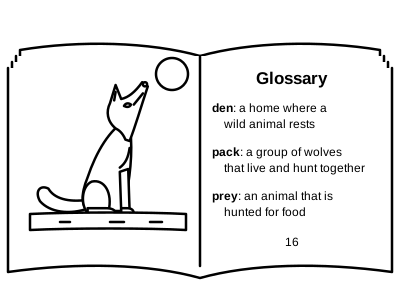
    Glossary

    den: a home where a wild animal rests pack: a group of wolves that live and hunt together prey: an animal that is hunted for food

    The glossary page at the back of a book about wolves lists the words den, pack and prey.

    Use the glossary above.

    1. What is a pack?
    2. Is a glossary at the front or the back of a book?frontback
    3. Which book tool lists topics in ABC order with page numbers?contentsglossaryindex

    Split and read.

    1. tennis
    2. pony
    3. maple
    4. inflate
    How did it go? Great Okay Tricky

    Science practice · Week 9 · Friday

    I can tell why different places have different living things.

    Copy the claim. Then add your evidence from Monday's survey.

    1. Different places have different living things because each place gives different food, water and shelter.
    2. My evidence: The ________ square had ________.

    Plan your shoebox habitat. Draw it and label the water, the food and the shelter.

    1. My shoebox habitat
    2. How does one animal in your box fit its habitat?

    You need: a shoebox, paper, twigs and cotton balls, glue or tape

    How did it go? Great Okay Tricky