Quarter 2Week 11FridayDay 55 of 180

    Week 11, Friday: Write and draw to explain why addition · Explain how specific images contribute to a text

    Day 55 · 3 lessons · 140 min

    Math

    Students write and draw to explain why addition and subtraction strategies work using place value and properties of operations (2.NBT.B.9).

    Standards Addressed

    Activities

    10 min

    Warm-Up

    Strategy match: read four solutions aloud and your child names the strategy. '70 + 20 = 90, 6 + 5 = 11, 101' (decompose); '48 + 30 = 78, minus 1 = 77' (compensation); 'jump 40, jump 7' (number line); 'circle 10 dots, draw a stick' (base-ten drawing).

    15 min

    Review Mini-Lesson

    Solve 74 - 36 = 38 together and write the explanation as a class model: 'I split 36 into 30 and 6. 74 - 30 = 44. 44 - 6 = 38. It works because taking 30 and then 6 is the same as taking 36.' Underline the 'because' sentence and say that every explanation needs one.

    paperpencil
    15 min

    Weekly Assessment

    Your child solves two problems, 68 + 27 and 345 - 178, using a different strategy for each, and for each writes or draws an explanation with at least one 'because' sentence telling why the strategy works (answers 95 and 167). Manipulatives allowed for the drawing, not for the written reasoning.

    paperpencilstraws bundled by tenloose straws
    5 min

    Wrap-Up

    Read the explanations back to your child and ask, 'Did you say what you did AND why it works?' Compare with the index card from Thursday and note growth.

    index cards

    Materials Needed

    paperpencilstraws bundled by tenloose strawsindex cards

    Assessment

    Write or draw to explain why addition and subtraction strategies work

    English Language Arts

    Students explain how specific images contribute to a text on an assessment and share a drafted All About section with its diagram (RI.2.7, W.2.2, W.2.8).

    Standards Addressed

    Activities

    10 min

    Reading Celebration

    Your child picks the single best image from this week's two books, shows it to a family member, and explains what the words on that page say and what the image adds. Remind them that last week's skill, author's purpose, tells you why Gail Gibbons chose drawings and why National Geographic chose photos.

    The Honey Makers by Gail GibbonsNational Geographic Kids Readers: Weather by Kristin Baird Rattinifamily member as audience
    15 min

    Reading Response or Assessment

    Your child reads the honeycomb page of 'The Honey Makers' independently and answers in writing: What does the diagram show? What do the labels tell you? Write one fact that is only in the words and one fact that is only in the picture. How did the picture help you understand the words?

    The Honey Makers by Gail Gibbonswriting notebookpencil
    15 min

    Publishing and Author's Chair

    Your child reads one drafted section of the All About book from the Author's Chair and holds up its diagram, then asks the audience, 'What did the picture help you understand?' Record the audience's answer on a sticky note for revising next week.

    foldersticky notespencil
    10 min

    Phonics Check

    Time a one-minute read of the bee-dance page from 'The Honey Makers' and count words read correctly, then dictate ten words for spelling: honey, nectar, pollen, another, through, thunder, freezing, jumped, landed, wanted. Note the rate and any word to review.

    The Honey Makers by Gail Gibbonskitchen timerwriting notebookpencil
    15 min

    Independent Reading

    Your child reads a self-chosen book for 15 minutes and marks one place where reading with expression made a sentence sound better, then reads that sentence to you two ways, flat and expressive.

    self-chosen booksticky notes

    Materials Needed

    The Honey Makers by Gail GibbonsNational Geographic Kids Readers: Weather by Kristin Baird Rattiniwriting notebookpencilfoldersticky noteskitchen timerself-chosen bookfamily member as audience

    Assessment

    Read the honeycomb page of The Honey Makers and explain in writing what the diagram shows and how it clarifies the text; one-minute timed fluency read and ten-word spelling check.

    Science

    Students build and test a hand pollinator, compare it to the cotton ball, and conclude that pollinators help plants make seeds (2-LS2-2, K-2-ETS1-2).

    This week's reading: From Flower to Seed

    Standards Addressed

    Activities

    10 min

    Drawing Conclusions

    Your child builds the pollinator sketched on Wednesday and runs the same two-flower test three times, shaking the pollen that arrives onto a dark paper each time and comparing the pile to the cotton ball's pile. Record 'more,' 'same,' or 'less' for each trial and decide whether the design worked.

    pollinator design materialscupcake liner flowerscornmealdark papernotebook
    15 min

    Art Connection: Pollinator Garden Plan

    Your child draws a garden bed from above, like the Week 7 maps, with at least four flowers of different colors and shapes, and adds three pollinators from 'Flowers Are Calling' (bee, hummingbird, butterfly) placed on the flowers they like. Write a title and a sentence: 'Pollinators need ______ and we need pollinators for ______.'

    Flowers Are Calling by Rita Graypapercrayons or markers
    5 min

    Week Reflection

    Ask, 'Last week seeds moved by wind, water, and animals. This week pollen moved by ______. Which is harder to see happening?' Your child writes one sentence answering the question of the week.

    notebookpencil

    Materials Needed

    pollinator design materialscupcake liner flowerscornmealdark papernotebookFlowers Are Calling by Rita Graypapercrayons or markerspencil

    Assessment

    Child explains that pollen must move between flowers to make seeds and shows a tested pollinator model, stating whether it carried more pollen than the cotton ball.

    Today's Practice

    One page for your child for each lesson. Answers are for grown-ups.

    Math practice · Week 11 · Friday

    Get ready: I can name a strategy and tell why it works.

    Name the strategy. Circle one.

    1. 54 + 38: 50 + 30 = 80, 4 + 8 = 12, 80 + 12 = 92break apartfriendly numbernumber line
    2. 39 + 25: 40 + 25 = 65, take away 1 = 64break apartfriendly numbernumber line
    3. 83 − 46: start at 83, jump back 40 to 43, jump back 6 to 37break apartfriendly numbernumber line

    Solve. Write a because sentence.

    1. 58 + 26 = ____

    Challenge

    • In 39 + 25, why do you take away 1 at the end?
    How did it go? Great Okay Tricky

    ELA practice · Week 11 · Friday

    Get ready: I can use a picture and words together.

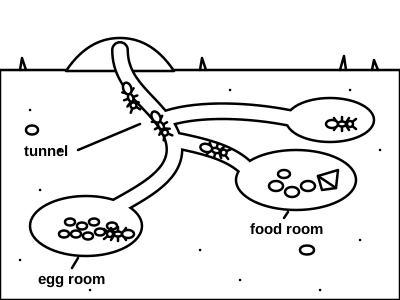
    An Ant Nest

    Ants dig tunnels under the ground. The tunnels lead to small rooms. Some rooms hold eggs. Other rooms store food. Ants keep busy all day!

    A cut-away drawing of an ant nest shows a tunnel, an egg room and a food room under the ground.

    An ant nest has many rooms.

    Use the words and the picture.

    1. Name one thing the labels tell you.
    2. Write one fact from the words.
    3. How does the picture help you?

    Read with expression.

    1. Read the last sentence two ways, flat and excited. Which sounds better?flatexcited
    How did it go? Great Okay Tricky

    Science practice · Week 11 · Friday

    I can test my pollinator tool and tell why pollinators matter.

    Test your tool three times. Compare it to the cotton ball.

    TrialMy tool: more, same or less pollen?
    1. Did your design work? How do you know?

    Draw a garden from above with four flowers and three pollinators (a bee, a hummingbird, a butterfly).

    1. My pollinator garden
    2. Pollinators need ________, and we need pollinators for ________.

    You need: the pollinator tool you planned, the two paper flowers and cornmeal, dark paper

    How did it go? Great Okay Tricky