Quarter 2Week 12MondayDay 56 of 180

    Week 12, Monday: Review place value and skip-counting by 5s, 10s · Describe the connection between a series

    Day 56 · 3 lessons · 140 min

    Math

    Students review place value and skip-counting by 5s, 10s, and 100s from any number to prepare for the unit assessment (2.NBT.A.1, 2.NBT.A.2, 2.NBT.A.3).

    Standards Addressed

    Activities

    10 min

    Warm-Up

    Spiral from Week 11: your child reads their fridge index card explanation aloud, then solves 46 + 38 that way (84). Then skip-count by 5s from 35 to 100 while touching each number on the hundreds chart.

    index cardsprinted hundreds chart
    15 min

    Mini-Lesson

    Write 627. Your child builds it with straw bundles (6 hundreds, 2 tens, 7 ones), writes it in expanded form (600 + 20 + 7), and in words (six hundred twenty-seven). Then skip-count by 10s from 627 to 727 and by 100s from 627 to 927, writing each number and circling the digit that changes.

    straws bundled by tenrubber bandspaperpencil
    15 min

    Practice

    Your child completes three tasks: (1) draw 408 and 480 in base-ten pictures and explain the difference; (2) fill in the blanks 215, 220, ___, 230, ___, ___ and 340, 350, ___, ___, 380 and 150, 250, ___, ___, 550; (3) write 5 hundreds 13 tens 4 ones as a standard number (634).

    paperpencil
    5 min

    Wrap-Up

    Ask, 'Why is 5 hundreds 13 tens 4 ones the same as 634?' Have your child show the 10 tens regrouping to a hundred with straws.

    straws bundled by ten

    Materials Needed

    index cardsprinted hundreds chartstraws bundled by tenrubber bandspaperpencil

    English Language Arts

    Students describe the connection between a series of scientific ideas in a text (cause and effect) and revise the All About book for clear order (RI.2.3, W.2.2, W.2.8).

    Standards Addressed

    Activities

    15 min

    Read-Aloud

    Say, 'Last week you saw how pictures and words connect. This week we look at how ideas connect: one thing causes another.' Read the first half of 'Where Do Polar Bears Live?' by Sarah L. Thomson from the Let's-Read-and-Find-Out Science series, through the pages about hunting seals on the ice. Each time you read a 'because' or 'so,' stop and say the two connected ideas out loud.

    Where Do Polar Bears Live? by Sarah L. Thomson
    10 min

    Mini-Lesson

    Draw a chain of three links on chart paper and label it 'Ideas that connect.' Fill it from the book: thick fur and fat keep the bear warm, so the bear can live on the ice, so the bear can hunt seals there. Explain that nonfiction authors link ideas with words like because, so, then, and as a result.

    chart papermarker
    15 min

    Guided Reading

    Reread the pages about the bear's body. Your child finds two more cause-and-effect pairs and writes each as a chain on an index card ('Wide paws' arrow 'walks on snow without sinking'). Read each card back as a full sentence using 'so' or 'because.'

    Where Do Polar Bears Live? by Sarah L. Thomsonindex cardspencil
    15 min

    Writing Workshop

    Begin revising the All About book. Your child reads all three sections aloud and decides on the best order (most books start with what the plant or animal looks like or where it lives). Number the pages, then add one connecting sentence between two sections using 'because' or 'so' ('Bees visit flowers because they need nectar.').

    folderpencil
    10 min

    Word Study

    Reading with purpose starts with knowing the words. Preview and read these words from the polar bear book, discussing meaning: Arctic, seal, blubber, glacier, cub, den, ice, melt, hunt, tundra. Have your child use three of them in one sentence about a polar bear.

    index cardsmarker

    Materials Needed

    Where Do Polar Bears Live? by Sarah L. Thomsonchart papermarkerindex cardspencilfolder

    Science

    Students review what plants need by comparing two seedlings grown under different conditions and restate evidence-based claims from the unit (2-LS2-1).

    Standards Addressed

    Activities

    5 min

    Science Question of the Week

    Say, 'This week we look back at everything we learned about plants, animals, and habitats. Our question: What can we prove about how living things get what they need?' Reread the four questions of the week from the notebook (Weeks 7 to 11).

    science notebook
    20 min

    Investigation: Seedling Check-Up

    Bring out the Week 7 soil cups (or start two fresh cups with bean sprouts from a bag, one watered and one not, if the old cups are gone). Measure each plant's height in centimeters, count the leaves, and describe the color. Read 'The Tiny Seed' by Eric Carle and pause at each danger the seed faces; ask which need was missing each time (too cold, no soil, no water, eaten).

    soil cupsrulerThe Tiny Seed by Eric Carlenotebook
    5 min

    Wrap-Up

    Your child writes the unit's first claim: 'Plants need water and light. My evidence is ______.'

    notebookpencil

    Materials Needed

    science notebooksoil cupsrulerThe Tiny Seed by Eric Carlepencil

    Today's Practice

    One page for your child for each lesson. Answers are for grown-ups.

    Math practice · Week 12 · Monday

    I can show a number many ways and skip-count from any number.

    Look: 546

    1. 5 hundreds, 4 tens, 6 ones.
    2. Expanded form: 500 + 40 + 6.
    3. Words: five hundred forty-six.

    Write each number another way.

    1. Write 739 in expanded form.
    2. Write 382 in words.
    3. 4 hundreds 12 tens 3 ones = ____
    4. Draw 306 and 360. How are they different?

    Skip-count. Fill in the missing numbers.

    1. 465, 470, ____, 480, ____, ____
    2. 720, 730, ____, ____, 760
    3. 260, 360, ____, ____, 660
    How did it go? Great Okay Tricky

    ELA practice · Week 12 · Monday

    I can tell how one idea causes another.

    Look: so and because

    1. Read: A duck has webbed feet, so it swims well.
    2. Webbed feet → it swims well.
    3. With because: A duck swims well because it has webbed feet.

    Camels in the Desert

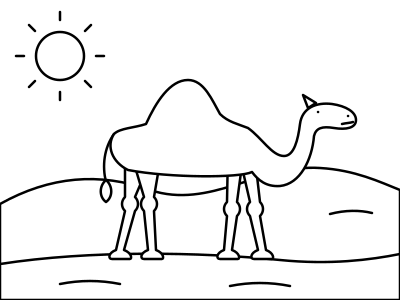
    A camel has long eyelashes, so sand stays out of its eyes. It has wide, flat feet, so it does not sink in the soft sand. A camel can go many days without a drink because its body saves water.

    A camel walks over sand dunes under the sun.

    Use the page above.

    1. Circle every so and because.
    2. Long eyelashes → ________
    3. Wide, flat feet → ________
    4. Write one chain as a sentence with because.

    Word power.

    1. Use desert and sand in one sentence about a camel.
    How did it go? Great Okay Tricky

    Science practice · Week 12 · Monday

    I can measure two plants and tell what plants need.

    Check your two plants. Write what you find.

    • height in cm
    • number of leaves
    • color
    Plant A (watered)Plant B (not watered)
    1. Which plant looks healthier?
    2. Plants need water and light. My evidence is ________.

    Think about the seeds in today's story.

    1. A seed lands on ice at the top of a mountain. Why can't it grow?
    2. Name two things a seed needs to grow.

    You need: your two plant cups, a ruler with centimeters

    How did it go? Great Okay Tricky