Quarter 2Week 13ThursdayDay 64 of 180

    Week 13, Thursday: Solve two-step addition word problems · Perform a poem with attention to rhythm

    Day 64 · 3 lessons · 140 min

    Math

    Students will solve two-step addition word problems by drawing a bar model for each step and writing two equations (2.OA.A.1).

    Standards Addressed

    Activities

    10 min

    Warm-Up

    Add three numbers quickly: 15 + 5 + 8, 20 + 30 + 4, 17 + 3 + 12. Ask, 'Which two did you add first and why?' Connect to Week 8's grouping strategy (look for a ten first).

    15 min

    Mini-Lesson

    Read: 'Rosa picked 23 apples in the morning and 19 more after lunch. Then her brother gave her 10 apples. How many apples does Rosa have now?' Say, 'This problem has two things happening.' Draw a bar for step one (23 + 19 = 42) and a second bar for step two (42 + 10 = 52). Write both equations in a numbered list. Emphasize: 'The answer to step one becomes a part in step two.'

    15 min

    Practice

    Your child solves: 'The class collected 34 cans on Monday and 28 cans on Tuesday. On Wednesday they collected 15 more. How many cans in all?' (34 + 28 = 62, 62 + 15 = 77). Then: 'Kai had 12 toy cars. He got 9 for his birthday and 14 from his cousin. How many toy cars does Kai have now?' (12 + 9 = 21, 21 + 14 = 35). Have your child act the second one out with toy cars or beans to confirm.

    5 min

    Wrap-Up

    Ask, 'What happens if you forget the second step?' Have your child explain why writing two numbered equations keeps the steps straight.

    Materials Needed

    toy cars or dried beanspaperpencilwhiteboard or large paper

    English Language Arts

    Students will perform a poem with attention to rhythm and will write a closing sentence for an opinion piece (RL.2.4, W.2.1, SL.2.4).

    Standards Addressed

    Activities

    15 min

    Shared Reading

    Read 'Where the Sidewalk Ends' (the title poem) twice, once plainly and once with a slow, hushed voice. Ask: 'Which reading matched the words better, and why?' Point out that the meaning (a quiet, magical place) tells the reader how fast and how loud to go.

    Where the Sidewalk Ends by Shel Silverstein
    10 min

    Mini-Lesson

    Model marking a poem for performance: on a copied or hand-written version of a short poem, draw a slash where you pause and underline words to say louder. Explain that a poem's rhythm is a set of directions the poet leaves for the reader's voice.

    paperpencil
    15 min

    Independent Reading

    Your child chooses one poem from either book to perform tomorrow, copies it or marks a photocopy with pauses and loud words, and rehearses it aloud three times. On the third read they should not need to look up for every line.

    Where the Sidewalk Ends by Shel SilversteinThe New Kid on the Block by Jack Prelutskypaperpencil
    15 min

    Writing Workshop

    Teach the closing sentence: 'That is why ____ is my favorite poem.' Your child writes the closing, then reads the whole piece aloud and fixes any sentence that does not start with a capital or end with a period. Count the reasons together: there should be two.

    writing folderpencil
    10 min

    Phonics: Word Families

    Introduce -ail and -eat. Write and read: mail, nail, pail, sail, tail, snail, trail, jail; beat, heat, meat, neat, seat, treat, wheat, cheat. Dictate four words (snail, trail, treat, wheat) and have your child write them, then read all 16 cards in under a minute.

    index cardsmarkerpaper

    Materials Needed

    Where the Sidewalk Ends by Shel SilversteinThe New Kid on the Block by Jack Prelutskypaperpencilwriting folderindex cardsmarker

    Social Studies

    Students will identify leaders and offices in their own local government and explain that leaders serve the people who live there (D2.Civ.1.K-2, D2.Civ.5.K-2).

    Standards Addressed

    Activities

    10 min

    Review and Extend

    Reread the Preamble page from 'We the Kids' and have your child chime in on 'We the People'. Then look up together (a quick internet search or the town website) the name of your mayor or town leader and where the town hall is. Write the leader's name and job title on an index card for the wall.

    We the Kids by David Catrowinternet access or town newsletterindex card
    15 min

    Project Work

    Begin the Unit 3 project, a 'Government at Work' poster. On a large sheet, draw a big outline of your town and glue or draw pictures for four services the government provides (fire station, library, road crew, school). Under each, write who pays for it: 'Taxes from the people'. Explain simply that taxes are money everyone chips in so the community can share these services.

    poster board or large paperold magazines or grocery flyersglue stickscissorsmarkers
    5 min

    Share Progress

    Your child presents the poster so far and answers: 'If the government did not exist, who would fix the road?' Record their answer on the back of the poster with today's date.

    Materials Needed

    We the Kids by David Catrowinternet access or town newsletterindex cardposter board or large paperold magazines or grocery flyersglue stickscissorsmarkers

    Today's Practice

    One page for your child for each lesson. Answers are for grown-ups.

    Math practice · Week 13 · Thursday

    I can solve a two-step adding story.

    Look: Ana has 14 red beads and 18 blue beads. Then she gets 20 more.

    1. Step 1: 14 + 18 = 32.
    2. Step 2: 32 + 20 = 52. Ana has 52 beads.
    3. The answer to step 1 is a part in step 2.

    Draw a bar for each step. Write two equations. Number them 1 and 2.

    1. A class picked up 26 cans on Monday and 17 cans on Tuesday. On Wednesday they picked up 21 more. How many cans in all?
    2. Jamal has 15 toy trucks. He gets 8 for his birthday and 13 from his uncle. How many trucks does he have now?
    3. A garden has 32 red flowers and 29 yellow flowers. Then Mei plants 16 white flowers. How many flowers now?

    Challenge

    • In problem 1, what answer would you get if you forgot step 2?
    How did it go? Great Okay Tricky

    ELA practice · Week 13 · Thursday

    I can read a poem with the right beat and voice.

    Look: pick the voice

    1. Read: Zoom, zoom, the rocket goes up!
    2. It is fast and exciting, so read it fast and loud.
    3. Stop for a breath at each comma.

    Snail Trail

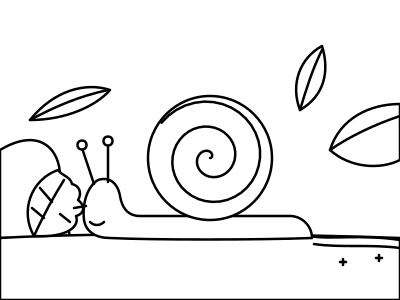
    Slow, slow, the snail on the trail, With his home on his back and a shine on his tail. Shh! Take a seat. Do not stomp your feet. He is munching a leaf. It is his treat.

    A slow snail with its shell on its back munches a leaf on a leafy trail, leaving a shiny line behind it.

    Get the poem ready to read out loud.

    1. Draw a slash / where you will stop for a breath in line 1.
    2. Underline two words you will say louder.
    3. Should you read this poem fast and loud, or slow and soft? Why?

    Add -ail or -eat. Write the word.

    1. tr____ (a yummy snack)
    2. wh____ (a plant used to make bread)
    3. s____ (a boat has one to catch the wind)
    4. h____ (it makes you warm)

    Challenge

    • Write the closing for your opinion: That is why ____ is my favorite poem.
    How did it go? Great Okay Tricky

    Social Studies practice · Week 13 · Thursday

    I can name a leader in my town and a job the town does.

    Find out with your family.

    1. Our town or city leader is ____.
    2. The leader's job title is ____ (mayor or another title).

    Write four things the government gives our town.

    ServiceWho pays for it?
    1. What are taxes?
    2. If there were no government, who would fix the road?
    How did it go? Great Okay Tricky