Quarter 2Week 15MondayDay 71 of 180

    Week 15, Monday: Use the doubles and near-doubles strategies · Identify key words in a nonfiction text

    Day 71 · 3 lessons · 140 min

    Math

    Students will use the doubles and near-doubles strategies to recall addition facts within 20 (2.OA.B.2).

    Standards Addressed

    Activities

    10 min

    Warm-Up

    Spiral from Week 14: read 'Sara had 17 stickers and gave away 9. How many left?' and let your child solve it (8). Then say, 'That took a while. This week we make facts like 17 - 9 fast.' Give a 1-minute pretest of 20 mixed facts within 20 and keep the paper to compare on Friday.

    15 min

    Mini-Lesson

    Post the doubles ladder: 1+1=2, 2+2=4, 3+3=6, 4+4=8, 5+5=10, 6+6=12, 7+7=14, 8+8=16, 9+9=18, 10+10=20. Chant it up and down with claps. Then teach near doubles: 6 + 7 is 'double 6 plus 1' (13); 8 + 9 is 'double 8 plus 1' (17); 7 + 5 is 'double 6, one up and one down' (12). Model with two rows of beans that are almost equal.

    15 min

    Practice

    Make 12 index cards: 6 doubles (3+3, 5+5, 6+6, 7+7, 8+8, 9+9) and 6 near doubles (4+5, 6+7, 7+8, 8+9, 5+6, 9+8). Your child flips a card, says the double it hides ('7+8 is double 7 plus 1'), and gives the answer. Time three passes through the deck and record the fastest time.

    5 min

    Wrap-Up

    Ask, 'Which double do you know the fastest? Which near double still makes you think?' Circle those on the ladder to practice tomorrow.

    Materials Needed

    index cardsdried beanstimerpaperpencil

    English Language Arts

    Students will identify key words in a nonfiction text and use the book's glossary to find their meanings (RI.2.4, L.2.4e).

    Standards Addressed

    Activities

    15 min

    Read-Aloud

    Read the first half of 'National Geographic Readers: Sharks!' by Anne Schreiber. Say that last week they compared stories; this week they will learn the special words that nonfiction authors use and where to find their meanings. Each time a bold word appears, stop and say 'key word' together.

    National Geographic Readers: Sharks! by Anne Schreiber
    10 min

    Mini-Lesson

    Turn to the picture glossary at the back of the book. Show that the words are in alphabetical order and each has a short definition and a photo. Look up 'predator' and 'prey' together and write both words and their meanings on an index card.

    National Geographic Readers: Sharks! by Anne Schreiberindex cardspencil
    15 min

    Guided Reading

    Reread the pages about shark senses and teeth with your child reading aloud. Each time they hit a bold word they stop, flip to the glossary, read the meaning, then reread the sentence. Keep a Key Word List on paper.

    National Geographic Readers: Sharks! by Anne Schreiberpaperpencil
    15 min

    Writing Workshop

    Begin a new opinion piece: 'Sharks are amazing animals' or 'Sharks are scary animals' (your child picks). They write the opinion sentence and one reason from the book using the word 'because': 'Sharks are amazing because they can smell one drop of blood far away.'

    writing paperpencilfolder
    10 min

    Phonics: Dictionary Skills

    Practice first-letter alphabetical order. Write the shark words shark, fin, gill, ocean, prey, tooth, whale, jaw on cards and have your child line them up in ABC order, then read them in order and backward.

    index cardsmarker

    Materials Needed

    National Geographic Readers: Sharks! by Anne Schreiberindex cardspencilpaperwriting paperfoldermarker

    Science

    Students will generate several possible solutions to the defined problem and sketch each one with labels (K-2-ETS1-2).

    This week's reading: Plan It, Sketch It

    Standards Addressed

    Activities

    5 min

    Science Question of the Week

    Ask: 'Why do engineers draw their ideas before they build them?' Read last week's Problem Brief aloud and the sticky-note idea. Say: 'Today we brainstorm, and in brainstorming every idea gets written down, even silly ones.'

    20 min

    Investigation

    Set a timer for 5 minutes and list as many crayon-holder ideas as possible on a big sheet (a tray with a lip, a cardboard tube with a base, an egg carton, a sock with the toe cut, a box with rubber bands). Then choose the three best and make a labeled sketch of each in the notebook: draw the shape, write the material next to each part, and write one criteria it meets ('lip stops rolling'). Support: give a choice of two materials to start the sketch. Stretch: add a top view and a side view of the favorite design.

    large papertimerEngineering Notebookpencilcolored pencils
    5 min

    Wrap-Up

    Count the ideas on the brainstorm sheet and celebrate the number. Ask: 'Which sketch would a stranger understand best, and why?' Circle the clearest label.

    Materials Needed

    large papertimerEngineering Notebookpencilcolored pencils

    Today's Practice

    One page for your child for each lesson. Answers are for grown-ups.

    Math practice · Week 15 · Monday

    I can use doubles to add fast.

    Look: 7 + 8

    1. 7 + 8 is close to 7 + 7.
    2. 7 + 7 = 14. 8 is one more than 7.
    3. 14 + 1 = 15. So 7 + 8 = 15.

    Doubles. Say them fast.

    1. 6 + 6 = ____
    2. 9 + 9 = ____
    3. 4 + 4 = ____

    Near doubles. Write the double that helps. Then solve.

    1. 3 + 4 = ____
    2. 10 + 9 = ____
    3. 6 + 8 = ____
    4. 9 + 7 = ____
    5. 5 + 4 = ____

    Challenge

    • Which double helps with 7 + 9?
    How did it go? Great Okay Tricky

    ELA practice · Week 15 · Monday

    I can find key words and their meanings.

    Look: ABC order

    1. Words: shell, fish, boat
    2. Look at the first letters: s, f, b.
    3. b comes first, then f, then s: boat, fish, shell.

    Sharks Hunt

    A shark is a predator. It hunts other animals for food. The animals it hunts are its prey. Sharks breathe with gills. A shark uses its fins to swim and turn.

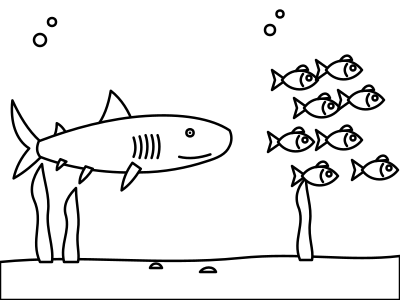
    A shark, a predator, swims near a group of small fish it hunts.

    Use the page above.

    1. Circle the four key words in bold.
    2. What is a predator?
    3. What does a shark use its fins for?

    Write the words in ABC order. Look at the first letter.

    1. reef, eel, crab, net
    2. wave, dive, kelp, sand

    Challenge

    • Finish: Sharks are ____ because ____.
    How did it go? Great Okay Tricky

    Science practice · Week 15 · Monday

    I can think of more than one way to solve a problem.

    Brainstorm for 5 minutes. Write every crayon holder idea, even silly ones.

    1. My ideas:
    2. I thought of ____ ideas.

    Pick your two best ideas. Draw each one and label the parts and materials.

    1. Idea 1:
    2. Idea 2:
    3. Why do engineers draw ideas before they build?
    How did it go? Great Okay Tricky