Week 15: Fluently Add and Subtract Within 20 · Key Words in Informational Text

    Quarter 2 · Detailed day-by-day lesson plans · Days 71–75

    0 of 15 lessons done this week

    Fluently Add and Subtract Within 20 Key Words in Informational Text

    Print

    Worksheets and answer keys

    Gather this week

    • Shop
    • Shop
    • Shop
    • Shop
    Everyday supplies (17)

    Writing prompt

    • Which is better — a cat or a dog? Use reasons and examples.
    Week 15 writing prompts

    Parent note

    This week's parent digest

    Specials this week

    Supplements

    This week at a glance

    Week 15 pushes timed fluency within 20: forty facts in three minutes. Readers identify key words in informational text and use linking words in opinion writing.

    Parent tip

    Run a 1-minute fact race every morning during breakfast.

    Materials this week

    Flash cards, timer, nonfiction article, opinion paragraph

    Mathematics

    Fluently Add and Subtract Within 20

    Operations & Algebraic Thinking · 2.OA.A.1

    Assessment: Timed fluency: 40 facts in 3 minutes; mental math strategies

    ELA

    Key Words in Informational Text

    Phonics: Dictionary and glossary skills

    Writing: Use linking words (because, and, also) in opinion writing

    Science

    Engineering Design & Testing

    K-2-ETS1-1, K-2-ETS1-2, K-2-ETS1-3

    Social Studies

    Civics, Government & Citizenship

    Monday — Day 71

    140 minutes of instruction

    Math

    Students will use the doubles and near-doubles strategies to recall addition facts within 20 (2.OA.B.2).

    Standards Addressed

    Activities

    10 min

    Warm-Up

    Spiral from Week 14: read 'Sara had 17 stickers and gave away 9. How many left?' and let your child solve it (8). Then say, 'That took a while. This week we make facts like 17 - 9 fast.' Give a 1-minute pretest of 20 mixed facts within 20 and keep the paper to compare on Friday.

    15 min

    Mini-Lesson

    Post the doubles ladder: 1+1=2, 2+2=4, 3+3=6, 4+4=8, 5+5=10, 6+6=12, 7+7=14, 8+8=16, 9+9=18, 10+10=20. Chant it up and down with claps. Then teach near doubles: 6 + 7 is 'double 6 plus 1' (13); 8 + 9 is 'double 8 plus 1' (17); 7 + 5 is 'double 6, one up and one down' (12). Model with two rows of beans that are almost equal.

    15 min

    Practice

    Make 12 index cards: 6 doubles (3+3, 5+5, 6+6, 7+7, 8+8, 9+9) and 6 near doubles (4+5, 6+7, 7+8, 8+9, 5+6, 9+8). Your child flips a card, says the double it hides ('7+8 is double 7 plus 1'), and gives the answer. Time three passes through the deck and record the fastest time.

    5 min

    Wrap-Up

    Ask, 'Which double do you know the fastest? Which near double still makes you think?' Circle those on the ladder to practice tomorrow.

    Materials Needed

    index cardsdried beanstimerpaperpencil

    English Language Arts

    Students will identify key words in a nonfiction text and use the book's glossary to find their meanings (RI.2.4, L.2.4e).

    Standards Addressed

    Activities

    15 min

    Read-Aloud

    Read the first half of 'National Geographic Readers: Sharks!' by Anne Schreiber. Say that last week they compared stories; this week they will learn the special words that nonfiction authors use and where to find their meanings. Each time a bold word appears, stop and say 'key word' together.

    National Geographic Readers: Sharks! by Anne Schreiber
    10 min

    Mini-Lesson

    Turn to the picture glossary at the back of the book. Show that the words are in alphabetical order and each has a short definition and a photo. Look up 'predator' and 'prey' together and write both words and their meanings on an index card.

    National Geographic Readers: Sharks! by Anne Schreiberindex cardspencil
    15 min

    Guided Reading

    Reread the pages about shark senses and teeth with your child reading aloud. Each time they hit a bold word they stop, flip to the glossary, read the meaning, then reread the sentence. Keep a Key Word List on paper.

    National Geographic Readers: Sharks! by Anne Schreiberpaperpencil
    15 min

    Writing Workshop

    Begin a new opinion piece: 'Sharks are amazing animals' or 'Sharks are scary animals' (your child picks). They write the opinion sentence and one reason from the book using the word 'because': 'Sharks are amazing because they can smell one drop of blood far away.'

    writing paperpencilfolder
    10 min

    Phonics: Dictionary Skills

    Practice first-letter alphabetical order. Write the shark words shark, fin, gill, ocean, prey, tooth, whale, jaw on cards and have your child line them up in ABC order, then read them in order and backward.

    index cardsmarker

    Materials Needed

    National Geographic Readers: Sharks! by Anne Schreiberindex cardspencilpaperwriting paperfoldermarker

    Science

    Students will generate several possible solutions to the defined problem and sketch each one with labels (K-2-ETS1-2).

    This week's reading: Plan It, Sketch It

    Standards Addressed

    Activities

    5 min

    Science Question of the Week

    Ask: 'Why do engineers draw their ideas before they build them?' Read last week's Problem Brief aloud and the sticky-note idea. Say: 'Today we brainstorm, and in brainstorming every idea gets written down, even silly ones.'

    20 min

    Investigation

    Set a timer for 5 minutes and list as many crayon-holder ideas as possible on a big sheet (a tray with a lip, a cardboard tube with a base, an egg carton, a sock with the toe cut, a box with rubber bands). Then choose the three best and make a labeled sketch of each in the notebook: draw the shape, write the material next to each part, and write one criteria it meets ('lip stops rolling'). Support: give a choice of two materials to start the sketch. Stretch: add a top view and a side view of the favorite design.

    large papertimerEngineering Notebookpencilcolored pencils
    5 min

    Wrap-Up

    Count the ideas on the brainstorm sheet and celebrate the number. Ask: 'Which sketch would a stranger understand best, and why?' Circle the clearest label.

    Materials Needed

    large papertimerEngineering Notebookpencilcolored pencils
    Open Monday on its own page
    Science

    Reading About Our World: Plan It, Sketch It

    Read it aloud first while your child follows along. Then read it together, and let your child read the parts they can. Talk about the words in the word box.

    Many Ideas

    Engineers know there is more than one way to solve a problem. Before they build, they think of many ideas. They often work in a team and write down every idea, even ones that seem silly at first.

    Draw a Sketch

    Next, they make a sketch. A sketch is a quick drawing of an idea. It does not need to be pretty. It needs to show how the idea will work.

    Add Labels

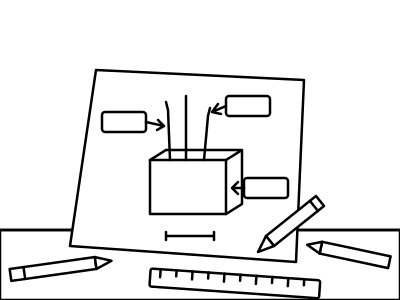
    Engineers add labels to their sketches. A label is a word that names a part. Arrows point from each label to the part. Engineers may write sizes on a sketch too, like 10 inches.

    Choose One

    Then they look at all their sketches and pick the idea they think will work best. Now they are ready to build.

    Try it! Sketch a way to keep your pencils from rolling off the table. Label each part.

    A child draws a sketch of a pencil holder, with arrows pointing to each part, next to pencils and a ruler.

    Word box

    sketch:
    a quick drawing that shows an idea
    label:
    a word that names a part of a drawing
    solution:
    a way to solve a problem
    arrow:
    a line with a point that shows where to look

    Questions

    1. What are the two key words in bold print?
    2. If this text had a glossary, what would it say "sketch" means?
    3. Which heading tells you about choosing an idea to build?

    Weekly check

    Math

    Weekly Check

    • I can add and subtract within 20 quickly from memory.
    • I can use doubles and make-a-ten to find a fact I don't know yet.
    1. 8 + 9 = ____
    2. 9 + 4 = ____
    3. 14 − 5 = ____
    4. 16 − 8 = ____
    5. 15 − 2 = ____
    6. Use a double to solve 6 + 7. Write the double you used.
    7. Use make a ten to solve 8 + 5. Show your steps.

    ELA

    Weekly Check

    • I can find key words in a nonfiction text.
    • I can use ABC order to find a word in a glossary or dictionary.

    The Octopus

    An octopus has eight arms. It can squirt ink to hide from a predator. An octopus has no bones, so it can squeeze into small cracks. Its arms have suckers that help it hold on to rocks.

    1. Write the three key words in bold.
    2. What do suckers do?
    3. Why does an octopus squirt ink?
    4. Put in ABC order: suckers, arms, ink
    5. Put in ABC order: bone, bat, bug
    6. The guide words are rip and rug. Would rock be on that page?yesno

    Science

    Weekly Check

    • I can think of more than one way to solve a problem.
    • I can draw and label a sketch of my idea.
    1. Books keep falling off a shelf. Write two different ways to solve this problem.
    2. Why is it good to think of more than one idea?
    3. Draw and label a sketch of one idea.
    4. What should a good sketch have?labelsno wordsonly colors
    5. What is brainstorming?

    Social Studies

    Weekly Check

    • I can name American symbols like the flag, the bald eagle and the Statue of Liberty.
    • I can tell what one symbol stands for.
    1. Which symbol holds a torch?the Liberty Bellthe Statue of Libertythe bald eagle
    2. Which symbol has a crack?the Liberty Bellthe Statue of Libertythe bald eagle
    3. What are the three colors of the American flag?
    4. What does the bald eagle stand for?
    5. Which one is NOT an American symbol?the flagthe bald eaglea traffic cone
    6. Draw one American symbol. Write what it stands for.

    Specials

    PE · Balance, Flexibility & Yoga · All Specials

    This Week's Specials Page

    PE · Week 15

    I can hold a balance and stretch with care.

    Balance time. Move in a clear, safe space with room to spread your arms. Stand near a wall you can touch if you wobble. A grown-up counts slowly. Write how many seconds you held each pose.

    PoseSeconds
    1. Tree pose on my right foot: ____ seconds
    2. Tree pose on my left foot: ____ seconds
    3. Heel-to-toe walk along a tape line: ____ steps without stepping off

    Calm down.

    1. Rest in child's pose for 5 slow breaths. Draw yourself in child's pose.
    2. Which foot was easier to balance on? Circle one.rightleftthe same

    You need: a mat or towel, floor tape or a string line

    How did it go? Great Okay Tricky

    Home Connection

    This week at home

    • Math

      Fast facts with doubles and making ten

    • ELA

      Key words and how to find them

    • Science

      Brainstorm many ideas, then sketch the best ones

    • Social Studies

      The flag, eagle and Statue of Liberty

    Three things to celebrate this week

    We did blank of 4 activities.

    Suggested Daily Schedule

    8:30–9:00 AM30 minMorning Meeting / Calendar / Read-Aloud
    9:00–9:30 AM30 minPhonics / Word Study / Spelling
    9:30–10:15 AM45 minReading Workshop
    10:15–10:35 AM20 minSnack and Outdoor Play / Movement Break
    10:35–11:05 AM30 minWriting Workshop
    11:05–11:50 AM45 minMathematics
    11:50 AM–12:35 PM45 minLunch and Free Play
    12:35–1:05 PM30 minScience OR Social Studies (alternating)
    1:05–1:35 PM30 minSpecials: PE / Art / Music / Health (rotating)
    1:35–2:00 PM25 minIndependent Reading / Enrichment