Quarter 2Week 17MondayDay 81 of 180

    Week 17, Monday: Determine whether a group of up to 20 objects is odd · Identify the most important points in a nonfiction

    Day 81 · 3 lessons · 140 min

    Math

    Students will determine whether a group of up to 20 objects is odd or even by pairing objects (2.OA.C.3).

    Standards Addressed

    Activities

    10 min

    Warm-Up

    Spiral from Week 16: solve 'Kai had 24 beans, gave 9 away, then found 7. How many now?' (22). Then hand your child those 22 beans and say, 'Can you split these into two equal teams with none left over?' Let them try before naming odd or even.

    15 min

    Mini-Lesson

    Take 8 beans and pair them up in two rows of 4: 'Every bean has a partner, so 8 is even.' Take 9 beans and pair them: one is left alone, so 9 is odd. Repeat with 12 (even) and 15 (odd). Write each number with 'E' or 'O' on a chart from 1 to 20 as you go, filling in only the ones you test today.

    15 min

    Practice

    Your child grabs a handful of beans (up to 20), counts, pairs them, and records the number and odd or even on the chart. Do this 8 times. Then check the socks in a drawer, the shoes by the door, and the chairs at the table, pairing each set and recording.

    5 min

    Wrap-Up

    Ask, 'What does an odd number always have when you pair up?' Listen for 'one left over.' Add odd and even to the word wall.

    Materials Needed

    dried beanspaper chart numbered 1 to 20pencilsocks and shoes for counting

    English Language Arts

    Students will identify the most important points in a nonfiction text and use prefixes to determine word meaning (RI.2.2, RI.2.9, L.2.4b).

    Standards Addressed

    Activities

    15 min

    Read-Aloud

    Read 'Owls' by Gail Gibbons. Say that last week they judged reasons; this week they will find the most important points two authors make about the same animal. Stop after each spread and ask: 'If you could keep one fact from this page, which one?'

    Owls by Gail Gibbons
    10 min

    Mini-Lesson

    Explain that an important point is something the whole book keeps coming back to, not a small detail. Start an Important Points chart with two columns, Gail Gibbons and National Geographic, and write three points from Gibbons (owls hunt at night; they have special feathers for silent flight; they swallow prey whole and cough up pellets).

    paperpencil
    15 min

    Guided Reading

    Reread the pages on owl eyes and ears with your child reading the labels. Ask them to say which sentence on each page is the main idea and which are details. Add one more important point to the chart.

    Owls by Gail Gibbonspaperpencil
    15 min

    Writing Workshop

    Introduce this week's project: an audio recording of a short piece your child writes. Today they write a four-sentence Owl Fact Report from the Gibbons book with a topic sentence, two facts, and a closing. Keep it in the Writing Folder.

    writing paperpencilfolder
    10 min

    Phonics: Prefixes

    Teach un- (not) and re- (again). Write and read: unhappy, unlock, untie, unfair, unsafe, redo, refill, replay, rewrite, reheat. Your child covers the prefix, reads the base word, then uncovers it and says the new meaning ('lock, unlock, not locked').

    index cardsmarker

    Materials Needed

    Owls by Gail Gibbonspaperpencilwriting paperfolderindex cardsmarker

    Science

    Students will build a second, different solution to the same problem so that two designs can be compared fairly (K-2-ETS1-3).

    This week's reading: Two Ways to Cross a River

    Standards Addressed

    Activities

    5 min

    Science Question of the Week

    Ask: 'How can we tell which of two designs is better?' Look at the two runner-up sketches from Week 15 and pick the one most different from the finished holder (if the winner was a box, choose a tube or a tray).

    20 min

    Investigation

    Build Design B from the runner-up sketch in 15 minutes using the same kinds of materials. Keep a star tally of changes on the plan just as before. Set Design A and Design B side by side and write on an index card under each: its name, its main material, and one way it is different from the other.

    recycling-bin materialsscissorstaperubber bands2 index cardsEngineering Notebookpencil
    5 min

    Wrap-Up

    Ask: 'To compare fairly, what has to be the same in both tests?' (same crayons, same tilt, same table). Write 'Fair test: same crayons, same book, same table' at the top of Wednesday's page.

    Materials Needed

    recycling-bin materialsscissorstaperubber bands2 index cardsEngineering Notebookpencil

    Today's Practice

    One page for your child for each lesson. Answers are for grown-ups.

    Math practice · Week 17 · Monday

    I can pair up objects to tell if a number is odd or even.

    Look: Is 9 odd or even?

    1. Draw 9 dots.
    2. Circle the dots in pairs: 2 at a time.
    3. One dot is left alone, so 9 is odd. No dot left over means even.

    Draw the dots. Circle pairs. Then circle odd or even.

    1. 7 dots
    2. 12 dots
    3. 15 dots
    4. 18 dots

    Count things at home. Pair them up. Write the number and odd or even.

    What I countedHow manyOdd or even?
    1. What does an odd number always have when you pair it up?

    Challenge

    • Mia has 11 socks. Does every sock have a partner? How do you know?
    How did it go? Great Okay Tricky

    ELA practice · Week 17 · Monday

    I can find the most important point and use the prefixes un- and re-.

    Look: un- or re-?

    1. un- means not. unlucky means not lucky.
    2. re- means again. replay means play again.
    3. Cover the prefix to find the base word.

    Owls Hunt at Night

    Most owls hunt at night. Big eyes help them see in the dark. Their ears are sharp, too. Some owls can hear a mouse moving under the snow. Soft edges on their feathers let them fly without a sound, so the mouse does not hear the owl coming. Some owls have tufts of feathers on top of their heads. The tufts look like ears, but they are not ears.

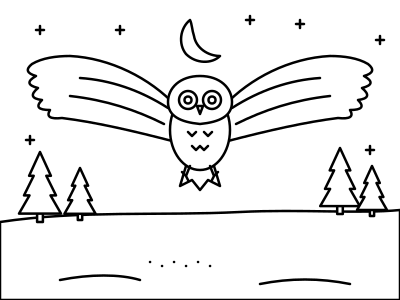
    An owl flies silently over the snow at night under the moon and stars.

    Use the page above.

    1. What is the most important point? It is what the whole page keeps coming back to.
    2. Which one is a small detail?Owls are good night hunters.Some owls have tufts of feathers.
    3. Underline the sentence that tells how owls fly without a sound.

    Add un- (not) or re- (again). Write the new word.

    1. not kind: ____
    2. paint again: ____
    3. not clear: ____
    4. tell again: ____
    5. What does unpacked mean?
    How did it go? Great Okay Tricky

    Science practice · Week 17 · Monday

    I can build a second design so I can compare two designs fairly.

    Write about each design. Row 1: its name. Row 2: its main material. Row 3: one way it is different.

    Design ADesign B
    1. How many changes did you make while building Design B? Count your stars.

    Think about a fair test.

    1. To compare fairly, what must be the same in both tests?
    2. Draw Design B.

    You need: Design A and your runner-up sketch, cardboard, paper and tape

    How did it go? Great Okay Tricky