Week 17: Odd and Even Numbers · Comparing Important Points in Two Texts

    Quarter 2 · Detailed day-by-day lesson plans · Days 81–85

    0 of 15 lessons done this week

    Odd and Even Numbers Comparing Important Points in Two Texts

    Print

    Worksheets and answer keys

    Gather this week

    • Shop
    • Shop
    • Shop
    • Shop
    • Shop
    Everyday supplies (14)

    Writing prompt

    • Teach a younger kid how to brush their teeth. Use clear steps.
    Week 17 writing prompts

    Parent note

    This week's parent digest

    Specials this week

    Supplements

    This week at a glance

    Week 17 identifies odd and even numbers by pairing, by looking at the ones digit, and by writing even numbers as two equal addends. In reading, children compare important points across two texts and record stories on audio.

    Parent tip

    Pair up socks from the laundry to see odd vs. even at home.

    Materials this week

    Counters, two short nonfiction articles, recording app

    Mathematics

    Odd and Even Numbers

    Operations & Algebraic Thinking · 2.OA.A.1

    Assessment: Determine if numbers are odd or even using pairing, models, and decomposition

    ELA

    Comparing Important Points in Two Texts

    Phonics: Affixes and roots for meaning

    Writing: Create audio recordings of stories or poems

    Science

    Engineering Design & Testing

    K-2-ETS1-1, K-2-ETS1-2, K-2-ETS1-3

    Social Studies

    Civics, Government & Citizenship

    Monday — Day 81

    140 minutes of instruction

    Math

    Students will determine whether a group of up to 20 objects is odd or even by pairing objects (2.OA.C.3).

    Standards Addressed

    Activities

    10 min

    Warm-Up

    Spiral from Week 16: solve 'Kai had 24 beans, gave 9 away, then found 7. How many now?' (22). Then hand your child those 22 beans and say, 'Can you split these into two equal teams with none left over?' Let them try before naming odd or even.

    15 min

    Mini-Lesson

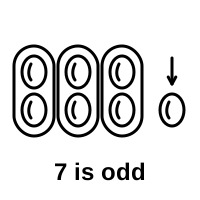
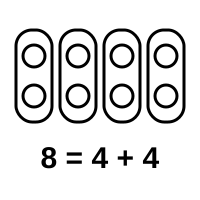
    Take 8 beans and pair them up in two rows of 4: 'Every bean has a partner, so 8 is even.' Take 9 beans and pair them: one is left alone, so 9 is odd. Repeat with 12 (even) and 15 (odd). Write each number with 'E' or 'O' on a chart from 1 to 20 as you go, filling in only the ones you test today.

    15 min

    Practice

    Your child grabs a handful of beans (up to 20), counts, pairs them, and records the number and odd or even on the chart. Do this 8 times. Then check the socks in a drawer, the shoes by the door, and the chairs at the table, pairing each set and recording.

    5 min

    Wrap-Up

    Ask, 'What does an odd number always have when you pair up?' Listen for 'one left over.' Add odd and even to the word wall.

    Materials Needed

    dried beanspaper chart numbered 1 to 20pencilsocks and shoes for counting

    English Language Arts

    Students will identify the most important points in a nonfiction text and use prefixes to determine word meaning (RI.2.2, RI.2.9, L.2.4b).

    Standards Addressed

    Activities

    15 min

    Read-Aloud

    Read 'Owls' by Gail Gibbons. Say that last week they judged reasons; this week they will find the most important points two authors make about the same animal. Stop after each spread and ask: 'If you could keep one fact from this page, which one?'

    Owls by Gail Gibbons
    10 min

    Mini-Lesson

    Explain that an important point is something the whole book keeps coming back to, not a small detail. Start an Important Points chart with two columns, Gail Gibbons and National Geographic, and write three points from Gibbons (owls hunt at night; they have special feathers for silent flight; they swallow prey whole and cough up pellets).

    paperpencil
    15 min

    Guided Reading

    Reread the pages on owl eyes and ears with your child reading the labels. Ask them to say which sentence on each page is the main idea and which are details. Add one more important point to the chart.

    Owls by Gail Gibbonspaperpencil
    15 min

    Writing Workshop

    Introduce this week's project: an audio recording of a short piece your child writes. Today they write a four-sentence Owl Fact Report from the Gibbons book with a topic sentence, two facts, and a closing. Keep it in the Writing Folder.

    writing paperpencilfolder
    10 min

    Phonics: Prefixes

    Teach un- (not) and re- (again). Write and read: unhappy, unlock, untie, unfair, unsafe, redo, refill, replay, rewrite, reheat. Your child covers the prefix, reads the base word, then uncovers it and says the new meaning ('lock, unlock, not locked').

    index cardsmarker

    Materials Needed

    Owls by Gail Gibbonspaperpencilwriting paperfolderindex cardsmarker

    Science

    Students will build a second, different solution to the same problem so that two designs can be compared fairly (K-2-ETS1-3).

    This week's reading: Two Ways to Cross a River

    Standards Addressed

    Activities

    5 min

    Science Question of the Week

    Ask: 'How can we tell which of two designs is better?' Look at the two runner-up sketches from Week 15 and pick the one most different from the finished holder (if the winner was a box, choose a tube or a tray).

    20 min

    Investigation

    Build Design B from the runner-up sketch in 15 minutes using the same kinds of materials. Keep a star tally of changes on the plan just as before. Set Design A and Design B side by side and write on an index card under each: its name, its main material, and one way it is different from the other.

    recycling-bin materialsscissorstaperubber bands2 index cardsEngineering Notebookpencil
    5 min

    Wrap-Up

    Ask: 'To compare fairly, what has to be the same in both tests?' (same crayons, same tilt, same table). Write 'Fair test: same crayons, same book, same table' at the top of Wednesday's page.

    Materials Needed

    recycling-bin materialsscissorstaperubber bands2 index cardsEngineering Notebookpencil
    Open Monday on its own page
    Science

    Reading About Our World: Two Ways to Cross a River

    Read it aloud first while your child follows along. Then read it together, and let your child read the parts they can. Talk about the words in the word box.

    A town sits on one side of a wide river. People need to get to the other side. Engineers came up with two solutions. Read about each one.

    Text 1: Build a Bridge

    A bridge lets people cross at any time of day or night. Cars, bikes and people on foot can all use it. But a bridge costs a lot of money. It can take years to build.

    Text 2: Use a Ferry

    A ferry is a boat that carries people and cars across water. A ferry can start working soon, and it costs less than a bridge. But a ferry runs only at certain times. People have to wait for it. In a bad storm, it may not run at all.

    Both solutions help people cross the river. Each one has good points and problems. Engineers compare solutions like these to choose the best one for a town. Which would you choose? Why?

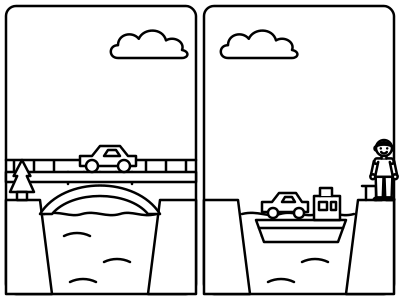
    Two ways to cross a river: a car drives over an arched bridge, and a ferry boat carries a car across the water.

    Word box

    solution:
    a way to solve a problem
    bridge:
    something built over water or a road so people can cross
    ferry:
    a boat that carries people and cars across water
    compare:
    to look at how things are the same and different

    Questions

    1. What important point do both texts share?
    2. What is one good point about the bridge that the ferry does not have?
    3. What is one good point about the ferry?

    Weekly check

    Math

    Weekly Check

    • I can tell if a number up to 20 is odd or even.
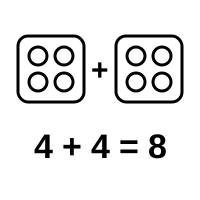
    • I can write an even number as the sum of two equal numbers (like 8 = 4 + 4).
    1. Draw 11 dots. Circle pairs. Is 11 odd or even?
    2. Is 76 odd or even?
    3. Circle the even numbers: 13, 20, 9, 14, 17
    4. 18 = ____ + ____
    5. 14 = ____ + ____
    6. Two friends share 13 crayons. Will there be one left over? Explain.

    ELA

    Weekly Check

    • I can compare the important points in two texts on the same topic.
    • I can use prefixes, suffixes and roots to figure out a word.

    Two Pages About Bats

    Page 1: Bats come out at night. Many bats use echoes to find bugs in the dark. Page 2: Bats sleep in the day, hanging upside down. At night, they fly out to eat bugs.

    1. What point do both pages make?
    2. What point does only Page 2 make?
    3. What does unpack mean?
    4. What does painless mean?
    5. Circle the root word: rethinking
    6. Which word means 'the most loud'?louderloudest

    Science

    Weekly Check

    • I can compare two solutions to the same problem.
    • I can use test results to choose the better solution.

    Two Foil Boats

    Kim built two boats from foil. She tested them in the same tub of water. Boat A held 12 pennies before it sank. Boat B held 20 pennies. Boat A was easier to fold.

    1. Which boat held more pennies?
    2. How many more pennies did Boat B hold?
    3. What did Kim keep the same so the test was fair?
    4. What is Boat A better at?
    5. Which boat would you choose to carry pennies? Why?

    Social Studies

    Weekly Check

    • I can name national holidays and why we have them.
    • I can tell who or what one holiday honors.
    1. Which holiday is on July 4?Independence DayThanksgivingMemorial Day
    2. Which holiday thanks everyone who served in the military?Veterans DayPresidents Day
    3. Martin Luther King Jr. Day honors ____.
    4. Why does our country have national holidays?
    5. Draw a symbol for one holiday. Write its name.

    Specials

    Art · Form, Space & Sculpture · All Specials

    This Week's Specials Page

    Art · Week 17

    I can show near and far in a picture.

    Look: Three parts of a landscape

    1. The foreground is closest to you. Things look big and are low on the page.
    2. The middle ground is in the middle.
    3. The background is far away. Things look small and are high on the page.

    Draw a landscape. Draw two lines across the box to make three parts.

    1. Draw a big flower or rock in the foreground, a tree or house in the middle ground and hills or clouds in the background.

    Look at your picture.

    1. Where did you draw the biggest thing? Circle one.foregroundmiddle groundbackground
    2. Why do far-away things look small?

    You need: crayons or colored pencils, paper

    How did it go? Great Okay Tricky

    Home Connection

    This week at home

    • Math

      Odd numbers always have one left over

    • ELA

      Comparing what two books say about owls

    • Science

      Testing two designs the same fair way

    • Social Studies

      Holidays help our whole country remember together

    Three things to celebrate this week

    We did blank of 4 activities.

    Suggested Daily Schedule

    8:30–9:00 AM30 minMorning Meeting / Calendar / Read-Aloud
    9:00–9:30 AM30 minPhonics / Word Study / Spelling
    9:30–10:15 AM45 minReading Workshop
    10:15–10:35 AM20 minSnack and Outdoor Play / Movement Break
    10:35–11:05 AM30 minWriting Workshop
    11:05–11:50 AM45 minMathematics
    11:50 AM–12:35 PM45 minLunch and Free Play
    12:35–1:05 PM30 minScience OR Social Studies (alternating)
    1:05–1:35 PM30 minSpecials: PE / Art / Music / Health (rotating)
    1:35–2:00 PM25 minIndependent Reading / Enrichment