Quarter 3Week 20MondayDay 96 of 180

    Week 20, Monday: Estimate lengths in inches · Generate questions before, during, and after reading

    Day 96 · 3 lessons · 140 min

    Math

    Students will estimate lengths in inches using benchmarks (a paper clip, a thumb, a hand span) before measuring (2.MD.A.3).

    Standards Addressed

    Activities

    10 min

    Warm-Up

    Ask your child to measure a fork with the ruler (about 7 inches) as a quick check of last week. Then hide the ruler and ask: 'Without measuring, about how long is this spoon?' Write their guess down; this is an estimate.

    forkspoonrulerpaperpencil
    15 min

    Mini-Lesson: Body Benchmarks

    Measure together and record three personal benchmarks: the width of your child's thumb (about 1 inch), the length of their hand from wrist to fingertip (about 5 inches), and the length of a large paper clip (about 2 inches). Show how to estimate a book by laying thumbs along it: 'About 9 thumbs, so about 9 inches.' Then measure to check and talk about how close the estimate was.

    rulerlarge paper clipbookindex cardpencil
    15 min

    Practice: Estimate, Then Measure

    Make a chart with columns Object, Estimate, Actual, Difference. Your child estimates and then measures 5 items in inches: a pencil, a cereal box, a placemat, a shoe, a remote control. For each, they subtract to find how far off the estimate was (for example, estimate 10, actual 12, difference 2). Support: let them lay paper clips along the object before estimating. Stretch: estimate in centimeters too.

    pencilcereal boxplacematshoeremote controlrulerpaper clipschart paper
    5 min

    Wrap-Up

    Ask: 'Which estimate was closest? Did your estimates get better as you went?' Your child writes 'An estimate is a careful guess' in their journal.

    math journalpencil

    Materials Needed

    forkspoonrulerlarge paper clippaper clipsbookindex cardpencilcereal boxplacematshoeremote controlchart papermath journal

    English Language Arts

    Students will generate questions before, during, and after reading and use them to understand a text more deeply (RI.2.1, RI.2.10).

    Standards Addressed

    Activities

    15 min

    Read-Aloud

    Introduce 'The Magic School Bus Inside the Earth' by Joanna Cole. Before you open it, remind your child that last week they learned three fix-it moves for hard books, and today you add a fourth: ask a question. Look at the cover and list three questions your child has (for example, 'How can a bus go inside the Earth?'), then read the first ten pages and stop when any question gets answered.

    The Magic School Bus Inside the Earth by Joanna Cole (library)paperpencil
    10 min

    Mini-Lesson: Thick and Thin Questions

    Explain that a thin question has a one-word answer in the book ('What color is the bus?') and a thick question makes you think ('Why did Ms. Frizzle want the class to see rocks up close?'). Sort your child's three cover questions into thin and thick. Say: 'Thick questions are the ones that help you understand.'

    paperpencil
    15 min

    Guided Reading

    Your child reads a leveled book for 12 minutes with three sticky notes, placing one at the beginning (a question before reading), one in the middle, and one at the end. Read the three questions together and mark each T for thick or t for thin.

    leveled booksticky notespencil
    15 min

    Writing Workshop: Getting Ready to Publish Digitally

    Tell your child that this week they will type last week's finished piece on a computer or tablet and add a photo. Today, open a blank document together, show where the keys for Shift and Space are, and let them type their name and the title. Save the file with the title as the filename and show them where it lives.

    computer or tablet with a word processing applast week's published writing piece
    10 min

    Word Study: Words That Change with the Sentence

    Write 'read, lead, wind, live, close, tear, bow, wound.' Read each word both ways, then write pairs of sentences ('I read a book today. I read a book yesterday.' 'The wind blew. Wind the string.') and have your child read them, rereading when the word sounds wrong. Say: 'If the sentence does not make sense, go back and try the other sound.'

    papermarker

    Materials Needed

    The Magic School Bus Inside the Earth by Joanna Cole (library)leveled booksticky notescomputer or tablet with a word processing applast week's published writing piecepapermarkerpencil

    Science

    Students will observe that some Earth changes happen quickly and others slowly, and model weathering by breaking rock into smaller pieces (2-ESS1-1, 2-ESS2-1).

    Standards Addressed

    Activities

    5 min

    Science Question of the Week

    Hold up a smooth pebble and a jagged rock. Ask: 'Last week we saw water flow downhill on our pan mountain. Could water make a rock smooth like this one? How long would that take?' Write their guess in the notebook.

    a smooth pebblea rough rocknotebook
    20 min

    Investigation: Sugar Cube Shake

    Put 5 sugar cubes in a jar with a lid, draw what they look like, then shake for 30 seconds and draw again. Repeat two more times, then pour out the crumbs and compare. Explain that bumping and rubbing that breaks rock into smaller pieces is called weathering, and real rocks take thousands of years to wear down.

    5 sugar cubesjar with lidtimerpaperpencil
    5 min

    Wrap-Up

    Sort these on a fast/slow chart: a river carving a canyon (slow), a landslide (fast), a rock getting smooth (slow), a flood washing away a road (fast). Say together: 'Some Earth changes are fast and some are very slow.'

    paperpencil

    Materials Needed

    a smooth pebblea rough rock5 sugar cubesjar with lidtimernotebookpaperpencil

    Today's Practice

    One page for your child for each lesson. Answers are for grown-ups.

    Math practice · Week 20 · Monday

    I can estimate lengths in inches with body benchmarks.

    Look: Benchmarks

    1. My thumb is about 1 inch wide.
    2. A large paper clip is about 2 inches long. My hand is about 5 inches.
    3. An estimate is a careful guess. Then measure to check.

    Estimate first. Then measure. Find the difference.

    ObjectEstimateActualDifference
    1. Which estimate was closest?

    How far off was each estimate?

    1. Estimate 8 inches. Actual 11 inches. Off by ____
    2. Estimate 15 inches. Actual 12 inches. Off by ____
    3. Estimate 6 inches. Actual 6 inches. Off by ____
    4. About how long is a new crayon?about 3 inchesabout 30 inches

    You need: a ruler

    How did it go? Great Okay Tricky

    ELA practice · Week 20 · Monday

    I can ask thick and thin questions about what I read.

    Look: Thick and thin

    1. Thin: What color is the frog? The book says it in one word: green.
    2. Thick: Why do frogs live near water? You have to think.
    3. Thick questions help you understand more.

    Inside the Earth

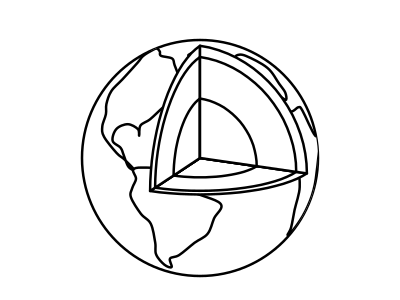
    Earth has layers, a bit like a peach. The outside layer is the crust. We live on the crust. Under the crust is the mantle. The mantle is very hot rock that moves very, very slowly. In the middle of Earth is the core. The core is the hottest part of all.

    A cut-open Earth shows the crust, the mantle and the core.

    A thin question has a short answer in the text. A thick question makes you think. Circle thick or thin.

    1. What is the outside layer called?thickthin
    2. How do people know about layers they cannot see?thickthin
    3. Where do we live?thickthin
    4. Write one thick question of your own.

    Read each sentence. Circle how the bold word sounds.

    1. Please close the door.close like 'nose'close like 'dose'
    2. I live near a park.live like 'give'live like 'five'
    3. The ribbon has a bow on top.bow like 'go'bow like 'cow'
    How did it go? Great Okay Tricky

    Science practice · Week 20 · Monday

    I can show that shaking and bumping break rock into smaller pieces.

    Sugar cube shake. Draw the cubes each time.

    1. Before shaking
    2. After 3 shakes
    3. Breaking rock into smaller pieces is called ____.

    Is the change fast or slow? Circle one.

    1. An earthquake cracks the ground.fastslow
    2. A stream makes a valley deeper.fastslow
    3. A volcano erupts.fastslow

    You need: 5 sugar cubes, a jar with a lid

    How did it go? Great Okay Tricky