Quarter 4Week 29FridayDay 145 of 180

    Week 29, Friday: Demonstrate that they can partition circles · Explain how words and pictures combine on one spread

    Day 145 · 3 lessons · 140 min

    Math

    Students will demonstrate that they can partition circles and rectangles into halves, thirds, and fourths and describe the shares with correct vocabulary (2.G.A.3).

    Standards Addressed

    Activities

    10 min

    Warm-Up

    Show three shapes shaded to show one half, two of the thirds, and three of the fourths. Your child names each shaded amount. Then ask, 'Which shape has the most shaded?'

    15 min

    Review Mini-Lesson

    Make a vocabulary chart together with three columns, halves, thirds, fourths, each with a drawn circle and rectangle showing the shares. Under each, write how many shares make the whole: two halves, three thirds, four fourths.

    15 min

    Weekly Assessment

    Your child draws two circles and two rectangles, partitioning one of each into halves and fourths, and one more rectangle into thirds. They shade one share on each and label it, then shade two of the fourths on the fourth rectangle and write the phrase. Finally they answer: 'Do equal shares of the same shape always have to look the same?' (No, and draw two different halves to prove it.)

    5 min

    Wrap-Up

    Reflect: 'When did you use halves, thirds, or fourths at a meal this week?' Preview next week: 'We will look back at everything from this unit, graphs, shapes, and shares.'

    Materials Needed

    paperpencilcrayonsruler

    Assessment

    Partition into halves, thirds, fourths; describe using vocabulary

    English Language Arts

    Students will explain how words and pictures combine on one spread, publish an Over and Under page, and complete a one-minute fluency check (RL.2.7, L.2.1f, RF.2.4).

    Standards Addressed

    Activities

    10 min

    Reading Celebration

    Your child reads the 'Over and Under Our Yard' page aloud with the book's rhythm. Ask: 'Last week you wrote from sources. This week you wrote from a pattern. Which was harder, and why?'

    Over and Under Our Yard draft
    15 min

    Reading Response

    Open 'Over and Under the Pond' to one spread. Your child completes three sentence frames in writing: 'The words say ...', 'The picture shows ...', 'Together they tell me ...'.

    Over and Under the Pondwriting notebookpencil
    15 min

    Publishing and Author's Chair

    Your child copies the four sentences onto a page split by a horizontal line, drawing the 'over' scene above and the 'under' scene below. Read from the author's chair, and the listener points out one place where the picture adds to the words.

    plain papercrayonspencil
    10 min

    Fluency Check

    Flash all thirty high-frequency cards from this week and note any missed. Then your child reads an unfamiliar grade-level page (a Frog and Toad story works well) for one minute while you count words correct and mark expression as smooth, choppy, or mixed.

    index cardsFrog and Toad booktimerwriting notebook
    15 min

    Independent Reading

    Fifteen minutes of independent reading, ending with your child reading one favorite sentence aloud two ways: plain, then with expression.

    library book

    Materials Needed

    Over and Under Our Yard draftOver and Under the Pond by Kate Messnerwriting notebookpencilplain papercrayonsindex cardsFrog and Toad booktimerlibrary book

    Assessment

    Written response integrating words and pictures on one spread; published Over and Under page with four expanded sentences including one compound sentence; fluency check of thirty high-frequency words and a one-minute timed read of a grade-level page with words correct and expression noted.

    Science

    Students will conclude that every living thing in an ecosystem is connected through food and create a food web mural of a chosen habitat (2-LS4-1, 2-LS2-2).

    This week's reading: Who Eats What?

    Standards Addressed

    Activities

    10 min

    Drawing Conclusions

    Look back at the yarn web. Your child writes three sentences: 'Every food chain starts with the sun and a plant. Animals get energy by eating plants or other animals. If one living thing disappears, many others are affected.' Ask how this connects to last week's pond problem: oil on the water kills the tiny plants, then the insects, then the frogs.

    notebookpencil
    15 min

    Art Connection: Habitat Food Web Mural

    On a large sheet, your child paints or draws one habitat (a pond, a forest, the ocean, or your own yard) with at least 6 living things and the sun. Draw arrows in a bold color from each food to its eater. Look at a library book such as 'Who Eats What? Food Chains and Food Webs' by Patricia Lauber (Let's-Read-and-Find-Out Science) for accurate pairs.

    large paperpaints or markersWho Eats What? by Patricia Lauber (library, optional)
    5 min

    Week Reflection

    Ask: 'Where are you on your own food web? What did you eat today that came from a plant?' Preview next week: 'How do animals' bodies help them survive in their habitat?'

    Materials Needed

    notebookpencillarge paperpaints or markersWho Eats What? by Patricia Lauber (library, optional)

    Today's Practice

    One page for your child for each lesson. Answers are for grown-ups.

    Math practice · Week 29 · Friday

    I can get ready to show what I know about equal shares.

    Get ready: draw, split and shade.

    1. Draw a circle. Split it into fourths. Shade three of the fourths.
    2. Draw a rectangle. Split it into thirds. Shade two of the thirds.
    3. Draw two squares. Show halves two different ways.

    Circle or write the answer.

    1. Which has more shares?halvesfourths
    2. Which share of the same shape is the smallest?one halfone thirdone fourth
    3. A rectangle has 2 rows of 4 squares. 4 + 4 = ____

    Challenge

    • Draw a square cracker. Show how 3 friends could share it fairly.
    How did it go? Great Okay Tricky

    ELA practice · Week 29 · Friday

    I can get ready: I use words and pictures together, and I read words fast.

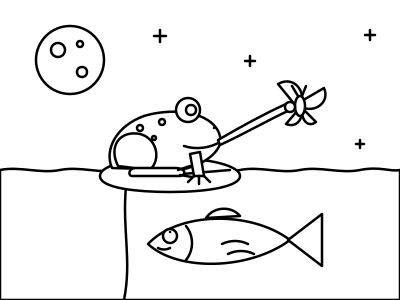
    Night at the Pond

    The moon is up. A frog sits on a lily pad. It waits and waits. Then, zip! Its long tongue grabs a moth.

    Under a full moon, a frog on a lily pad catches a moth with its long tongue while a big fish watches from under the water.

    Use the words and the picture above.

    1. The words say ____
    2. The picture shows ____
    3. Together they tell me ____

    Fill in each blank with a word from the box.

    • laugh
    • would
    • their
    • every
    1. The joke made us ____.
    2. The birds made ____ nest.
    3. I read ____ day.
    4. ____ you like to come?

    Challenge

    • Read one sentence from the page two ways: plain, then with expression. Which sounds better?
    How did it go? Great Okay Tricky

    Science practice · Week 29 · Friday

    I can show how living things in a habitat are connected by food.

    Finish each sentence.

    1. Every food chain starts with the ____ and a ____.
    2. Animals get energy by eating ____ or other ____.
    3. If one living thing disappears, ____.

    Make a food web mural of one habitat.

    1. Draw the sun and at least 6 living things. Draw arrows from each food to its eater.
    2. What did you eat today that came from a plant?

    Challenge

    • Oil spills on a pond and kills the tiny plants. What might happen next?

    You need: a large sheet of paper

    How did it go? Great Okay Tricky