Week 29: Partitioning Circles and Rectangles into Equal Shares · Illustrations and Text Integration

    Quarter 4 · Detailed day-by-day lesson plans · Days 141–145

    0 of 15 lessons done this week

    Partitioning Circles and Rectangles into Equal Shares Illustrations and Text Integration

    Print

    Worksheets and answer keys

    Gather this week

    • Shop
    • Shop
    • Shop
    • Shop
    • Shop
    Everyday supplies (13)

    Writing prompt

    • Write about your community. What buildings, helpers, and places matter most?
    Writing prompts (from Week 28)

    Parent note

    This week's parent digest

    Specials this week

    This week at a glance

    Week 29 partitions circles and rectangles into halves, thirds, and fourths, using the language of equal shares. Readers integrate illustrations with text and write complete sentences.

    Parent tip

    Cut a tortilla into thirds and fourths and compare the slice sizes.

    Materials this week

    Paper plates, scissors, picture book with rich art

    Mathematics

    Partitioning Circles and Rectangles into Equal Shares

    Data & Geometry · 2.MD.D.9

    Assessment: Partition into halves, thirds, fourths; describe using vocabulary

    ELA

    Illustrations and Text Integration

    Phonics: Fluency assessment and practice

    Writing: Produce complete sentences; expand and rearrange

    Science

    Biodiversity & Interdependence

    2-LS2-1, 2-LS2-2, 2-LS4-1

    Social Studies

    Economics: Needs, Wants & Choices

    Monday — Day 141

    140 minutes of instruction

    Math

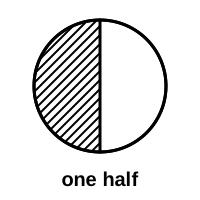
    Students will partition circles and rectangles into two equal shares and describe them as halves (2.G.A.3).

    Standards Addressed

    Activities

    10 min

    Warm-Up

    Spiral from Week 28: draw a rectangle with 2 rows of 3 squares and ask for the total and the repeated addition sentence. Then ask, 'If two people shared this cracker fairly, how much would each get?'

    15 min

    Mini-Lesson

    Fold a paper circle in half and a paper rectangle in half, showing that the two parts match exactly. Say, 'Two equal shares are called halves. Each part is one half of the whole.' Then fold a rectangle unevenly and ask why those are not halves.

    15 min

    Practice

    Your child cuts a slice of bread, a paper plate, and a paper rectangle into halves, checking each by stacking the two pieces. Then they draw three rectangles and show halves three different ways: a vertical line, a horizontal line, and a diagonal line.

    5 min

    Wrap-Up

    Ask, 'Can halves of the same shape look different?' Show the vertical and diagonal halves and confirm that both are two equal shares.

    Materials Needed

    paper circles and rectanglesscissorsslice of breadpaper platepencil

    English Language Arts

    Students will explain how the words and pictures in 'Over and Under the Pond' work together and expand simple sentences with where, when, and how (RL.2.7, L.2.1f).

    Standards Addressed

    Activities

    15 min

    Read-Aloud: Over and Under the Pond

    Say: 'Last week you asked why an author wrote a book. This week we ask what the pictures do that the words cannot.' Read 'Over and Under the Pond' by Kate Messner, illustrated by Christopher Silas Neal, and on each spread ask, 'What does the picture show that the words did not say?' Tie to science: this pond is an ecosystem with a food web.

    Over and Under the Pond by Kate Messner
    10 min

    Mini-Lesson: Words Tell, Pictures Show

    Make a two-column chart, 'The words tell me' and 'The picture shows me,' and fill it for the beaver spread (the words tell what the beaver does; the picture shows the lodge, the size, the light under the water). Point out that a reader needs both columns to get the whole story.

    chart papermarkerOver and Under the Pond
    15 min

    Guided Reading: Three Spreads

    Your child chooses three spreads and fills a row of the chart for each, talking through each choice with a stem ('I want to add on, the picture also shows ...'). Stop and reread any spread where the two columns say the same thing.

    Over and Under the Pondchart paperpencil
    15 min

    Writing Workshop: Expanding Sentences

    Write 'The turtle sat.' and show how to expand it with where, when, and how: 'The turtle sat on a warm log in the morning sun.' Your child expands four pond sentences the same way: The loon called. The beaver swam. Minnows darted. A dragonfly hovered.

    writing notebookpencil
    10 min

    Fluency: High-Frequency Words, List 1

    Word cards: again, always, around, because, before, been, both, could, does, every. Your child reads the list three times, timing each pass, then reads two phrase cards: 'around the pond' and 'because it was quiet.' Record the best time.

    index cardstimerwriting notebook

    Materials Needed

    Over and Under the Pond by Kate Messnerchart papermarkerpencilwriting notebookindex cardstimer

    Science

    Students will build a simple food chain (sun, plant, animal, animal) from a real habitat and explain that energy passes from one living thing to the next (2-LS4-1, 2-LS2-2).

    This week's reading: Who Eats What?

    Standards Addressed

    Activities

    5 min

    Science Question of the Week

    Hold up the habitat sign from last week. Ask: 'The frog on your sign, what does it eat? What eats the frog?' Write the week's question: 'How does food move through a habitat?' Introduce the words food chain and ecosystem (all the living and non-living things in a place, working together).

    20 min

    Investigation: Backyard Food Chain Cards

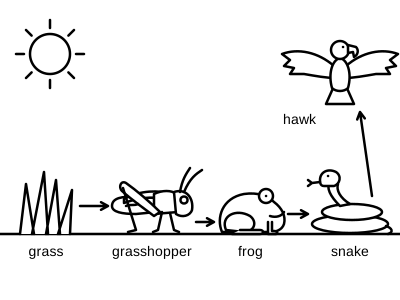
    Make 8 index cards with drawings: sun, grass, grasshopper, frog, snake, hawk, clover, rabbit. Your child arranges them in chains with arrows drawn on strips of paper pointing from the eaten to the eater: sun to grass to grasshopper to frog to snake to hawk. Build a second chain: sun to clover to rabbit to hawk. Ask at every arrow, 'Who is getting energy from whom?' Then go outside for 5 minutes and find one real link (an insect on a leaf, a bird on the lawn) and add a card for it.

    8 index cardscrayonspaper strips for arrows
    5 min

    Wrap-Up

    Ask: 'What is at the start of every chain?' (The sun, then a plant.) Say: 'Plants are producers because they make their own food. Animals are consumers because they eat.' Connect to the social studies words your child already knows.

    Materials Needed

    8 index cardscrayonspaper strips for arrowshabitat sign from last week
    Open Monday on its own page
    Science

    Reading About Our World: Who Eats What?

    Read it aloud first while your child follows along. Then read it together, and let your child read the parts they can. Talk about the words in the word box.

    Energy From the Sun

    Every living thing needs food for energy. Plants make their own food. They use sunlight, water and air. Animals get energy by eating.

    A Food Chain

    Animals cannot make their own food. They eat plants or other animals. In a meadow, a grasshopper eats grass. A frog eats the grasshopper. A snake eats the frog. A hawk eats the snake. This is a food chain. It shows who eats what.

    A Food Web

    Most animals eat more than one kind of food. A hawk eats mice, too. When we draw all the food chains in one place together, they make a food web. A food web shows how living things in a place depend on each other.

    The Clean-Up Crew

    When plants and animals die, worms, mushrooms and tiny living things break them down. This puts nutrients back into the soil. Then new plants can grow, and the chain starts again.

    A food chain with arrows: grass, then a grasshopper, a frog, a snake and a hawk.

    Picture caption: The arrows show which way the food energy goes: grass → grasshopper → frog → snake → hawk.

    Word box

    energy:
    what living things need to move, grow and live
    food chain:
    a picture or list that shows who eats what
    food web:
    all the food chains in one place, drawn together
    meadow:
    a field of grass and wildflowers

    Questions

    1. What does the caption say the arrows show?
    2. In the food chain, what eats the grasshopper?
    3. Why don't plants need to eat other living things?

    Weekly check

    Math

    Weekly Check

    • I can split circles and rectangles into halves, thirds and fourths.
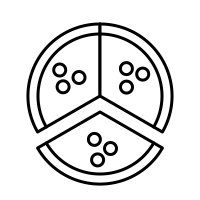
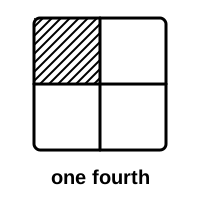
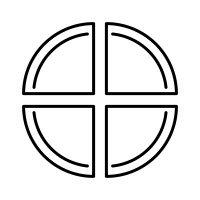
    • I can explain that equal shares are the same size, and that 2 halves, 3 thirds or 4 fourths make one whole.
    1. Draw a rectangle. Split it into fourths.
    2. Draw a circle. Split it into halves. Shade one half.
    3. Draw a rectangle. Split it into thirds.
    4. How many thirds make one whole?
    5. A square is cut into 2 parts. One part is bigger. Are the parts halves?yesno
    6. Which is bigger, one third or one fourth of the same granola bar?one thirdone fourth

    ELA

    Weekly Check

    • I can use pictures and words together to understand a text.
    • I can write complete sentences and make them longer.

    The Busy Beaver

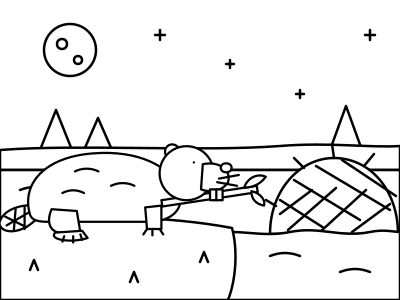
    A beaver cuts sticks with its sharp teeth. It uses the sticks to build a home in the pond.

    A beaver carries a stick in its mouth next to its big dome of sticks in the pond, with the moon in the sky.
    1. What do the words tell you?
    2. The picture shows the moon. What does that tell you that the words do not?
    3. Make it longer. Tell where or when: The dog ran.
    4. Make this a complete sentence: the big green frog
    5. Move the phrase to the front: The owl hooted in the barn.

    Science

    Weekly Check

    • I can explain how a food chain shows who eats what.
    • I can explain where plants get their energy.
    1. Put this food chain in order: fox, grass, sun, rabbit.
    2. Where do plants get their energy?
    3. Is a plant a producer or a consumer?producerconsumer
    4. In a food chain, the arrow points to the ____.eaterfood
    5. A caterpillar eats leaves. A bird eats the caterpillar. Draw this food chain with arrows.

    Social Studies

    Weekly Check

    • I can explain that people make choices because they can't have everything.
    • I can tell what I give up when I make a choice.
    1. Why do people have to make choices?
    2. Jada has 5 cents. A ball costs 5 cents and a pencil costs 4 cents. She buys the ball. What does she give up?
    3. You can go to the park or the pool, but not both. You pick the park. What do you give up?
    4. Which word means not having enough to get everything we want?scarcitytradesaving
    5. Tell about a choice you made this week. What did you give up?

    Specials

    Art · Art from Around the World · All Specials

    This Week's Specials Page

    Art · Week 29

    I can fold paper to make a shape.

    Look: Origami

    1. Origami is the art of paper folding from Japan.
    2. Crease each fold hard with your fingernail.
    3. Start with a square piece of paper.

    Fold a dog face. Put a check after each step.

    1. Fold the square corner to corner to make a big triangle. Point the long side up.
    2. Fold the two side corners down to make floppy ears.
    3. Fold the bottom tip up a little to make a flat chin.
    4. Draw eyes and a nose. Glue your dog face here.

    Think about it.

    1. What shape did you start with, and what shape did your first fold make?

    You need: a square of paper (cut a sheet of printer paper to a square), glue stick, a marker

    How did it go? Great Okay Tricky

    Home Connection

    This week at home

    • Math

      Cutting shapes into halves, thirds and fourths fairly

    • ELA

      Pictures and words work together in books

    • Science

      Food chains show who eats whom

    • Social Studies

      We cannot have everything, so we choose

    Three things to celebrate this week

    We did blank of 4 activities.

    Suggested Daily Schedule

    8:30–9:00 AM30 minMorning Meeting / Calendar / Read-Aloud
    9:00–9:30 AM30 minPhonics / Word Study / Spelling
    9:30–10:15 AM45 minReading Workshop
    10:15–10:35 AM20 minSnack and Outdoor Play / Movement Break
    10:35–11:05 AM30 minWriting Workshop
    11:05–11:50 AM45 minMathematics
    11:50 AM–12:35 PM45 minLunch and Free Play
    12:35–1:05 PM30 minScience OR Social Studies (alternating)
    1:05–1:35 PM30 minSpecials: PE / Art / Music / Health (rotating)
    1:35–2:00 PM25 minIndependent Reading / Enrichment