Quarter 4Week 32MondayDay 156 of 180

    Week 32, Monday: Read, write, and represent three-digit numbers · Ask and answer questions about key details

    Day 156 · 3 lessons · 140 min

    Math

    Students will read, write, and represent three-digit numbers in standard, word, and expanded form and with base-ten drawings (2.NBT.A.1, 2.NBT.A.3).

    Activities

    10 min

    Warm-Up

    Ask your child to retell last week's checklist for two-step problems. Then hold up 10 bundles of 10 straws (or 10 groups of 10 beans) and ask, 'How many? How do you know?' Say together: '10 tens make 100.'

    straws or dried beansrubber bands
    15 min

    Mini-Lesson

    Review place value to 1000 (first taught Weeks 2 to 5). Display 583. Your child writes it in words (five hundred eighty-three), in expanded form (500 + 80 + 3), and draws 5 flats, 8 rods, 3 units. Repeat with 407 (watch for the empty tens place) and 960.

    place value chartpaperpencil
    15 min

    Practice

    Number card mix-up: write digits 0 through 9 on index cards. Your child draws three cards, builds the largest number and the smallest number possible, and records both in all three forms. Do four rounds. Ask each time: 'What does the 7 mean in this number?'

    index cardspaperpencil
    5 min

    Wrap-Up

    Ask: 'What happens if I put a zero in the tens place? Does the number get smaller?' File one number in three forms in the portfolio.

    folder

    Materials Needed

    straws or dried beansrubber bandsplace value chartpaperpencilindex cardsfolder

    English Language Arts

    Students will ask and answer questions about key details in an informational text (RI.2.1, first taught in Week 7) and take research notes from a source (W.2.7, first taught in Week 10).

    Standards Addressed

    Activities

    15 min

    Shared Reading

    Read the first half of Who Would Win? Lion vs. Tiger by Jerry Pallotta, stopping at the size and weight pages. Say: 'Back in Week 7 we learned to ask questions before, during, and after nonfiction.' Before reading, write two questions your child has about lions and tigers on sticky notes and stick them to the cover.

    Who Would Win? Lion vs. Tiger by Jerry Pallottasticky notespencil
    10 min

    Mini-Lesson

    Model a 'Question, Answer, Page' chart: Question: How heavy is a tiger? Answer: found on the weight page. Show that a nonfiction answer is often in a caption or a fact box, not only in the main text. Move any sticky-note question that was answered to the chart.

    15 min

    Guided Reading

    Your child rereads the pages on teeth and claws and writes two new questions and answers on the chart, each with a page number. Then they choose the one fact that surprised them most and read it to you.

    Who Would Win? Lion vs. Tiger by Jerry Pallottareading notebook
    15 min

    Writing Workshop

    Research review from Week 10. Set up a 'Big Cat Facts' notes page with two columns, Lion and Tiger. Your child writes three short facts in each column from today's reading, in their own words, no full sentences needed yet.

    10 min

    Word Study

    Suffix review from Week 7 with words from the book: powerful, fearless, quickly, sharpness. Your child covers the suffix, reads the base, uncovers it, reads the whole word, and tells what the suffix adds ('-less means without').

    index cardspencil

    Materials Needed

    Who Would Win? Lion vs. Tiger by Jerry Pallottasticky notespencilreading notebookindex cardswriting notebook

    Science

    Students will count and record the different kinds of living things in a small outdoor area to review the idea of biodiversity (2-LS4-1).

    Standards Addressed

    Activities

    5 min

    Science Question of the Week

    Ask: 'Last week we followed one bean through its life cycle. How many different kinds of living things do you think live in one square of our yard or a nearby park?' Have your child write a guess on a sticky note before you go outside.

    20 min

    Investigation

    Lay a piece of string in a square about as wide as your child's arms (roughly 1 meter on each side) on grass, dirt, or a sidewalk edge with weeds. For 10 minutes your child looks closely, using a spoon to lift leaves, and tallies each different kind of living thing in a table with columns for plants, insects and bugs, and other (worms, birds seen overhead, mushrooms). Then repeat the tally in a second square on a different surface, such as bare pavement.

    4 meters of string or yarnplastic spoonclipboard or notebookpencilmagnifying glass (optional)
    5 min

    Wrap-Up

    Compare the two tallies. Ask: 'Which square had more kinds of living things? Why do you think that is?' Review the word biodiversity from Week 25: more kinds of living things means more biodiversity.

    Materials Needed

    4 meters of string or yarnplastic spoonnotebookpencilsticky notemagnifying glass (optional)

    Today's Practice

    One page for your child for each lesson. Answers are for grown-ups.

    Math practice · Week 32 · Monday

    I can write a three-digit number three ways.

    Look: 652

    1. Word form: six hundred fifty-two.
    2. Expanded form: 600 + 50 + 2.
    3. Base-ten drawing: 6 squares, 5 sticks, 2 dots.

    Write each number the way it says.

    1. Write 348 in words.
    2. Write 348 in expanded form.
    3. Draw 348 with squares, sticks and dots.
    4. Write 506 in expanded form.
    5. Write seven hundred ninety as a number.

    Use the digit cards 3, 8 and 1.

    1. Make the largest number.
    2. Make the smallest number.
    3. What does the 3 mean in your largest number?

    Challenge

    • Write 400 + 5 as a number. Why do you need a zero?
    How did it go? Great Okay Tricky

    ELA practice · Week 32 · Monday

    I can answer questions about key details and take notes.

    Look: A detail and a note

    1. Text: Penguins cannot fly. They use their wings to swim.
    2. Question: How do penguins use their wings? Answer: to swim.
    3. Note in my own words: wings help penguins swim.

    Lions and Tigers

    Lions and tigers are big cats. Most wild lions live in Africa. They live in groups called prides. Wild tigers live in Asia. A tiger most often lives and hunts alone. No two tigers have the same stripes.

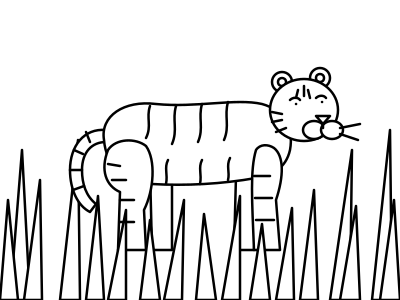
    A striped tiger walks through tall grass.

    A tiger's stripes help it hide in tall grass.

    Use the page above.

    1. Where do most wild lions live?
    2. What is a group of lions called?
    3. How do stripes help a tiger? Where did you find it?

    Take notes. Write two short facts about each cat in your own words.

    LionTiger
    1. Write one question you still have about big cats.

    Challenge

    • Cover the suffix and read the base word: fearless, powerful. What does -less mean?
    How did it go? Great Okay Tricky

    Science practice · Week 32 · Monday

    I can count the kinds of living things in a small space.

    Before you go outside:

    1. My guess: how many kinds of living things are in one square?

    Look in each square for 10 minutes. Tally each different kind of living thing.

    Kind of living thingSquare 1: ____Square 2: ____
    1. Which square had more kinds of living things?
    2. Why do you think so?
    3. More kinds of living things in a place means more ____.

    You need: string, a spoon

    How did it go? Great Okay Tricky