Week 32: Place Value and Operations Review · Informational Text Review

    Quarter 4 · Detailed day-by-day lesson plans · Days 156–160

    0 of 15 lessons done this week

    Place Value and Operations Review Informational Text Review

    Print

    Worksheets and answer keys

    Gather this week

    • Shop
    • Shop
    • Shop
    Everyday supplies (12)

    Writing prompt

    • Imagine a school on the moon. What's different about your day?
    Writing prompts (from Week 31)

    Parent note

    This week's parent digest

    This week at a glance

    Week 32 reviews place value and operations within 1000 in a mixed format. In ELA, children review informational text comprehension and research-writing skills.

    Parent tip

    Pick a favorite animal and do a 10-minute mini research session.

    Materials this week

    Mixed-math review, kid-friendly research books

    Mathematics

    Place Value and Operations Review

    Review, Word Problems & Consolidation · All Grade 2 CCSS-M Standards

    Assessment: Mixed place value, addition, subtraction within 1000

    ELA

    Informational Text Review

    Phonics: Word analysis and vocabulary review

    Writing: Research and opinion writing review

    Science

    Review, Projects & Science Fair

    Review of all Grade 2 science standards; K-2-ETS1-1, K-2-ETS1-3 (science fair)

    Social Studies

    Review, Projects & Celebration

    Monday — Day 156

    140 minutes of instruction

    Math

    Students will read, write, and represent three-digit numbers in standard, word, and expanded form and with base-ten drawings (2.NBT.A.1, 2.NBT.A.3).

    Activities

    10 min

    Warm-Up

    Ask your child to retell last week's checklist for two-step problems. Then hold up 10 bundles of 10 straws (or 10 groups of 10 beans) and ask, 'How many? How do you know?' Say together: '10 tens make 100.'

    straws or dried beansrubber bands
    15 min

    Mini-Lesson

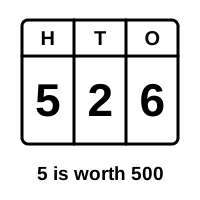
    Review place value to 1000 (first taught Weeks 2 to 5). Display 583. Your child writes it in words (five hundred eighty-three), in expanded form (500 + 80 + 3), and draws 5 flats, 8 rods, 3 units. Repeat with 407 (watch for the empty tens place) and 960.

    place value chartpaperpencil
    15 min

    Practice

    Number card mix-up: write digits 0 through 9 on index cards. Your child draws three cards, builds the largest number and the smallest number possible, and records both in all three forms. Do four rounds. Ask each time: 'What does the 7 mean in this number?'

    index cardspaperpencil
    5 min

    Wrap-Up

    Ask: 'What happens if I put a zero in the tens place? Does the number get smaller?' File one number in three forms in the portfolio.

    folder

    Materials Needed

    straws or dried beansrubber bandsplace value chartpaperpencilindex cardsfolder

    English Language Arts

    Students will ask and answer questions about key details in an informational text (RI.2.1, first taught in Week 7) and take research notes from a source (W.2.7, first taught in Week 10).

    Standards Addressed

    Activities

    15 min

    Shared Reading

    Read the first half of Who Would Win? Lion vs. Tiger by Jerry Pallotta, stopping at the size and weight pages. Say: 'Back in Week 7 we learned to ask questions before, during, and after nonfiction.' Before reading, write two questions your child has about lions and tigers on sticky notes and stick them to the cover.

    Who Would Win? Lion vs. Tiger by Jerry Pallottasticky notespencil
    10 min

    Mini-Lesson

    Model a 'Question, Answer, Page' chart: Question: How heavy is a tiger? Answer: found on the weight page. Show that a nonfiction answer is often in a caption or a fact box, not only in the main text. Move any sticky-note question that was answered to the chart.

    15 min

    Guided Reading

    Your child rereads the pages on teeth and claws and writes two new questions and answers on the chart, each with a page number. Then they choose the one fact that surprised them most and read it to you.

    Who Would Win? Lion vs. Tiger by Jerry Pallottareading notebook
    15 min

    Writing Workshop

    Research review from Week 10. Set up a 'Big Cat Facts' notes page with two columns, Lion and Tiger. Your child writes three short facts in each column from today's reading, in their own words, no full sentences needed yet.

    10 min

    Word Study

    Suffix review from Week 7 with words from the book: powerful, fearless, quickly, sharpness. Your child covers the suffix, reads the base, uncovers it, reads the whole word, and tells what the suffix adds ('-less means without').

    index cardspencil

    Materials Needed

    Who Would Win? Lion vs. Tiger by Jerry Pallottasticky notespencilreading notebookindex cardswriting notebook

    Science

    Students will count and record the different kinds of living things in a small outdoor area to review the idea of biodiversity (2-LS4-1).

    Standards Addressed

    Activities

    5 min

    Science Question of the Week

    Ask: 'Last week we followed one bean through its life cycle. How many different kinds of living things do you think live in one square of our yard or a nearby park?' Have your child write a guess on a sticky note before you go outside.

    20 min

    Investigation

    Lay a piece of string in a square about as wide as your child's arms (roughly 1 meter on each side) on grass, dirt, or a sidewalk edge with weeds. For 10 minutes your child looks closely, using a spoon to lift leaves, and tallies each different kind of living thing in a table with columns for plants, insects and bugs, and other (worms, birds seen overhead, mushrooms). Then repeat the tally in a second square on a different surface, such as bare pavement.

    4 meters of string or yarnplastic spoonclipboard or notebookpencilmagnifying glass (optional)
    5 min

    Wrap-Up

    Compare the two tallies. Ask: 'Which square had more kinds of living things? Why do you think that is?' Review the word biodiversity from Week 25: more kinds of living things means more biodiversity.

    Materials Needed

    4 meters of string or yarnplastic spoonnotebookpencilsticky notemagnifying glass (optional)
    Open Monday on its own page
    Social Studies

    Reading About Our World: What Is Culture?

    Read it aloud first while your child follows along. Then read it together, and let your child read the parts they can. Talk about the words in the word box.

    A Way of Life

    Culture is the way a group of people lives. It includes the food they eat and the languages they speak. It includes their music, their stories and their clothes. It also includes the days they celebrate.

    Many Cultures

    People in the United States come from many different cultures. Many languages are spoken here, such as English, Spanish and Chinese.

    Traditions

    A tradition is something people do again and again, often for many years. Traditions are often passed down from older family members. One family might make the same soup every winter. Another family might sing a special song on birthdays.

    Sharing Cultures

    When we learn about other cultures, we learn new foods, games and words. We also learn that families everywhere care about each other. Every culture adds something special to our country. What is one tradition in your family?

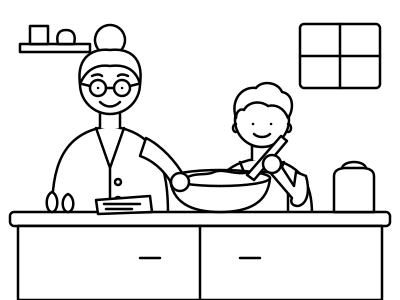
    A grandmother teaches her grandson how to make a family recipe.

    Picture caption: A grandmother teaches her grandson how to make a family recipe.

    Word box

    culture:
    the way a group of people lives
    tradition:
    something people do again and again, often for many years
    language:
    the words people use to speak and write
    celebrate:
    to do something special for an important day

    Questions

    1. Which heading would help you find out what a tradition is?
    2. What does the bold word "culture" mean?
    3. What does the caption tell you?

    Weekly check

    Math

    Weekly Check

    • I can add and subtract within 1000.
    • I can check my answer with the opposite operation.
    1. 427 + 386 = ____
    2. 563 + 248 = ____
    3. 804 − 529 = ____
    4. 650 − 273 = ____
    5. 912 − 468 = 444. Write the addition that checks it.
    6. Solve 700 − 356 = ____. Then check with addition.

    ELA

    Weekly Check

    • I can use headings, bold words and a glossary to find information.
    • I can use prefixes, suffixes and root words to work out meanings.

    Bees Make Honey

    Honeybees live in a hive. Worker bees fly from flower to flower. They sip nectar and carry it back to the hive to make honey.

    A worker bee visits a flower.

    1. What is the heading?
    2. What is the bold word?
    3. What does the caption tell you?
    4. What does the prefix un- mean in unhelpful?
    5. What does the suffix -less mean in hopeless?
    6. What is the root word in rebuilding?
    7. What does reread mean?

    Science

    Weekly Check

    • I can explain what biodiversity means.
    • I can describe matter and living things using this year's science words.
    1. What does biodiversity mean?
    2. Which place most likely has more biodiversity?a ponda parking lot
    3. Name two properties of a rubber ball.
    4. Is a metal spoon hard or soft?hardsoft
    5. Does a wooden block sink or float?sinkfloat
    6. Name one living thing and one nonliving thing you saw outside this week.

    Social Studies

    Weekly Check

    • I can explain what culture and traditions are.
    • I can describe a tradition in my family.
    1. What is a tradition?
    2. Culture is the way a group of people live. Name two parts of culture.
    3. Who often passes traditions down to children?
    4. Why might families in different places eat different foods?
    5. Describe a tradition in your family.

    Specials

    Health · Kindness, Community and Wellbeing Celebration · All Specials

    This Week's Specials Page

    Health · Week 32

    I can do kind things for others and for myself.

    Kindness calendar. Do one small kind act each day. Draw a heart in the box when you do it.

    MonTueWedThuFri
    1. Write one kind act you did this week.
    2. How did the other person feel? How did you feel?

    Kind to my community.

    1. Make a card for a neighbor, a firefighter or someone who helps your town. Draw the front here first.
    2. Being kind to yourself counts too. Write one kind thing you can say to yourself.

    You need: paper for a card, crayons or markers, stickers (optional)

    How did it go? Great Okay Tricky

    Home Connection

    This week at home

    • Math

      Big numbers: hundreds, tens and ones

    • ELA

      Text features help me find facts fast

    • Science

      More kinds of living things means more biodiversity

    • Social Studies

      Traditions and culture make each family special

    Three things to celebrate this week

    We did blank of 4 activities.

    Suggested Daily Schedule

    8:30–9:00 AM30 minMorning Meeting / Calendar / Read-Aloud
    9:00–9:30 AM30 minPhonics / Word Study / Spelling
    9:30–10:15 AM45 minReading Workshop
    10:15–10:35 AM20 minSnack and Outdoor Play / Movement Break
    10:35–11:05 AM30 minWriting Workshop
    11:05–11:50 AM45 minMathematics
    11:50 AM–12:35 PM45 minLunch and Free Play
    12:35–1:05 PM30 minScience OR Social Studies (alternating)
    1:05–1:35 PM30 minSpecials: PE / Art / Music / Health (rotating)
    1:35–2:00 PM25 minIndependent Reading / Enrichment