Quarter 4Week 32WednesdayDay 158 of 180

    Week 32, Wednesday: Add within 1000 using base-ten drawings · Use text features such as headings, captions

    Day 158 · 3 lessons · 140 min

    Math

    Students will add within 1000 using base-ten drawings and a written method with regrouping (2.NBT.B.7).

    Standards Addressed

    Activities

    10 min

    Warm-Up

    Ten more, ten less, hundred more, hundred less for 468, 792, 305, and 950. Then ask: 'What do we do when we have more than 9 ones?' Answer together: 'Bundle ten ones into a ten.'

    straws or dried beans
    15 min

    Mini-Lesson

    Review addition within 1000 with models (first taught Week 9). Solve 347 + 285: draw 3 flats 4 rods 7 units and 2 flats 8 rods 5 units, combine units (12, regroup to 1 rod 2 units), combine rods (13, regroup to 1 flat 3 rods), combine flats (6). Answer 632. Then show the same problem in the written column method and match each regrouping to the drawing.

    paperpencilbase-ten blocks or drawn squares
    15 min

    Practice

    Your child solves 456 + 237 (693), 178 + 364 (542), 529 + 391 (920), and 685 + 275 (960), drawing the model for the first two and using the column method for the last two. For each, circle where a regroup happened.

    paperpencil
    5 min

    Wrap-Up

    Ask: 'Which problem needed two regroups? How did you know?' Add one model to the portfolio with the regroup circled.

    folder

    Materials Needed

    straws or dried beanspaperpencilbase-ten blocks or drawn squaresfolder

    English Language Arts

    Students will use text features such as headings, captions, bold words, and glossaries to locate information efficiently (RI.2.5, first taught in Week 9) and gather facts from two sources.

    Standards Addressed

    Activities

    15 min

    Shared Reading

    Read Big Cats by Elizabeth Carney (National Geographic Kids Readers). Before the first page, do a 'feature hunt' from Week 9: your child finds the table of contents, one heading, one caption, one bold word, and the glossary, and marks each with a sticky flag.

    Big Cats by Elizabeth Carney (National Geographic Kids Readers)sticky flags
    10 min

    Mini-Lesson

    Play 'Find It Fast'. Say: 'Find where the book tells how fast a cheetah runs.' Time your child using the table of contents versus flipping every page. Say: 'Text features are shortcuts. Headings tell us where, captions tell us what a picture shows, bold words tell us to check the glossary.'

    kitchen timer
    15 min

    Guided Reading

    Your child picks two bold words from Big Cats, finds each in the glossary, and writes the word and meaning in the reading notebook. Then they compare: 'What does Big Cats say about tigers that Who Would Win? also said? What is new?'

    Big Cats by Elizabeth Carney (National Geographic Kids Readers)reading notebookpencil
    15 min

    Writing Workshop

    Gathering from sources review from Week 10 and Week 28. Your child adds a third column, 'From Big Cats', to the Big Cat Facts page and writes two new facts with the page number next to each. Say: 'A researcher always knows where a fact came from.'

    10 min

    Word Study

    Dictionary and glossary skills review from Week 15. Give your child a children's dictionary and three words from this week (predator, habitat, stripes). They find each using the guide words, read the meaning aloud, and tell which meaning fits the book. Support: mark the correct page with a sticky note first. Stretch: have them find a fourth word of their own and write a sentence using it.

    children's dictionarysticky notes

    Materials Needed

    Big Cats by Elizabeth Carney (National Geographic Kids Readers)Who Would Win? Lion vs. Tiger by Jerry Pallottasticky flagskitchen timerreading notebookpencilchildren's dictionarysticky noteswriting notebook

    Science

    Students will review the properties of matter by sorting kitchen materials by observable properties and testing which are best for a purpose (2-PS1-1, 2-PS1-2).

    Standards Addressed

    Activities

    5 min

    Review

    Ask: 'In Unit 1 we described matter by its properties. Name three properties we can observe.' List them on an index card: color, hardness, texture, flexibility, whether it soaks up water. Show a spoon and ask your child to describe it with three of those words.

    20 min

    Deeper Investigation

    Gather 8 objects: a cotton ball, a metal spoon, a rubber band, a plastic lid, a wooden block or clothespin, a piece of foil, a sponge, and a rock. Your child sorts them three ways, one property at a time (hard or soft, bends or does not bend, sinks or floats in a bowl of water), and records each sort in a table. Then pose a purpose: 'Which one would you pick to soak up a spill, and which to hold a door open?' Your child tests both picks.

    cotton ballmetal spoonrubber bandplastic lidwooden block or clothespinfoilspongerockbowl of watertowel
    5 min

    Data Discussion

    Ask: 'Did any object change groups when we changed the property?' Point out that the same object can be hard and also float (the plastic lid), so scientists describe matter with many properties, not just one.

    Materials Needed

    cotton ballmetal spoonrubber bandplastic lidwooden block or clothespinfoilspongerockbowl of watertowelnotebook

    Today's Practice

    One page for your child for each lesson. Answers are for grown-ups.

    Math practice · Week 32 · Wednesday

    I can add three-digit numbers and trade when I need to.

    Look: 268 + 457

    1. Ones: 8 + 7 = 15. Trade 10 ones for 1 ten. Write 5.
    2. Tens: 1 + 6 + 5 = 12 tens. Trade 10 tens for 1 hundred. Write 2.
    3. Hundreds: 1 + 2 + 4 = 7. The answer is 725.

    Draw squares, sticks and dots for the first two. Use columns for the rest. Circle each trade.

    1. 236 + 158 = ____
    2. 374 + 249 = ____
    3. 485 + 316 = ____
    4. 157 + 638 = ____
    5. 609 + 283 = ____

    Solve.

    1. A school collected 359 cans on Monday and 276 cans on Tuesday. How many cans in all?

    Challenge

    • Which problems needed two trades? Put a star next to them.
    How did it go? Great Okay Tricky

    ELA practice · Week 32 · Wednesday

    I can use text features to find facts fast.

    Look: Find it fast

    1. Question: What do koalas eat?
    2. Look at the headings. Find the one called Food.
    3. Read under it: koalas eat leaves.

    Cheetahs

    A cheetah can run faster than any other animal on land, but only for a short time. A cheetah is a predator. It hunts other animals for food. Its spots help it hide in dry grass.

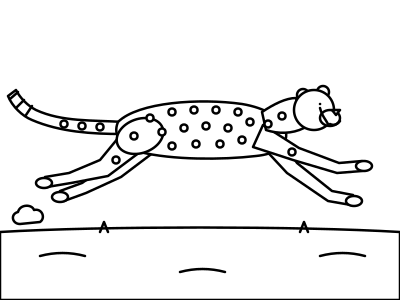
    A spotted cheetah runs fast with its long tail stretched out behind it.

    A cheetah's long tail helps it turn fast.

    Use the page above.

    1. Draw a box around the heading.
    2. Circle the bold word.
    3. Underline the caption.
    4. A glossary says a predator is an animal that hunts other animals for food. Name another predator.

    Use guide words. The guide words on a page are hat and hive.

    1. Would hen be on this page?yesno
    2. Would hop be on this page?yesno
    3. Put in ABC order: stripes, habitat, predator

    Challenge

    • Which text feature told you about the cheetah's tail?
    How did it go? Great Okay Tricky

    Science practice · Week 32 · Wednesday

    I can sort objects by their properties.

    Test each object. Write what you find.

    ObjectHard or softBends or notSinks or floats
    1. Name one object that is hard and also floats.

    Pick the best object for each job. Test it.

    1. Which object would you pick to soak up a spill? Why?
    2. Which object would you pick to hold a door open? Why?
    3. Did any object change groups when you changed the property?

    You need: a cotton ball, a metal spoon, a rubber band, a plastic lid, a wooden block or clothespin, foil, a sponge, a rock, a bowl of water

    How did it go? Great Okay Tricky