Quarter 4Week 32FridayDay 160 of 180

    Week 32, Friday: Demonstrate place value understanding and add · Explain how images contribute to and clarify a text

    Day 160 · 3 lessons · 140 min

    Math

    Students will demonstrate place value understanding and add and subtract within 1000 on a mixed assessment (2.NBT.A.1, 2.NBT.A.3, 2.NBT.A.4, 2.NBT.B.7).

    Activities

    10 min

    Warm-Up

    Quick review round: say 726 in words, write 300 + 40 + 9 as a number, compare 481 and 418, and count by 100s from 175. Ask your child which of this week's skills felt easiest and which felt hardest.

    paperpencil
    15 min

    Mini-Lesson

    Model one complete problem from each part of the assessment so the format is familiar: represent 604 three ways, compare 356 and 365, solve 289 + 436 (725), and solve 800 - 347 (453). Talk through where errors usually happen (empty places and double regroups).

    paperpencil
    15 min

    Weekly Assessment

    Part 1: write 917 and 380 in words and expanded form. Part 2: compare 472 and 427, 600 and 599, 815 and 851 with symbols. Part 3: mental math, 10 more and 100 less for 543 and 990. Part 4: add 368 + 254 (622) and 495 + 305 (800); subtract 731 - 286 (445) and 500 - 124 (376). Allow drawings.

    assessment sheetpencilbase-ten blocks optional
    5 min

    Wrap-Up

    Portfolio routine: file the assessment and write one sticky note: 'A place value fact I know for sure is...' Preview next week: fluency within 20 and strategies within 100.

    foldersticky note

    Materials Needed

    paperpencilassessment sheetbase-ten blocks optionalfoldersticky note

    Assessment

    Mixed place value, addition, subtraction within 1000

    English Language Arts

    Students will explain how images contribute to and clarify a text (RI.2.7, first taught in Week 11), demonstrate mastery of Dolch grade-2 sight words, and publish an opinion piece.

    Standards Addressed

    Activities

    10 min

    Reading Celebration

    Flip through both big-cat books and let your child pick their favorite diagram or photo. Ask the Week 11 question: 'What does this picture help you understand that the words alone could not?' Listen for a specific detail such as the size comparison or the paw diagram.

    Who Would Win? Lion vs. Tiger by Jerry PallottaBig Cats by Elizabeth Carney (National Geographic Kids Readers)
    15 min

    Reading Response or Assessment

    Weekly assessment. Give three short questions on paper: 1. What is the main topic of Who Would Win? Lion vs. Tiger? 2. Name two reasons the author gives for the winner. 3. Pick one picture in Big Cats and tell what it shows that the words do not. Your child answers in complete sentences.

    paperpencil
    15 min

    Publishing and Author's Chair

    Your child copies Thursday's opinion piece neatly or types it (Week 20 digital tools review), adds a labeled drawing of the winner, and reads it aloud from the author's chair. Family members respond with 'I agree because' or 'I disagree because'. File it in the Finished Pieces folder.

    paper or computercrayonsFinished Pieces folder
    10 min

    Phonics Check

    Dolch grade-2 sight word check (Week 8 irregular and high-frequency word review). Show the 46 words on cards, one per second: always, around, because, been, before, best, both, buy, call, cold, does, don't, fast, first, five, found, gave, goes, green, its, made, many, off, or, pull, read, right, sing, sit, sleep, tell, their, these, those, upon, us, use, very, wash, which, why, wish, work, would, write, your. Record the count correct out of 46 and set aside any missed words for daily practice.

    46 Dolch grade-2 word cards
    15 min

    Independent Reading

    Free choice reading, nonfiction encouraged. Offer another Who Would Win? title (such as Killer Whale vs. Great White Shark) and ask your child to predict the winner from the cover before reading.

    nonfiction library book of choice

    Materials Needed

    Who Would Win? Lion vs. Tiger by Jerry PallottaBig Cats by Elizabeth Carney (National Geographic Kids Readers)paperpencilpaper or computercrayonsFinished Pieces folder46 Dolch grade-2 word cardsnonfiction library book of choice

    Assessment

    Three-question written response on main topic, author's reasons, and how an image supports the text; Dolch grade-2 sight word check scored out of 46; published opinion piece with two text-based reasons.

    Science

    Students will draw conclusions about why some places have more living things than others and connect biodiversity to the properties of the materials found there (2-LS4-1, 2-PS1-1).

    Standards Addressed

    Activities

    10 min

    Drawing Conclusions

    Look at Monday's two tallies. Ask: 'The pavement square had fewer living things. What properties of pavement make it a hard place to live?' Guide toward: hard, dry, no soil, soaks up no water. Your child writes one conclusion: 'More living things live where there is ____ and ____.'

    15 min

    Extension or Art Connection

    Make a biodiversity collage of the grassy square: your child draws the square on paper and glues on real bits collected outside (a leaf, a blade of grass, a seed, a pebble) and draws the animals seen, labeling each. Add a caption that names the number of different kinds counted.

    paperglue stickleaf, grass, seed, pebble collected outsidecrayons
    5 min

    Week Reflection

    Ask: 'Last week we said every living thing has a life cycle. Pick one thing from your square and tell me its life cycle.' Then preview next week: 'Starting Monday you will become a scientist with your own question for a science fair.' Place the tallies and collage in the portfolio folder.

    Materials Needed

    Monday's tally tablespaperglue stickcollected leaf, grass, seed, pebblecrayonsportfolio folder

    Today's Practice

    One page for your child for each lesson. Answers are for grown-ups.

    Math practice · Week 32 · Friday

    I can get ready: place value and counting.

    Get ready: write each answer.

    1. Write 853 in words.
    2. Write 700 + 20 + 9 as a number.
    3. What does the 0 in 604 mean?
    4. 594 ____ 549 (write >, = or <)

    Ten more, a hundred less, and count.

    1. 10 more than 386 is ____.
    2. 100 less than 512 is ____.
    3. Count by 100s: 265, ____, ____, ____

    Challenge

    • Which is harder for you: numbers with a zero, or problems with two trades? Why?
    How did it go? Great Okay Tricky

    ELA practice · Week 32 · Friday

    I can get ready: I tell what a picture adds, and I read sight words.

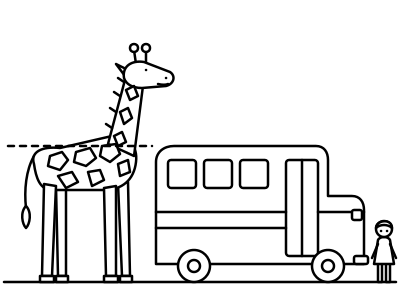
    How Tall Is a Giraffe?

    A giraffe is the tallest animal on land. Its long neck helps it eat leaves from the tops of trees.

    A grown giraffe stands taller than a school bus, with a child next to the bus.

    A grown giraffe is taller than a school bus.

    Use the page above.

    1. What is the main topic?
    2. What does the picture help you understand that the words alone do not?

    Fill in each blank with a word from the box.

    • which
    • wash
    • upon
    • because
    • those
    1. ____ hat is yours?
    2. Please ____ your hands.
    3. Once ____ a time, there was a giraffe.
    4. We stayed in ____ it rained.
    5. May I have ____ blocks over there?

    Challenge

    • Draw a labeled picture of your favorite big cat. What does your picture show?
    How did it go? Great Okay Tricky

    Science practice · Week 32 · Friday

    I can explain why some places have more living things than others.

    Look at Monday's two tallies.

    1. The pavement square had fewer living things. What properties make pavement a hard place to live?
    2. More living things live where there is ____ and ____.

    Make a collage of your grassy square. Glue on bits from outside and draw the animals you saw.

    1. My biodiversity collage:
    2. How many different kinds did you count?

    Challenge

    • Pick one living thing from your square. Tell its life cycle.

    You need: glue, a leaf, grass, a seed or a pebble from outside

    How did it go? Great Okay Tricky