Quarter 1Week 9TuesdayDay 42 of 180

    Week 9, Tuesday: Explore regrouping tens into hundreds when adding · Use a table of contents, glossary

    Day 42 · 3 lessons · 140 min

    Math

    Students explore regrouping tens into hundreds when adding within 1000, using straw bundles and drawings (2.NBT.B.7).

    Standards Addressed

    Activities

    10 min

    Warm-Up

    Bundle-of-bundles: have your child rubber-band 10 straw bundles into one big bundle of 100. Ask, 'How many straws is this?' Then say 380 + 20 and have them show it: 3 hundred-bundles, 8 ten-bundles, add 2 ten-bundles, and regroup 10 tens into a fourth hundred (400).

    straws bundled by tenrubber bands
    15 min

    Mini-Lesson

    Write 362 + 275. Draw base-ten: 3 squares, 6 sticks, 2 dots plus 2 squares, 7 sticks, 5 dots. Ones: 7 dots, no regroup. Tens: 13 sticks, circle 10 and redraw as a square. Now 6 squares, 3 sticks, 7 dots: 637. Then do 485 + 178, which regroups twice (663), narrating each circle.

    paperpencil
    15 min

    Practice

    Your child solves 293 + 154, 571 + 265, 386 + 447, and 649 + 283 (answers 447, 836, 833, 932). For each, they write R1, R2, or R0 next to the answer to say how many times they regrouped (1, 1, 2, 2).

    paperpencil
    5 min

    Wrap-Up

    Ask, 'Can you tell before you start whether a problem will need regrouping? How?' Listen for checking whether the ones or tens add to 10 or more.

    Materials Needed

    straws bundled by tenrubber bandspaperpencil

    English Language Arts

    Students use a table of contents, glossary, and index to locate information efficiently and draft the beginning of a sequenced narrative (RI.2.5, W.2.3).

    Standards Addressed

    Activities

    15 min

    Read-Aloud

    Finish 'Sharks,' then turn to the table of contents and glossary at the front and back. Read the glossary words aloud and ask, 'Where did we see this word in the book?' Have your child use the table of contents to flip straight to the section about baby sharks.

    National Geographic Kids Readers: Sharks by Anne Schreiber
    10 min

    Mini-Lesson

    Add three features to the Toolbox chart: table of contents (front, lists sections and page numbers), glossary (back, defines important words), index (back, lists topics in ABC order with pages). Explain that these live at the front and back of the book, while headings and captions live inside.

    chart papermarker
    15 min

    Guided Reading

    Choose a library nonfiction book with a table of contents and index (most Gail Gibbons and DK titles have them). Give three lookups: 'Find the page about food,' 'Find what the word habitat means,' 'Find every page that mentions eggs.' Your child names which feature to use, then does it while you time each search. Support: Show the glossary and index pages first and read their headings together. Stretch: Write your own index entry for a page in the book with the correct page number.

    library nonfiction bookkitchen timerwriting notebookpencil
    15 min

    Writing Workshop

    Your child writes the First box as two or three sentences, starting with a time word ('One morning,' 'Last Saturday,'). Remind them that the reader was not there, so name where you were and who was with you. Watch for past tense verbs and fix any 'goed' to 'went' or 'runned' to 'ran' together.

    writing notebookpencil
    10 min

    Phonics

    Teach open syllables: a syllable that ends in a vowel usually says the long sound. Read and divide after the first vowel: robot, tiger, music, paper, spider, silent, moment, bacon, pilot, open. Have your child sort yesterday's closed-syllable cards and today's open-syllable cards into two columns.

    index cardsmarker

    Materials Needed

    National Geographic Kids Readers: Sharks by Anne Schreiberchart papermarkerlibrary nonfiction bookkitchen timerwriting notebookpencilindex cards

    Social Studies

    Students identify major landforms (mountain, hill, valley, plain, island) and bodies of water (river, lake, ocean) and describe them with pictures and words (D2.Geo.2.K-2, D2.Geo.3.K-2).

    Standards Addressed

    Activities

    10 min

    Read-Aloud and Discussion

    Read 'Where the River Begins' by Thomas Locker. As the boys walk upstream, stop and name what you see: the wide river, the meadow (a plain), the hills, the pond (a lake), the mountains. Ask, 'Where does the river start? Where do you think it ends?'

    Where the River Begins by Thomas Locker
    15 min

    Hands-On Activity: Landform Salt Dough

    Mix 1 cup flour, half a cup salt, and half a cup water into dough. On a paper plate, your child shapes a mountain, a hill, a flat plain, a valley between two hills, and an island in a 'lake' (a pressed-in dip). Press a finger to carve a river from the mountain to the lake. Label each with a toothpick flag.

    floursaltwaterbowlpaper platetoothpickspaper scrapstape
    5 min

    Quick Write

    Your child writes: 'A ______ is high and rocky. A ______ is flat land. Water that flows is a ______.'

    notebookpencil

    Materials Needed

    Where the River Begins by Thomas Lockerfloursaltwaterbowlpaper platetoothpickspaper scrapstapenotebookpencil

    Today's Practice

    One page for your child for each lesson. Answers are for grown-ups.

    Math practice · Week 9 · Tuesday

    I can trade 10 tens for a hundred when I add.

    Look: 374 + 152

    1. Draw both numbers. Add the ones: 4 + 2 = 6 dots. No trade.
    2. Add the tens: 7 + 5 = 12 sticks. Circle 10 sticks and trade them for 1 square.
    3. Now count: 5 hundreds, 2 tens, 6 ones = 526.

    Draw and add. Circle each trade. Write how many trades you made.

    1. 283 + 164 = ____ Trades: ____
    2. 452 + 376 = ____ Trades: ____
    3. 568 + 257 = ____ Trades: ____
    4. 695 + 138 = ____ Trades: ____

    Will you need to trade? Circle yes or no.

    1. 341 + 225yesno
    2. 460 + 380yesno
    3. 127 + 251yesno

    Challenge

    • How can you tell before you start that a problem needs a trade?
    How did it go? Great Okay Tricky

    ELA practice · Week 9 · Tuesday

    I can use a table of contents, a glossary and an index.

    Look: robot → ro|bot

    1. Split after the first vowel: ro|bot.
    2. The first part ends with o, so the o says its name: /ō/.
    3. Read: ro-bot, robot.

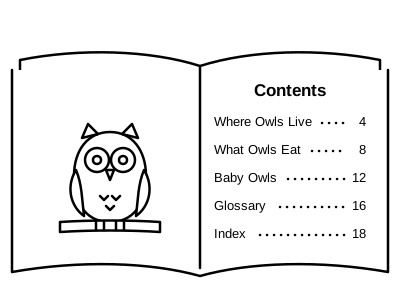
    Contents

    Where Owls Live ........ 4 What Owls Eat ........ 8 Baby Owls ........ 12 Glossary ........ 16 Index ........ 18

    An open book about owls shows an owl on one page and the contents page on the other.

    Use the contents page above.

    1. What page tells about baby owls?
    2. What page would you turn to to learn what owls eat?
    3. You want to know what a word means. Where do you look?contentsglossaryindex
    4. You want every page that tells about eggs. Where do you look?contentsglossaryindex

    Split each word after the first vowel. Read each part. The first part says its long vowel sound.

    1. baby
    2. zero
    3. tulip
    4. hotel
    How did it go? Great Okay Tricky

    Social Studies practice · Week 9 · Tuesday

    I can name landforms and bodies of water.

    Circle the word that matches.

    1. High, rocky landmountainplainlake
    2. Flat landhillplainriver
    3. Low land between two hillsvalleyislandocean
    4. Land with water all around itmountainislandplain
    5. Water that flowslakeriverhill

    Draw your salt dough plate. Label a mountain, a hill, a valley, a plain, an island and a river.

    1. My landform plate
    2. Where does a river start, up high or down low?up highdown low

    You need: flour, salt and water, a paper plate, toothpicks and small paper flags

    How did it go? Great Okay Tricky