Week 9: Add and Subtract Within 1000 Using Models · Using Text Features to Locate Information

    Quarter 1 · Detailed day-by-day lesson plans · Days 41–45

    0 of 15 lessons done this week

    Add and Subtract Within 1000 Using Models Using Text Features to Locate Information

    Print

    Worksheets and answer keys

    Gather this week

    • Shop
    • Shop
    • Shop
    • Shop
    Everyday supplies (13)

    Writing prompt

    • Should kids have homework on weekends? Tell why or why not.
    Week 9 writing prompts

    Parent note

    This week's parent digest

    Specials this week

    Supplements

    This week at a glance

    Week 9 closes Quarter 1 with addition and subtraction within 1000 using models. Readers use headings, captions, and bold words to locate information quickly.

    Parent tip

    Read a nonfiction kids' magazine together and point out text features.

    Materials this week

    Base-ten blocks, kids' science magazine, sticky notes

    Mathematics

    Add and Subtract Within 1000 Using Models

    Addition & Subtraction Within 100 · 2.NBT.B.5

    Assessment: Use base-ten blocks and drawings to solve addition/subtraction within 1000

    ELA

    Using Text Features to Locate Information

    Phonics: Multisyllabic word decoding

    Writing: Narrative writing

    Science

    Plants, Animals & Habitats

    2-LS2-1, 2-LS2-2, 2-LS4-1, K-2-ETS1-2

    Social Studies

    Maps, Geography & Our World

    Monday — Day 41

    140 minutes of instruction

    Math

    Students add three-digit numbers within 1000 using base-ten drawings and regrouping ones into tens (2.NBT.B.7).

    Standards Addressed

    Activities

    10 min

    Warm-Up

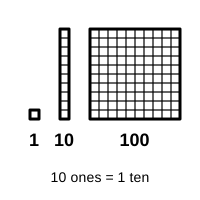
    Spiral from last week: 25 + 35 + 40 mentally (100). Then review base-ten drawing conventions: a large square for 100, a stick for 10, a dot for 1. Your child draws 236 (2 squares, 3 sticks, 6 dots) and 405 (4 squares, 0 sticks, 5 dots).

    paperpencil
    15 min

    Mini-Lesson

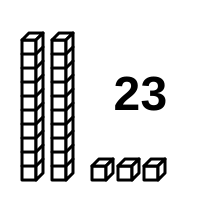
    Write 247 + 136. Draw both numbers in base-ten pictures. Combine: 3 squares, 7 sticks, 13 dots. Circle 10 dots and redraw them as a new stick, saying, 'Ten ones regroup into one ten.' Now 3 squares, 8 sticks, 3 dots: 383. Repeat with 328 + 245 (573), letting your child do the regrouping circle.

    paperpencil
    15 min

    Practice

    Your child draws and solves 156 + 227, 419 + 348, 263 + 519, and 335 + 428 (answers 383, 767, 782, 763). Each drawing must show the circled ten dots turning into a stick.

    paperpencil
    5 min

    Wrap-Up

    Ask, 'How is regrouping dots into a stick like bundling straws?' Have your child hold up a straw bundle to explain.

    straws bundled by ten

    Materials Needed

    paperpencilstraws bundled by ten

    English Language Arts

    Students use headings, captions, and bold print to locate information in a nonfiction reader and begin a narrative about a sequence of events (RI.2.5, W.2.3).

    Standards Addressed

    Activities

    15 min

    Read-Aloud

    Say, 'Last week you found what a book is mostly about. This week we learn the tools authors give us to find facts fast.' Read the first half of 'Sharks' from the National Geographic Kids Readers series by Anne Schreiber. Each time you meet a heading, a caption, or a bold word, stop and name it out loud, and have your child tally each kind on a scrap of paper.

    National Geographic Kids Readers: Sharks by Anne Schreiberscrap paperpencil
    10 min

    Mini-Lesson

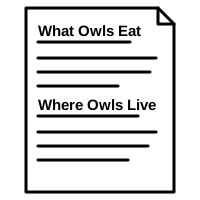
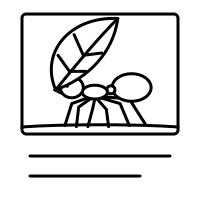
    Make a 'Text Features Toolbox' chart with a drawing and job for each: heading (tells what a section is about), caption (explains a picture), bold word (an important word to learn), photo (shows what it really looks like). Have your child find one example of each in the book and mark it with a sticky flag.

    chart papermarkersticky notesNational Geographic Kids Readers: Sharks by Anne Schreiber
    15 min

    Guided Reading

    Play 'Feature Finder': say a fact you want ('How many teeth can a shark grow in its life?') and your child decides which feature will get there fastest (a heading, a caption, a bold word) before searching. Do five rounds and talk about which feature helped most each time.

    National Geographic Kids Readers: Sharks by Anne Schreiberkitchen timer
    15 min

    Writing Workshop

    Introduce this week's narrative writing: a true story about something that happened to your child in order. Brainstorm three small moments (losing a tooth, a trip to the pool, planting the bean seeds in science) on a list and circle one. Your child draws three boxes labeled First, Next, Last and sketches each part.

    writing notebookpencil
    10 min

    Phonics

    Teach closed syllables: when a vowel is followed by a consonant, it is usually short. Write these two-syllable words and have your child draw a line between the two middle consonants, then read each part: rabbit, napkin, basket, magnet, picnic, sunset, cactus, muffin, kitten, dentist. Clap the syllables of each word.

    whiteboard or papermarker

    Materials Needed

    National Geographic Kids Readers: Sharks by Anne Schreiberscrap paperpencilchart papermarkersticky noteskitchen timerwriting notebookwhiteboard or paper

    Science

    Students describe what a habitat provides (food, water, shelter, space) and compare living things found in two outdoor spots (2-LS4-1).

    This week's reading: A Home for Every Animal

    Standards Addressed

    Activities

    5 min

    Science Question of the Week

    Say, 'Last week we saw that a beak matches its food. A habitat is the place that gives an animal its food, water, shelter, and space. Our question: Do different places have different living things?' Post the question on the wall.

    index cardtape
    20 min

    Investigation: Two-Square-Foot Survey

    Make a square of string about the size of a bath towel and lay it on grass or dirt; lay a second square on a paved or gravel area. Your child spends 5 minutes at each square counting every living thing seen: ants, worms, grass blades, weeds, spiders, birds overhead. Tally each kind on a two-column chart labeled Grass Square and Hard Square.

    stringhand lens or magnifying glassnotebookpencilclipboard
    5 min

    Wrap-Up

    Ask, 'Which square had more kinds of living things? What did that square have that the other did not?' Your child writes the totals in the notebook.

    notebookpencil

    Materials Needed

    index cardtapestringhand lens or magnifying glassnotebookpencilclipboard
    Open Monday on its own page
    Science

    Reading About Our World: A Home for Every Animal

    Read it aloud first while your child follows along. Then read it together, and let your child read the parts they can. Talk about the words in the word box.

    What Is a Habitat?

    A habitat is the place where a plant or animal lives. It has the food, water and shelter that living things need.

    Hot and Dry

    A desert gets very little rain. Camels, lizards and cactus plants live there. A cactus stores water in its thick stem.

    Wet and Green

    A rain forest gets rain almost every day. Monkeys swing in the tall trees, and frogs hide in the wet leaves.

    Cold and Icy

    The Arctic is cold and snowy. Polar bears have thick fur and a layer of fat to stay warm.

    Each animal fits its habitat. A polar bear would be much too hot in a desert!

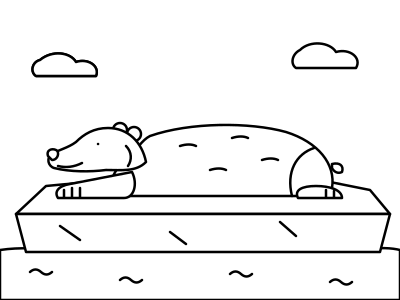
    A polar bear rests on the ice with its thick fur keeping it warm.

    Picture caption: A polar bear rests on the ice. Its thick fur keeps it warm.

    Word box

    habitat:
    the place where a plant or animal lives
    shelter:
    a place that keeps an animal safe
    desert:
    a place that gets very little rain
    rain forest:
    a warm place with tall trees that gets rain almost every day

    Questions

    1. Which heading would help you find facts about camels?
    2. What does the bold word "habitat" mean?
    3. What does the caption tell you?

    Weekly check

    Math

    Weekly Check

    • I can add and subtract within 1000 using blocks or drawings.
    • I can explain when I need to trade 10 ones for a ten, or 10 tens for a hundred.
    1. 243 + 135 = ____
    2. 368 + 254 = ____
    3. 475 − 238 = ____
    4. 603 − 145 = ____
    5. Draw 316 with squares, sticks and dots.

    ELA

    Weekly Check

    • I can use text features (headings, captions, bold words) to find information.
    • I can read two-syllable words by splitting them.

    Frogs Grow Up

    A frog starts as an egg. The egg hatches into a tadpole. A tadpole lives in water and has a tail.

    A tadpole swims in a pond.

    1. What is the heading?
    2. What is the bold word?
    3. What does the caption tell you?
    4. Split into syllables: sunset
    5. Split into syllables: picnic

    Science

    Weekly Check

    • I can describe a habitat and the plants and animals that live there.
    • I can explain how living things fit their habitat.
    1. Name the four things a habitat gives an animal.
    2. Which habitat is hot and dry with little rain?ponddesertocean
    3. Circle the animal that lives in the ocean.cameljellyfishdeer
    4. Name one animal that lives in a forest.
    5. Why is a pond a good home for a frog?
    6. Why can't a fish live in a desert?

    Social Studies

    Weekly Check

    • I can describe landforms (mountain, hill, valley, plain) and bodies of water (river, lake, ocean).
    • I can find landforms on a map.
    1. Land with water all around it is an ________.
    2. Low land between hills is a ________.
    3. Which is higher?a hilla mountain
    4. A huge body of salty water is an ________.
    5. On a map, what does a blue line usually show?
    6. Give one reason people build towns near rivers.

    Specials

    Art · Color Theory & Texture · All Specials

    This Week's Specials Page

    Art · Week 9

    I can mix primary colors to make secondary colors.

    Look: Primary colors

    1. Red, yellow and blue are the primary colors.
    2. When you mix two primary colors, you make a secondary color.

    Mix the colors with paint, or color one crayon on top of the other. Color the box, then write the new color.

    1. red + yellow = ____
    2. yellow + blue = ____
    3. red + blue = ____

    Texture rubbings. Put paper over something bumpy. Rub the side of a crayon on top.

    1. Make two rubbings here (try a leaf, a coin or a sneaker sole).
    2. Write one word that tells how one of your things feels.

    Challenge

    • Are red, orange and yellow warm colors or cool colors?

    You need: crayons with the paper peeled off, paint if you have it, a leaf, coin or sneaker

    How did it go? Great Okay Tricky

    Home Connection

    This week at home

    • Math

      Adding and taking away big numbers with drawings

    • ELA

      Tools that help me find facts fast

    • Science

      Habitats: homes for plants and animals

    • Social Studies

      Mountains, hills, rivers and lakes

    Three things to celebrate this week

    We did blank of 4 activities.

    Suggested Daily Schedule

    8:30–9:00 AM30 minMorning Meeting / Calendar / Read-Aloud
    9:00–9:30 AM30 minPhonics / Word Study / Spelling
    9:30–10:15 AM45 minReading Workshop
    10:15–10:35 AM20 minSnack and Outdoor Play / Movement Break
    10:35–11:05 AM30 minWriting Workshop
    11:05–11:50 AM45 minMathematics
    11:50 AM–12:35 PM45 minLunch and Free Play
    12:35–1:05 PM30 minScience OR Social Studies (alternating)
    1:05–1:35 PM30 minSpecials: PE / Art / Music / Health (rotating)
    1:35–2:00 PM25 minIndependent Reading / Enrichment