Quarter 3Week 19MondayDay 91 of 180

    Week 19, Monday: Choose an appropriate tool · Read a complex informational text closely

    Day 91 · 3 lessons · 140 min

    Math

    Students will choose an appropriate tool (ruler, yardstick, or tape measure) and measure the length of an object in inches (2.MD.A.1).

    Standards Addressed

    Activities

    10 min

    Warm-Up

    Lay out 12 paper clips in 3 rows of 4 and have your child write the repeated addition sentence from last week (4 + 4 + 4 = 12). Then line the 12 clips end to end in a single row and ask: 'How could we tell someone exactly how long this row is?' Listen for 'measure it' and 'use a ruler.'

    12 paper clipspaperpencil
    15 min

    Mini-Lesson: Meet the Tools

    Put a 12-inch ruler, a yardstick (or a 36-inch strip of masking tape marked every inch), and a tape measure side by side. Show that each is marked in inches, that measuring starts at the 0 mark (not the end of the wood), and that a ruler is for short things, a yardstick for medium things like a table, and a tape measure for long or curved things. Measure a crayon together (about 3 inches) and say 'The crayon is 3 inches long' while sliding a finger from 0 to 3.

    12-inch ruleryardstick or 36-inch marked tape striptape measurecrayon
    15 min

    Practice: Which Tool?

    Give your child a spoon, a book, the kitchen table, a shoe, and a doorway. For each, they say which tool fits best, measure to the nearest inch, and record the result on a chart with columns for Object, Tool, and Inches (expect roughly spoon 6 in, book 9 in, table 48 in, shoe 8 in, doorway 80 in). Support: pre-mark the 0 end of each tool with a sticker. Stretch: measure the table with the ruler too and count how many times the ruler had to be moved.

    spoonbookshoeruleryardsticktape measurechart paperpencilsticker
    5 min

    Wrap-Up

    Ask: 'Why did you pick the tape measure for the doorway instead of the ruler?' Have your child write one sentence: 'I use a ruler for short things and a tape measure for long things.'

    math journalpencil

    Materials Needed

    12 paper clips12-inch ruleryardstick or 36-inch marked tape striptape measurecrayonspoonbookshoechart paperstickermath journalpencil

    English Language Arts

    Students will read a complex informational text closely, using rereading and text features to make sense of hard sentences (RI.2.10).

    Standards Addressed

    Activities

    15 min

    Read-Aloud

    Introduce 'A Drop of Water: A Book of Science and Wonder' by Walter Wick and read the first six pages (the faucet drop, the splash, and the water striders). Before reading, ask what your child remembers about fables from last week, then explain that this week's book is different: it is true, it is packed with facts, and it will feel harder, so you will read slowly and look at every photo. Pause after each page and ask, 'What did the photo show that the words explained?'

    A Drop of Water by Walter Wick (library)
    10 min

    Mini-Lesson: When a Text Feels Hard

    Write three fix-it moves on an index card: 1. Reread the sentence slowly. 2. Look at the photo or diagram. 3. Find the hard word and break it into parts. Model on the sentence about surface tension: reread it, point to the photo of the water strider, and break 'ten-sion' into parts. Keep the card on the table all week.

    index cardmarker
    15 min

    Guided Reading

    Your child reads a nonfiction book at their level (a National Geographic Kids Reader or a Let's-Read-and-Find-Out title works well) for 12 minutes, marking one hard sentence with a sticky note. Together, apply one of the three fix-it moves to that sentence and have your child explain what it means now.

    leveled nonfiction booksticky notes
    15 min

    Writing Workshop: Choosing a Piece to Revise

    Pull out two informational pieces your child wrote earlier this year (the Unit 2 research piece is ideal). Read both aloud and let your child pick the one they want to make better; they write the title on a fresh 'Revision Plan' sheet and one sentence about why they chose it. Explain that revising means making the writing clearer and more interesting, and editing means fixing spelling and punctuation, and that this week you will do both.

    two earlier informational writing piecesRevision Plan sheet (paper with title line and three boxes)pencil
    10 min

    Word Study: ea Says Two Things

    Write two columns: long e ('bead, leaf, mean, seat, team, clean') and short e ('bread, head, dead, thread, meant, ready'). Read each column, then shuffle the twelve words on index cards and have your child sort and read them. Say: 'When ea does not sound right, try the other sound.'

    12 index cardsmarker

    Materials Needed

    A Drop of Water by Walter Wick (library)leveled nonfiction bookindex cardsmarkersticky notestwo earlier informational writing piecesRevision Plan sheetpencil

    Science

    Students will identify where water and land are found on Earth and build a simple model showing both (2-ESS2-2).

    This week's reading: Land and Water on Earth

    Standards Addressed

    Activities

    5 min

    Science Question of the Week

    Ask: 'If you looked at Earth from space, would you see more land or more water?' Remind your child that last week's engineering showcase was about solving problems, and this unit is about understanding the planet those problems happen on. Record their guess on an index card to check on Friday.

    index cardpencil
    20 min

    Investigation: Globe Toss

    Use a globe, an inflatable globe, or a printed world map taped to a ball. Toss it gently back and forth 20 times; each catch, your child says whether their right thumb landed on water or land and you tally it. Count the tallies together (expect roughly 14 water, 6 land) and ask what that tells us about Earth's surface. Support: use a printed map and a dried bean dropped from above instead of a toss. Stretch: name the ocean or continent under the thumb each time.

    globe or world map taped to a ballpaper for tally markspencil
    5 min

    Wrap-Up

    Your child draws a quick circle 'Earth' and colors roughly three parts blue and one part green to match the tally. Say the key sentence together: 'Most of Earth's surface is covered by water.'

    paperblue and green crayons

    Materials Needed

    globe or world map taped to a ballindex cardpaperpencilblue and green crayonsdried beans (optional)

    Today's Practice

    One page for your child for each lesson. Answers are for grown-ups.

    Math practice · Week 19 · Monday

    I can choose a tool and measure in inches, starting at 0.

    Look: Which tool?

    1. A ruler (12 inches) is for short things.
    2. A yardstick (36 inches) is for medium things, like a desk.
    3. A tape measure is for long or curved things.

    Circle the best tool.

    1. a forkruleryardsticktape measure
    2. a long hallwayruleryardsticktape measure
    3. around a tree trunkruleryardsticktape measure
    4. a pencil boxruleryardsticktape measure

    Measure 3 things at home to the nearest inch. Start at 0.

    ObjectToolInches
    1. Why do you start at 0 and not at the end of the ruler?

    You need: a ruler, a tape measure or yardstick if you have one

    How did it go? Great Okay Tricky

    ELA practice · Week 19 · Monday

    I can use fix-it moves when a text feels hard.

    Look: Fix a hard sentence

    1. Roots absorb water from the soil. Reread it slowly.
    2. Look at the picture: water moves up into the roots.
    3. Break the hard word: ab|sorb. It means soak up.

    Water Has a Skin

    Fill a cup with water to the very top. Then add one more drop. The water bulges up over the rim, but it does not spill! Water pulls on itself. This pull is called surface tension. It works like a thin skin on top of the water. A small bug called a water strider can stand on this skin without sinking.

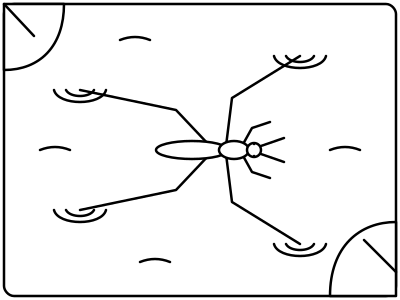
    A water strider stands on top of a pond, its long legs making small dents in the water.

    A water strider stands on top of a pond.

    Use the fix-it moves: reread, look at the picture, break the hard word into parts.

    1. Reread the sentence with the bold words. What is surface tension?
    2. Break the word 'tension' into two parts.
    3. How does the picture help you?

    ea can say long e (seat) or short e (head). Circle the sound.

    1. beachlong eshort e
    2. featherlong eshort e
    3. dreamlong eshort e
    4. heavylong eshort e
    5. breathlong eshort e
    How did it go? Great Okay Tricky

    Science practice · Week 19 · Monday

    I can find out if Earth has more land or more water.

    Globe toss. Catch the globe 20 times. Tally where your right thumb lands.

    Where my thumb landedTallyTotal
    1. Which had more tallies, water or land?
    2. My guess before the toss was ____.

    Show what you found.

    1. Draw a circle for Earth. Color about 3 parts blue for water and 1 part green for land.
    2. Most of Earth's surface is covered by ____.

    You need: a globe, a beach ball globe, or a world map taped to a ball

    How did it go? Great Okay Tricky