Quarter 3Week 19TuesdayDay 92 of 180

    Week 19, Tuesday: Measure objects in centimeters using a ruler · Use a diagram and a caption to explain a science

    Day 92 · 3 lessons · 140 min

    Math

    Students will measure objects in centimeters using a ruler and explain why every measurement starts at 0 (2.MD.A.1).

    Standards Addressed

    Activities

    10 min

    Warm-Up

    Hold up the crayon from yesterday and ask your child to measure it again in inches, this time starting from the end of the ruler instead of the 0 mark, and compare the two answers. Talk about why the answer changed and agree on the rule: 'Always line up the object with 0.'

    crayon12-inch ruler
    15 min

    Mini-Lesson: The Centimeter Side

    Flip the ruler to the centimeter side and show that there are 30 small centimeters on a 12-inch ruler, so a centimeter is shorter than an inch (about the width of a pinky fingernail). Measure a standard paper clip together (about 3 cm) and a new pencil (about 19 cm), writing each as '3 cm' and '19 cm.' Ask: 'Will the pencil measure more centimeters or more inches? Why?'

    ruler with centimeter sidepaper clipnew pencil
    15 min

    Practice: Centimeter Hunt

    Your child finds 6 small items (a key, a spoon, an eraser, a toy car, a playing card, a sticky note) and measures each to the nearest centimeter, recording results on a chart. Then they order the six items from shortest to longest using only their chart numbers, and check by lining the items up.

    keyspoonerasertoy carplaying cardsticky noterulerchart paperpencil
    5 min

    Wrap-Up

    Ask: 'What was the shortest item and how long was it? What was the longest?' Have your child write 'A centimeter is smaller than an inch' in their journal.

    math journalpencil

    Materials Needed

    crayonruler with inch and centimeter sidespaper clipnew pencilkeyspoonerasertoy carplaying cardsticky notechart papermath journalpencil

    English Language Arts

    Students will use a diagram and a caption to explain a science idea from a complex text in their own words (RI.2.10, RI.2.7).

    Standards Addressed

    Activities

    15 min

    Shared Reading

    Read the pages of 'A Drop of Water' about evaporation, condensation, and the steaming kettle. Read each paragraph twice: once straight through, once with your child echoing the sentence that has the science word ('evaporate,' 'condense'). Ask, 'Where did the water go when it disappeared from the glass?'

    A Drop of Water by Walter Wick
    10 min

    Mini-Lesson: Pictures Carry Facts

    Show the photo of frost on the window and cover the words. Ask your child to say three things the picture teaches, then uncover the caption and compare. Say: 'In hard books, the pictures are not decoration; they are part of the explanation.'

    A Drop of Water by Walter Wickpaperpencil
    15 min

    Independent Reading

    Your child reads their nonfiction book for 12 minutes and chooses one diagram or photo to explain to you. They must use the caption and at least one sentence from the page in their explanation.

    leveled nonfiction book
    15 min

    Writing Workshop: Revising with ARMS

    Teach ARMS on a card: Add a detail, Remove a part that does not belong, Move a sentence to a better spot, Substitute a boring word for a better one. Reread the chosen piece together and make two ARMS changes in a colored pencil (for example, add a fact from a book, and swap 'big' for 'enormous'). Support: you point to the sentence that needs a detail and your child supplies it. Stretch: your child makes all four ARMS moves and labels each with its letter in the margin.

    chosen writing pieceARMS cardcolored pencil
    10 min

    Word Study: ow Says Two Things

    Write the words 'snow, grow, throw, own, low, slow' and 'cow, how, now, town, down, brown.' Have your child read each list, then you say a word and they hold up one finger for the /oh/ sound and two for the /ow/ sound. Finish by reading the sentence 'How did the snow blow down to town?' together.

    papermarker

    Materials Needed

    A Drop of Water by Walter Wickleveled nonfiction bookchosen writing pieceARMS cardcolored pencilpapermarkerpencil

    Social Studies

    Students will compare how daily life in the past differs from life today and use the words 'past,' 'present,' and 'long ago' correctly (D2.His.1.K-2, D2.His.2.K-2).

    Standards Addressed

    Activities

    10 min

    Read-Aloud and Discussion

    Read 'When I Was Young in the Mountains' by Cynthia Rylant. Pause on the pages about the pump, the outhouse, and the swimming hole and ask: 'What do we use instead today? How do you know this story happened long ago?'

    When I Was Young in the Mountains by Cynthia Rylant (library)
    15 min

    Hands-On Activity: Then and Now Sort

    Write 12 items on index cards: candle, lamp, horse and wagon, car, washboard, washing machine, letter, video call, ice box, refrigerator, wood stove, microwave. Your child sorts them into a THEN pile and a NOW pile, then pairs each old item with the new item that does the same job. Ask for each pair: 'What job do both of these do?'

    12 index cardsmarker
    5 min

    Quick Write

    Your child completes two sentence frames: 'Long ago, people used ___ to ___.' and 'Today, we use ___ to ___.' Encourage them to pick their favorite pair from the sort.

    notebookpencil

    Materials Needed

    When I Was Young in the Mountains by Cynthia Rylant (library)12 index cardsmarkernotebookpencil

    Today's Practice

    One page for your child for each lesson. Answers are for grown-ups.

    Math practice · Week 19 · Tuesday

    I can measure in centimeters, starting at 0.

    Look: Centimeters

    1. Use the centimeter side of the ruler.
    2. Line up the end of the object with 0.
    3. A centimeter is shorter than an inch, about the width of your pinky nail.

    How long is it? Subtract if it does not start at 0.

    1. A key starts at 0 and ends at 6 cm. How long is it?
    2. A bead starts at 2 and ends at 5 cm. How long is it?
    3. Which is shorter?1 inch1 centimeter

    Measure 4 small things to the nearest centimeter.

    ObjectCentimeters
    1. Write your objects in order from shortest to longest.

    Challenge

    • Will a crayon measure more centimeters or more inches? Why?

    You need: a ruler with a centimeter side

    How did it go? Great Okay Tricky

    ELA practice · Week 19 · Tuesday

    I can use a picture and its caption to explain a science idea.

    Look: A picture and a caption

    1. The picture shows a cold glass with drops on the outside.
    2. The caption says: Water in the air turns to drops on a cold glass.
    3. In my words: cold makes water in the air turn into drops.

    Where Did the Puddle Go?

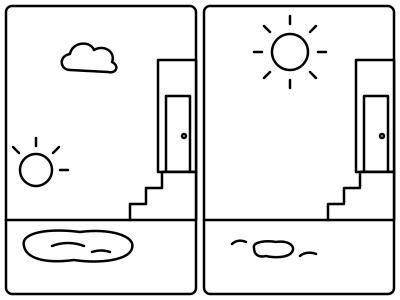
    After the rain, there was a big puddle by the steps. The sun came out and warmed the ground. By the afternoon, the puddle was gone. Some water soaked into the ground. Some turned into a gas you cannot see. This is called evaporation. Warm days make water evaporate faster.

    The same puddle by the steps is big in the morning and small in the afternoon.

    The same puddle in the morning and in the afternoon.

    Use the page above.

    1. What does the caption tell you about the pictures?
    2. In your own words, where did the water go?
    3. ARMS: Substitute a better word. The puddle was big. The puddle was ____.

    ow can say /oh/ (snow) or /ow/ (cow). Circle the sound.

    1. bowl/oh/ as in snow/ow/ as in cow
    2. owl/oh/ as in snow/ow/ as in cow
    3. crowd/oh/ as in snow/ow/ as in cow
    4. show/oh/ as in snow/ow/ as in cow
    How did it go? Great Okay Tricky

    Social Studies practice · Week 19 · Tuesday

    I can compare life long ago with life today.

    Match the old thing with the new thing that does the same job.

    • faucet
    • computer
    • electric fan
    • phone or speaker
    1. Long ago: a well and a bucket. Today: ____
    2. Long ago: a typewriter. Today: ____
    3. Long ago: a hand fan. Today: ____
    4. Long ago: a record player. Today: ____

    Finish the sentences.

    1. Long ago, people used ____ to ____.
    2. Today, we use ____ to ____.
    3. How do you know the story you read today happened long ago?
    How did it go? Great Okay Tricky