Week 19: Measuring Length with Appropriate Tools · Reading Complex Informational Texts

    Quarter 3 · Detailed day-by-day lesson plans · Days 91–95

    0 of 15 lessons done this week

    Measuring Length with Appropriate Tools Reading Complex Informational Texts

    Print

    Worksheets and answer keys

    Gather this week

    • Shop
    • Shop
    • Shop
    • Shop
    • Shop
    • Shop
    Everyday supplies (18)

    Writing prompt

    • Write about your favorite family tradition. What makes it special?
    Writing prompts (from Week 18)

    Parent note

    This week's parent digest

    Specials this week

    Supplements

    This week at a glance

    Week 19 begins measurement: rulers, yardsticks, and tape measures. In ELA, children read more complex informational text and revise writing with peer feedback.

    Parent tip

    Measure five household objects together and record the lengths.

    Materials this week

    Rulers, yardstick, tape measure, peer-revision form

    Mathematics

    Measuring Length with Appropriate Tools

    Measurement & Data · 2.MD.A.1

    Assessment: Measure 6 objects using rulers, yardsticks, and tape measures

    ELA

    Reading Complex Informational Texts

    Phonics: Identify inconsistently spelled words

    Writing: Revising and editing with peer and adult guidance

    Science

    Earth's Systems: Water, Wind & Land

    2-ESS1-1, 2-ESS2-1, 2-ESS2-2, 2-ESS2-3

    Social Studies

    History: Past and Present

    Monday — Day 91

    140 minutes of instruction

    Math

    Students will choose an appropriate tool (ruler, yardstick, or tape measure) and measure the length of an object in inches (2.MD.A.1).

    Standards Addressed

    Activities

    10 min

    Warm-Up

    Lay out 12 paper clips in 3 rows of 4 and have your child write the repeated addition sentence from last week (4 + 4 + 4 = 12). Then line the 12 clips end to end in a single row and ask: 'How could we tell someone exactly how long this row is?' Listen for 'measure it' and 'use a ruler.'

    12 paper clipspaperpencil
    15 min

    Mini-Lesson: Meet the Tools

    Put a 12-inch ruler, a yardstick (or a 36-inch strip of masking tape marked every inch), and a tape measure side by side. Show that each is marked in inches, that measuring starts at the 0 mark (not the end of the wood), and that a ruler is for short things, a yardstick for medium things like a table, and a tape measure for long or curved things. Measure a crayon together (about 3 inches) and say 'The crayon is 3 inches long' while sliding a finger from 0 to 3.

    12-inch ruleryardstick or 36-inch marked tape striptape measurecrayon
    15 min

    Practice: Which Tool?

    Give your child a spoon, a book, the kitchen table, a shoe, and a doorway. For each, they say which tool fits best, measure to the nearest inch, and record the result on a chart with columns for Object, Tool, and Inches (expect roughly spoon 6 in, book 9 in, table 48 in, shoe 8 in, doorway 80 in). Support: pre-mark the 0 end of each tool with a sticker. Stretch: measure the table with the ruler too and count how many times the ruler had to be moved.

    spoonbookshoeruleryardsticktape measurechart paperpencilsticker
    5 min

    Wrap-Up

    Ask: 'Why did you pick the tape measure for the doorway instead of the ruler?' Have your child write one sentence: 'I use a ruler for short things and a tape measure for long things.'

    math journalpencil

    Materials Needed

    12 paper clips12-inch ruleryardstick or 36-inch marked tape striptape measurecrayonspoonbookshoechart paperstickermath journalpencil

    English Language Arts

    Students will read a complex informational text closely, using rereading and text features to make sense of hard sentences (RI.2.10).

    Standards Addressed

    Activities

    15 min

    Read-Aloud

    Introduce 'A Drop of Water: A Book of Science and Wonder' by Walter Wick and read the first six pages (the faucet drop, the splash, and the water striders). Before reading, ask what your child remembers about fables from last week, then explain that this week's book is different: it is true, it is packed with facts, and it will feel harder, so you will read slowly and look at every photo. Pause after each page and ask, 'What did the photo show that the words explained?'

    A Drop of Water by Walter Wick (library)
    10 min

    Mini-Lesson: When a Text Feels Hard

    Write three fix-it moves on an index card: 1. Reread the sentence slowly. 2. Look at the photo or diagram. 3. Find the hard word and break it into parts. Model on the sentence about surface tension: reread it, point to the photo of the water strider, and break 'ten-sion' into parts. Keep the card on the table all week.

    index cardmarker
    15 min

    Guided Reading

    Your child reads a nonfiction book at their level (a National Geographic Kids Reader or a Let's-Read-and-Find-Out title works well) for 12 minutes, marking one hard sentence with a sticky note. Together, apply one of the three fix-it moves to that sentence and have your child explain what it means now.

    leveled nonfiction booksticky notes
    15 min

    Writing Workshop: Choosing a Piece to Revise

    Pull out two informational pieces your child wrote earlier this year (the Unit 2 research piece is ideal). Read both aloud and let your child pick the one they want to make better; they write the title on a fresh 'Revision Plan' sheet and one sentence about why they chose it. Explain that revising means making the writing clearer and more interesting, and editing means fixing spelling and punctuation, and that this week you will do both.

    two earlier informational writing piecesRevision Plan sheet (paper with title line and three boxes)pencil
    10 min

    Word Study: ea Says Two Things

    Write two columns: long e ('bead, leaf, mean, seat, team, clean') and short e ('bread, head, dead, thread, meant, ready'). Read each column, then shuffle the twelve words on index cards and have your child sort and read them. Say: 'When ea does not sound right, try the other sound.'

    12 index cardsmarker

    Materials Needed

    A Drop of Water by Walter Wick (library)leveled nonfiction bookindex cardsmarkersticky notestwo earlier informational writing piecesRevision Plan sheetpencil

    Science

    Students will identify where water and land are found on Earth and build a simple model showing both (2-ESS2-2).

    This week's reading: Land and Water on Earth

    Standards Addressed

    Activities

    5 min

    Science Question of the Week

    Ask: 'If you looked at Earth from space, would you see more land or more water?' Remind your child that last week's engineering showcase was about solving problems, and this unit is about understanding the planet those problems happen on. Record their guess on an index card to check on Friday.

    index cardpencil
    20 min

    Investigation: Globe Toss

    Use a globe, an inflatable globe, or a printed world map taped to a ball. Toss it gently back and forth 20 times; each catch, your child says whether their right thumb landed on water or land and you tally it. Count the tallies together (expect roughly 14 water, 6 land) and ask what that tells us about Earth's surface. Support: use a printed map and a dried bean dropped from above instead of a toss. Stretch: name the ocean or continent under the thumb each time.

    globe or world map taped to a ballpaper for tally markspencil
    5 min

    Wrap-Up

    Your child draws a quick circle 'Earth' and colors roughly three parts blue and one part green to match the tally. Say the key sentence together: 'Most of Earth's surface is covered by water.'

    paperblue and green crayons

    Materials Needed

    globe or world map taped to a ballindex cardpaperpencilblue and green crayonsdried beans (optional)
    Open Monday on its own page
    Science

    Reading About Our World: Land and Water on Earth

    Read it aloud first while your child follows along. Then read it together, and let your child read the parts they can. Talk about the words in the word box.

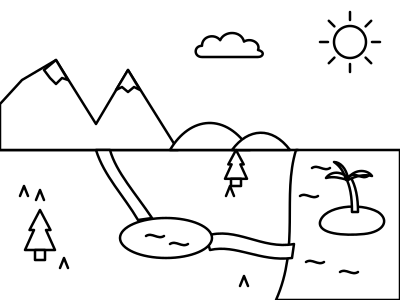
    Look at a globe. You will see a lot of blue. The blue parts show water. The other colors show land.

    Water covers most of Earth. Most of that water is in the oceans. Ocean water is salty, so people cannot drink it.

    Some water is fresh, not salty. Rivers, lakes and ponds hold fresh water. A river is water that flows across the land. Many rivers flow into a lake or an ocean. A lake is water with land all around it. A pond is like a small lake.

    Land comes in many shapes. A mountain is very high land. A hill is lower and rounder. A valley is low land between hills or mountains. A plain is wide, flat land. An island is land with water all around it.

    A lake and an island are opposites. One is water with land all around it. The other is land with water all around it. What land and water can you find near your home?

    Land and water on Earth: mountains, hills and a valley, a river flowing into a lake, the ocean and an island.

    Word box

    fresh water:
    water that is not salty
    river:
    water that flows across the land
    valley:
    low land between hills or mountains
    island:
    land with water all around it

    Questions

    1. Where is most of Earth's water?
    2. Name two places where you can find fresh water.
    3. How is a lake different from an island?

    Weekly check

    Math

    Weekly Check

    • I can measure an object with a ruler the right way.
    • I can choose a ruler, yardstick or tape measure for a job.
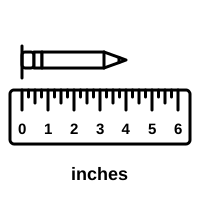
    1. A pencil starts at 0 and ends at 6 on the ruler. How long is it?
    2. A ribbon starts at 1 and ends at 8. How long is it?
    3. Where should you line up the end of an object on a ruler?
    4. Best tool for a swimming pool?ruleryardsticktape measure
    5. Best tool for an eraser?ruleryardsticktape measure
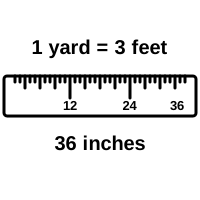
    6. Which tool is 36 inches long?ruleryardsticktape measure

    ELA

    Weekly Check

    • I can read a harder nonfiction text and tell what I learned.
    • I can spell words with tricky patterns like igh and -dge.

    Rivers of Ice

    A glacier is a huge sheet of ice. It can form high in the mountains, where snow piles up year after year. The snow gets packed down into thick ice. A glacier moves downhill very slowly. As it moves, it scrapes the rock under it.

    1. What is a glacier?
    2. Write one thing you learned about glaciers.
    3. Which fix-it move could help you with the word 'glacier'?
    4. Write the word: the dark part of the day (n____)
    5. Write the word: it goes over a river (bri____)
    6. Write the word: not low (h____)
    7. Write the word: the side of a table (e____)

    Science

    Weekly Check

    • I can name kinds of land, like mountains, hills, valleys, plains and islands.
    • I can name bodies of water, like oceans, rivers, lakes and ponds.
    1. Land with water all around itislandvalleyplain
    2. Low land between mountains or hillsislandvalleyplain
    3. Wide, flat landhillvalleyplain
    4. The biggest bodies of salt waterpondsoceansrivers
    5. Water that flows in a long path to a lake or oceanpondriverlake
    6. Name one kind of land that is higher than a hill.

    Social Studies

    Weekly Check

    • I can compare life long ago with life today.
    • I can use the words past, present and future.
    1. Yesterday is in the ____.pastpresentfuture
    2. Right now is the ____.pastpresentfuture
    3. Next summer is in the ____.pastpresentfuture
    4. Long ago, people washed clothes by hand. Today, we use a ____.
    5. Long ago, people read by candlelight. What do we use today?
    6. Tell one way life today is different from long ago.

    Specials

    PE · Kicking, Dribbling & Ball Control · All Specials

    This Week's Specials Page

    PE · Week 19

    I can kick a ball to a target.

    Look: Kicking to a target

    1. Step next to the ball with your other foot.
    2. Kick with the inside of your foot for more control.
    3. Keep your eyes on the ball, then follow through toward the target.

    Set up a goal with two shoes or cones outside or in a big clear space. Kick 10 times from 5 big steps away. Make a tally mark for each goal.

    1. Right foot: ____ goals out of 10
    2. Left foot: ____ goals out of 10
    3. Which foot scored more? Circle one.rightleftthe same

    Think about it.

    1. What part of your foot helped you aim best?

    You need: a soft ball or playground ball, two shoes or cones for a goal

    How did it go? Great Okay Tricky

    Home Connection

    This week at home

    • Math

      Measuring starts at zero with the right tool

    • ELA

      Hard books get easier when I reread

    • Science

      Earth has more water than land

    • Social Studies

      Life long ago was different from today

    Three things to celebrate this week

    We did blank of 4 activities.

    Suggested Daily Schedule

    8:30–9:00 AM30 minMorning Meeting / Calendar / Read-Aloud
    9:00–9:30 AM30 minPhonics / Word Study / Spelling
    9:30–10:15 AM45 minReading Workshop
    10:15–10:35 AM20 minSnack and Outdoor Play / Movement Break
    10:35–11:05 AM30 minWriting Workshop
    11:05–11:50 AM45 minMathematics
    11:50 AM–12:35 PM45 minLunch and Free Play
    12:35–1:05 PM30 minScience OR Social Studies (alternating)
    1:05–1:35 PM30 minSpecials: PE / Art / Music / Health (rotating)
    1:35–2:00 PM25 minIndependent Reading / Enrichment