Quarter 3Week 21MondayDay 101 of 180

    Week 21, Monday: Solve addition word problems about lengths · Ask and answer who, what, where, when, why

    Day 101 · 3 lessons · 140 min

    Math

    Students will solve addition word problems about lengths in the same unit by drawing a picture and writing an equation (2.MD.B.5).

    Standards Addressed

    Activities

    10 min

    Warm-Up

    Your child estimates and then measures a piece of string you cut to 15 inches. Ask: 'If I tie on another string that is 10 inches, how long is the whole string?' Let them add and then tie and measure to check (about 25 inches).

    string cut to 15 inches and 10 inchesruler or tape measure
    15 min

    Mini-Lesson: Adding Lengths

    Read this problem aloud: 'Maya has a ribbon that is 24 inches long. She buys another ribbon that is 18 inches long. How many inches of ribbon does she have altogether?' Draw one long bar split into a 24 part and an 18 part, write 24 + 18 = ?, solve it (42 inches), and check by cutting real ribbon or string to those lengths and measuring the total.

    ribbon or stringruler or tape measurepaperpencil
    15 min

    Practice: Length Stories

    Your child draws a bar model and writes an equation for each of these three problems. 1: 'A garden row of carrots is 36 inches long and a row of beans is 27 inches long. How long are both rows together?' (63 inches). 2: 'Jonah walks 45 meters to the mailbox and then 38 more meters to the park. How far did he walk?' (83 meters). 3: 'A caterpillar crawled 19 centimeters, rested, then crawled 32 more centimeters. How far did it crawl?' (51 cm).

    paperpencilcrayons
    5 min

    Wrap-Up

    Ask: 'What did all three problems have in common?' (putting two lengths together, same unit). Your child writes 'Add lengths when you put them together' in their journal.

    math journalpencil

    Materials Needed

    string cut to 15 inches and 10 inchesribbon or stringruler or tape measurepaperpencilcrayonsmath journal

    English Language Arts

    Students will ask and answer who, what, where, when, why, and how questions about a nonfiction text (RI.2.1).

    Standards Addressed

    Activities

    15 min

    Read-Aloud

    Introduce 'Penguins!' by Gail Gibbons and read the first half (kinds of penguins, where they live, how they swim). Remind your child that last week they asked thick and thin questions; this week the questions get a name: who, what, where, when, why, how. After reading, ask one of each and let your child find the answer on the page.

    Penguins! by Gail Gibbons (library)
    10 min

    Mini-Lesson: The Six Question Words

    Write the six question words on six index cards. Show that 'where' answers point to places, 'when' to times, 'why' to reasons, and 'how' to steps. Put the cards in a cup; draw one and ask a question about penguins using it.

    6 index cardsmarkercup
    15 min

    Guided Reading

    Your child reads a nonfiction book at their level for 12 minutes, then draws two question cards from the cup and asks you a question about their book with each. You answer using only what they read to you.

    leveled nonfiction bookquestion word cards
    15 min

    Writing Workshop: Collective Nouns

    Say: 'A group of penguins is a colony. English has special group words.' List on chart paper: colony of penguins, flock of birds, herd of cows, school of fish, pod of whales, pack of wolves, team of players, class of students, crowd of people, bunch of grapes. Your child writes three sentences about penguins using 'colony' and two other collective nouns.

    chart papermarkerpaperpencil
    10 min

    Word Study: Irregular Words in Sentences

    Review the wall cards 'said, were, come, some, again, friend, because' and add 'there, where, their.' Your child reads each, then writes 'The penguins were cold, so some of them said, come again, friend' from dictation. Circle every irregular word spelled correctly.

    irregular word wall cardspaperpencil

    Materials Needed

    Penguins! by Gail Gibbons (library)leveled nonfiction bookindex cardsmarkercupchart paperirregular word wall cardspaperpencil

    Science

    Students will make a map of a model landscape, using a key with symbols for land and water features (2-ESS2-2).

    This week's reading: Reading a Map of Earth

    Standards Addressed

    Activities

    5 min

    Science Question of the Week

    Show your child last week's hill sketch and ask: 'If a friend had never seen our pan, how could a drawing help them find the lake?' Introduce the goal: a map is a drawing of a place seen from above, with a key that explains the symbols.

    last week's sketch
    20 min

    Investigation: Map the Pan

    Build a fresh pan landscape with a mountain, a river, a lake, and a flat field, and add a pebble 'boulder' and a twig 'tree.' Your child stands on a chair to look straight down and draws what they see on a sheet, then makes a key box with a symbol for each feature (blue wavy line for river, brown triangle for mountain, green dot for tree). Trade places and see if you can find the boulder using only the map.

    baking pandamp sand or soilwaterpebbletwigpapercolored pencilssturdy chair
    5 min

    Wrap-Up

    Ask: 'What does the key do? Why do maps use symbols instead of pictures?' Say together: 'A map shows the shapes of land and water from above.'

    completed map

    Materials Needed

    last week's sketchbaking pandamp sand or soilwaterpebbletwigpapercolored pencilssturdy chair

    Today's Practice

    One page for your child for each lesson. Answers are for grown-ups.

    Math practice · Week 21 · Monday

    I can add lengths with a bar model and an equation.

    Look: 26 inches + 17 inches

    1. Draw one long bar. Split it into a 26 part and a 17 part.
    2. Write the equation: 26 + 17 = ?
    3. Add: 26 + 17 = 43. The whole bar is 43 inches.

    Draw a bar model. Write an equation. Write the answer with the unit.

    1. Ava has a ribbon that is 28 inches long and another that is 34 inches long. How many inches of ribbon does she have?
    2. Kofi's toy train is 46 cm long. He adds a car that is 29 cm long. How long is the train now?
    3. Lin runs 39 meters to the gate. Then she runs 25 more meters to the swings. How far did she run?
    4. A green snake is 18 inches long. A brown snake is 45 inches long. How long are they end to end?

    Challenge

    • What word tells the unit in each answer? Circle it in each problem.
    How did it go? Great Okay Tricky

    ELA practice · Week 21 · Monday

    I can ask and answer who, what, where, when, why and how questions.

    Look: Question words

    1. Read: Tom walked to the park after lunch because it was sunny.
    2. Where? To the park. When? After lunch.
    3. Why? Because it was sunny.

    Sea Otters

    Sea otters live in the cold ocean near the shore. They float on their backs to rest. A group of otters resting together is called a raft. Otters sometimes hold paws when they sleep so they do not drift apart. Sea otters eat clams, crabs and sea urchins. An otter can use a rock to crack a hard shell. Its thick fur keeps it warm in the cold water.

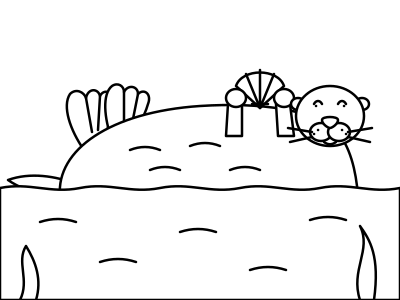
    A sea otter floats on its back in the ocean, holding a shell on its chest.

    Answer each question. Look back at the text.

    1. Where do sea otters live?
    2. What do sea otters eat?
    3. How does an otter crack a hard shell?
    4. Why do otters hold paws when they sleep?

    Write the group word from the box.

    • flock
    • herd
    • pack
    • school
    1. a ________ of fish
    2. a ________ of wolves
    3. a ________ of cows
    4. a ________ of birds

    Challenge

    • Write your own question about sea otters that starts with When.
    How did it go? Great Okay Tricky

    Science practice · Week 21 · Monday

    I can make a map with a key.

    Look straight down at the pan. Draw what you see from above.

    1. My map of the pan:

    Make a key. Draw a symbol for each feature.

    FeatureMy symbol
    1. What does a map key tell you?
    2. Could someone find the boulder using only your map? Why?

    You need: a baking pan, sand or soil, water, a pebble, a twig

    How did it go? Great Okay Tricky