Quarter 3Week 21TuesdayDay 102 of 180

    Week 21, Tuesday: Solve subtraction word problems about lengths · Answer questions with evidence from a nonfiction

    Day 102 · 3 lessons · 140 min

    Math

    Students will solve subtraction word problems about lengths (cutting off, using up, comparing) with drawings and equations (2.MD.B.5).

    Standards Addressed

    Activities

    10 min

    Warm-Up

    Hold a 30-centimeter strip of paper and cut off 12 centimeters. Ask: 'How long is what is left?' Your child writes 30 - 12 = 18 and measures the leftover piece to confirm.

    paper strip cut to 30 cmrulerscissors
    15 min

    Mini-Lesson: Taking Lengths Away

    Read: 'A rope is 50 feet long. Dad cuts off 23 feet to make a swing. How much rope is left?' Draw a 50 bar, shade the 23 part that is cut away, and write 50 - 23 = ? (27 feet). Then read a comparison problem: 'Lena jumped 42 inches. Ben jumped 35 inches. How much farther did Lena jump?' Draw two bars lined up at the left, and write 42 - 35 = 7 inches.

    paperpencilcrayons
    15 min

    Practice: Cut It, Compare It

    Your child solves three problems with a bar drawing and an equation. 1: 'A string is 64 centimeters long. Priya uses 29 centimeters for a bracelet. How much string is left?' (35 cm). 2: 'A snake is 58 inches long. A lizard is 21 inches long. How much longer is the snake?' (37 inches). 3: 'A hallway is 90 feet. Sam has walked 47 feet. How many more feet until the end?' (43 feet). Support: act out problem 1 with real string and scissors. Stretch: write a fourth subtraction length problem and solve it.

    stringrulerscissorspaperpencil
    5 min

    Wrap-Up

    Ask: 'How did you know each problem was subtraction?' Listen for 'cut off,' 'used,' 'how much longer,' and 'how many more.'

    math journalpencil

    Materials Needed

    paper strip cut to 30 cmstringrulerscissorspaperpencilcrayonsmath journal

    English Language Arts

    Students will answer questions with evidence from a nonfiction text and use irregular plural nouns correctly (RI.2.1, L.2.1b).

    Standards Addressed

    Activities

    15 min

    Shared Reading

    Read the second half of 'Penguins!' (nests, eggs, chicks, dangers). Your child reads the labels on the diagrams while you read the paragraphs. Ask 'How does a father emperor penguin keep the egg warm?' and 'Why do chicks huddle?' and have your child put a finger on the sentence that answers each.

    Penguins! by Gail Gibbons
    10 min

    Mini-Lesson: Prove It

    Write 'The book says...' on an index card. Ask a why question and model answering with 'The book says penguins huddle because they share warmth.' Say: 'An answer is not done until you can say where it came from.'

    index cardmarker
    15 min

    Independent Reading

    Your child reads their nonfiction book for 12 minutes and answers one why or how question you write on a sticky note before they begin. Their answer must start with 'The book says.'

    leveled nonfiction booksticky notespencil
    15 min

    Writing Workshop: Irregular Plurals

    Write 'one foot, two feet; one tooth, two teeth; one mouse, two mice; one child, two children; one goose, two geese; one man, two men; one woman, two women; one fish, two fish; one sheep, two sheep; one deer, two deer.' Your child reads the pairs, then writes four sentences about penguins and their neighbors using at least three irregular plurals (for example, 'Penguins have two feet and no teeth.'). Support: provide sentence frames with the plural blank. Stretch: add two more pairs they know (mouse and mice already given, so try 'person, people' and 'leaf, leaves').

    paperpencil
    10 min

    Word Study: Irregular Past Tense Verbs

    Write 'go, went; come, came; run, ran; see, saw; give, gave; take, took; eat, ate; have, had.' Read the pairs, then say a present verb and have your child say and write the past form. Dictate 'The penguin went to the sea and ate some fish.'

    paperpencil

    Materials Needed

    Penguins! by Gail Gibbonsleveled nonfiction bookindex cardmarkersticky notespaperpencil

    Social Studies

    Students will name specific Native American nations, describe how the Cherokee people expressed gratitude across the seasons, and understand that these nations exist today (D2.His.2.K-2, D2.His.3.K-2, D2.Geo.5.K-2).

    Activities

    10 min

    Read-Aloud and Discussion

    Read 'We Are Grateful: Otsaliheliga' by Traci Sorell, who is a citizen of the Cherokee Nation. Point out that the family in the book lives today, with cars and basketball and ceremonies all at once. Ask: 'What are the Cherokee people grateful for in each season? Which of those things does your family also enjoy?'

    We Are Grateful: Otsaliheliga by Traci Sorell (library)
    15 min

    Hands-On Activity: Nations Map

    On a printed outline map of the United States, help your child label four nations and their homelands: Lenape (around the Delaware River, New York and New Jersey), Haudenosaunee (New York), Cherokee (southern Appalachian Mountains, with the Cherokee Nation in Oklahoma today), and Navajo, or Dine (Arizona, New Mexico, Utah). Then find your own state and look up together which nation's homeland it is. Explain that many nations were forced to move, and that all four still have governments and citizens today.

    printed outline map of the United Statescolored pencilslibrary book or adult-supervised internet lookup
    5 min

    Quick Write

    Your child writes: 'The ___ people live in ___. Today they ___.' using one nation from the map.

    notebookpencil

    Materials Needed

    We Are Grateful: Otsaliheliga by Traci Sorell (library)printed outline map of the United Statescolored pencilsnotebookpencil

    Today's Practice

    One page for your child for each lesson. Answers are for grown-ups.

    Math practice · Week 21 · Tuesday

    I can subtract lengths to find what is left or how much longer.

    Look: 60 cm − 24 cm

    1. Draw a bar for 60 cm.
    2. Shade the 24 cm part that is cut off.
    3. Subtract: 60 − 24 = 36. There are 36 cm left.

    Draw a bar model. Write an equation. Write the answer with the unit.

    1. A ribbon is 72 inches long. Mia cuts off 35 inches. How much ribbon is left?
    2. A red fence is 81 feet long. A white fence is 46 feet long. How much longer is the red fence?
    3. Omar has a paper strip that is 55 cm long. He uses 19 cm. How much is left?
    4. A path is 90 meters long. Grace has walked 64 meters. How many more meters to the end?

    Challenge

    • Underline the words that told you to subtract.
    How did it go? Great Okay Tricky

    ELA practice · Week 21 · Tuesday

    I can prove my answer with the text and use irregular plurals.

    Look: Prove it

    1. Text: Ducks have oily feathers, so water rolls off them.
    2. Question: Why does water roll off ducks?
    3. Answer: The text says ducks have oily feathers.

    Geese on the Move

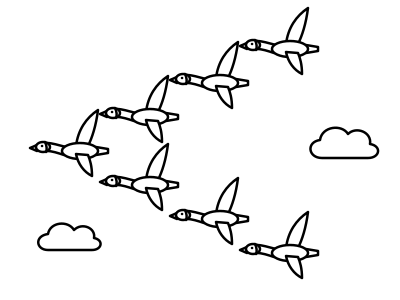
    In the fall, many geese fly south in a big V. Flying in a V helps them save energy. Each goose takes a turn in front. When the lead goose gets tired, it moves back, and another goose flies to the front. Geese honk to stay together. In the spring, the geese fly north again to lay eggs.

    Seven geese fly across the sky in a V.

    Answer. Start with "The text says."

    1. Why do geese fly in a V?
    2. What happens when the lead goose gets tired?

    Write the right word.

    1. one goose, two ________
    2. one tooth, two ________
    3. one sheep, two ________
    4. one person, two ________
    5. Today I go. Yesterday I ________.
    6. Today I see. Yesterday I ________.
    How did it go? Great Okay Tricky

    Social Studies practice · Week 21 · Tuesday

    I can name Native American nations and where they live.

    Use your map. Write the nation from the box.

    • Lenape
    • Haudenosaunee
    • Cherokee
    • Navajo (Diné)
    1. Their homeland is around the Delaware River.
    2. Their homeland is in New York.
    3. Their homeland is in the southern Appalachian Mountains. Many citizens live in Oklahoma today.
    4. Their nation has land in Arizona, New Mexico and Utah.

    Write about a nation.

    1. The Cherokee word otsaliheliga means "we are ________."
    2. Our state is ____________. It is the homeland of the ____________ people.
    3. The ________ people live in ________. Today they ________.

    You need: an outline map of the United States

    How did it go? Great Okay Tricky