Week 21: Relating Addition/Subtraction to Length · Asking and Answering Questions (Nonfiction)

    Quarter 3 · Detailed day-by-day lesson plans · Days 101–105

    0 of 15 lessons done this week

    Relating Addition/Subtraction to Length Asking and Answering Questions (Nonfiction)

    Print

    Worksheets and answer keys

    Gather this week

    • Shop
    • Shop
    • Shop
    • Shop
    • Shop
    • Shop
    Everyday supplies (8)

    Writing prompt

    • What is the most important rule in your house? Why does it matter?
    Week 21 writing prompts

    Parent note

    This week's parent digest

    This week at a glance

    Week 21 connects addition and subtraction to length through word problems. In ELA, writers practice collective nouns and irregular plurals while readers tackle nonfiction questions.

    Parent tip

    Plan a trip 'how much further to grandma's?' as a measurement problem.

    Materials this week

    Tape measure, road map or stroll path, grammar reference

    Mathematics

    Relating Addition/Subtraction to Length

    Measurement & Data · 2.MD.A.1

    Assessment: Solve word problems involving lengths using drawings and equations

    ELA

    Asking and Answering Questions (Nonfiction)

    Phonics: Irregular verb spelling patterns (e.g., said, were)

    Writing: Collective nouns and irregular plurals in writing

    Science

    Earth's Systems: Water, Wind & Land

    2-ESS1-1, 2-ESS2-1, 2-ESS2-2, 2-ESS2-3

    Social Studies

    History: Past and Present

    Monday — Day 101

    140 minutes of instruction

    Math

    Students will solve addition word problems about lengths in the same unit by drawing a picture and writing an equation (2.MD.B.5).

    Standards Addressed

    Activities

    10 min

    Warm-Up

    Your child estimates and then measures a piece of string you cut to 15 inches. Ask: 'If I tie on another string that is 10 inches, how long is the whole string?' Let them add and then tie and measure to check (about 25 inches).

    string cut to 15 inches and 10 inchesruler or tape measure
    15 min

    Mini-Lesson: Adding Lengths

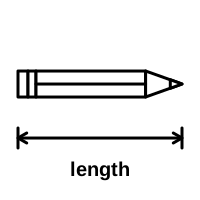
    Read this problem aloud: 'Maya has a ribbon that is 24 inches long. She buys another ribbon that is 18 inches long. How many inches of ribbon does she have altogether?' Draw one long bar split into a 24 part and an 18 part, write 24 + 18 = ?, solve it (42 inches), and check by cutting real ribbon or string to those lengths and measuring the total.

    ribbon or stringruler or tape measurepaperpencil
    15 min

    Practice: Length Stories

    Your child draws a bar model and writes an equation for each of these three problems. 1: 'A garden row of carrots is 36 inches long and a row of beans is 27 inches long. How long are both rows together?' (63 inches). 2: 'Jonah walks 45 meters to the mailbox and then 38 more meters to the park. How far did he walk?' (83 meters). 3: 'A caterpillar crawled 19 centimeters, rested, then crawled 32 more centimeters. How far did it crawl?' (51 cm).

    paperpencilcrayons
    5 min

    Wrap-Up

    Ask: 'What did all three problems have in common?' (putting two lengths together, same unit). Your child writes 'Add lengths when you put them together' in their journal.

    math journalpencil

    Materials Needed

    string cut to 15 inches and 10 inchesribbon or stringruler or tape measurepaperpencilcrayonsmath journal

    English Language Arts

    Students will ask and answer who, what, where, when, why, and how questions about a nonfiction text (RI.2.1).

    Standards Addressed

    Activities

    15 min

    Read-Aloud

    Introduce 'Penguins!' by Gail Gibbons and read the first half (kinds of penguins, where they live, how they swim). Remind your child that last week they asked thick and thin questions; this week the questions get a name: who, what, where, when, why, how. After reading, ask one of each and let your child find the answer on the page.

    Penguins! by Gail Gibbons (library)
    10 min

    Mini-Lesson: The Six Question Words

    Write the six question words on six index cards. Show that 'where' answers point to places, 'when' to times, 'why' to reasons, and 'how' to steps. Put the cards in a cup; draw one and ask a question about penguins using it.

    6 index cardsmarkercup
    15 min

    Guided Reading

    Your child reads a nonfiction book at their level for 12 minutes, then draws two question cards from the cup and asks you a question about their book with each. You answer using only what they read to you.

    leveled nonfiction bookquestion word cards
    15 min

    Writing Workshop: Collective Nouns

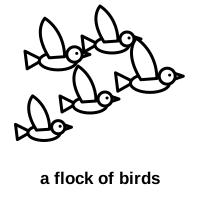
    Say: 'A group of penguins is a colony. English has special group words.' List on chart paper: colony of penguins, flock of birds, herd of cows, school of fish, pod of whales, pack of wolves, team of players, class of students, crowd of people, bunch of grapes. Your child writes three sentences about penguins using 'colony' and two other collective nouns.

    chart papermarkerpaperpencil
    10 min

    Word Study: Irregular Words in Sentences

    Review the wall cards 'said, were, come, some, again, friend, because' and add 'there, where, their.' Your child reads each, then writes 'The penguins were cold, so some of them said, come again, friend' from dictation. Circle every irregular word spelled correctly.

    irregular word wall cardspaperpencil

    Materials Needed

    Penguins! by Gail Gibbons (library)leveled nonfiction bookindex cardsmarkercupchart paperirregular word wall cardspaperpencil

    Science

    Students will make a map of a model landscape, using a key with symbols for land and water features (2-ESS2-2).

    This week's reading: Reading a Map of Earth

    Standards Addressed

    Activities

    5 min

    Science Question of the Week

    Show your child last week's hill sketch and ask: 'If a friend had never seen our pan, how could a drawing help them find the lake?' Introduce the goal: a map is a drawing of a place seen from above, with a key that explains the symbols.

    last week's sketch
    20 min

    Investigation: Map the Pan

    Build a fresh pan landscape with a mountain, a river, a lake, and a flat field, and add a pebble 'boulder' and a twig 'tree.' Your child stands on a chair to look straight down and draws what they see on a sheet, then makes a key box with a symbol for each feature (blue wavy line for river, brown triangle for mountain, green dot for tree). Trade places and see if you can find the boulder using only the map.

    baking pandamp sand or soilwaterpebbletwigpapercolored pencilssturdy chair
    5 min

    Wrap-Up

    Ask: 'What does the key do? Why do maps use symbols instead of pictures?' Say together: 'A map shows the shapes of land and water from above.'

    completed map

    Materials Needed

    last week's sketchbaking pandamp sand or soilwaterpebbletwigpapercolored pencilssturdy chair
    Open Monday on its own page
    Science

    Reading About Our World: Reading a Map of Earth

    Read it aloud first while your child follows along. Then read it together, and let your child read the parts they can. Talk about the words in the word box.

    What Maps Show

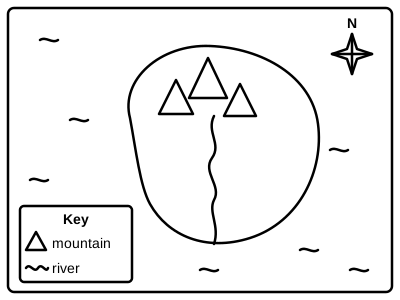
    A map is a flat drawing of a place. Maps can show land and water. They can show mountains, rivers, lakes and oceans.

    The Map Key

    A map key tells what the colors and symbols on a map mean. On many maps, blue means water. A small triangle can stand for a mountain. A wiggly blue line can stand for a river.

    Finding Your Way

    A compass rose shows directions: north, south, east and west. On most maps, north is at the top.

    High and Low Land

    Some maps use colors to show how high the land is. Mountains might be brown. Low, flat land might be green. Always check the map key to be sure.

    Scientists and travelers use maps to find rivers, lakes and mountains. Try drawing a map of a park with its own map key!

    A map of an island with three mountains shown as triangles, a river, a compass rose and a map key.

    Picture caption: A map of an island. The key shows that a triangle means a mountain.

    Word box

    map:
    a flat drawing of a place
    map key:
    the part of a map that tells what its colors and symbols mean
    symbol:
    a small picture or mark that stands for something
    compass rose:
    a drawing on a map that shows north, south, east and west

    Questions

    1. Which heading would help you learn about north and south?
    2. What do the bold words "map key" mean?
    3. What does the caption tell you?

    Weekly check

    Math

    Weekly Check

    • I can solve word problems about length.
    • I can draw a picture or bar model to show a length problem.
    1. Jada's ribbon is 38 inches. Theo's ribbon is 47 inches. How long are both together?
    2. A board is 64 cm long. 27 cm is cut off. How much is left?
    3. A whale is 52 feet long. A shark is 18 feet long. How much longer is the whale?
    4. Two ropes together are 90 meters long. One rope is 57 meters. How long is the other?
    5. Draw a bar model. Solve: Eli walks 26 meters and then 45 more meters. How far does he walk?

    ELA

    Weekly Check

    • I can ask and answer questions about a nonfiction text.
    • I can use irregular verbs and irregular plurals.

    Honeybees

    Honeybees live in a hive. A big group of bees that lives together is called a colony. Worker bees make honey from the nectar of flowers. When a bee finds flowers, it does a dance to show the other bees where to go.

    1. Where do honeybees live?
    2. What do worker bees make?
    3. How does a bee show other bees where the flowers are?
    4. What is the group word for bees?
    5. one mouse, two ________
    6. Yesterday my friend ________ (come) to play.

    Science

    Weekly Check

    • I can use a map to find land and water features.
    • I can use a map key to read symbols.
    1. What does a map key show?
    2. A map shows a place from ________.abovethe side
    3. On most maps, what does blue show?
    4. A wavy blue line on a map is most likely a ________.riverroadmountain
    5. The key shows a green dot for a tree. What does a green dot on the map mean?
    6. Name one land feature and one water feature.

    Social Studies

    Weekly Check

    • I can name some Native American nations and where they live today.
    • I can explain that Native American nations are living nations that keep their languages and traditions.
    1. Name two Native American nations.
    2. Where is the Navajo (Diné) Nation today?
    3. Native American nations are only in the past.truefalse
    4. Native American nations today have their own governments.truefalse
    5. Name one thing a Native American nation keeps alive today.

    Specials

    Art · Value, Self-Expression & Portraits · All Specials

    This Week's Specials Page

    Art · Week 21

    I can show light and dark in my art.

    Look: Value

    1. Value means how light or dark a color is.
    2. Press lightly for a light value. Press hard for a dark value.
    3. Add white to a color to make a tint. Add black to make a shade.

    Value strip. Use a pencil. Fill the boxes from lightest to darkest.

    1 lightest2345 darkest
    1. Pink is red plus white. Is pink a tint or a shade?tintshade

    Feeling faces. Look in a mirror and make each face. Then draw it.

    1. happy
    2. surprised
    3. Pick a color that matches one of your faces. Why did you pick it?

    You need: a pencil, crayons, a small mirror (unbreakable if you have one)

    How did it go? Great Okay Tricky

    Home Connection

    This week at home

    • Math

      Adding and taking away lengths with bar drawings

    • ELA

      Asking who, what, where, when, why, how

    • Science

      Maps use keys to show land and water

    • Social Studies

      Native American nations live and thrive today

    Three things to celebrate this week

    We did blank of 4 activities.

    Suggested Daily Schedule

    8:30–9:00 AM30 minMorning Meeting / Calendar / Read-Aloud
    9:00–9:30 AM30 minPhonics / Word Study / Spelling
    9:30–10:15 AM45 minReading Workshop
    10:15–10:35 AM20 minSnack and Outdoor Play / Movement Break
    10:35–11:05 AM30 minWriting Workshop
    11:05–11:50 AM45 minMathematics
    11:50 AM–12:35 PM45 minLunch and Free Play
    12:35–1:05 PM30 minScience OR Social Studies (alternating)
    1:05–1:35 PM30 minSpecials: PE / Art / Music / Health (rotating)
    1:35–2:00 PM25 minIndependent Reading / Enrichment