Quarter 3Week 22MondayDay 106 of 180

    Week 22, Monday: Build a number line with equally spaced points · Retell a story in order, including the central

    Day 106 · 3 lessons · 140 min

    Math

    Students will build a number line with equally spaced points and locate whole numbers on it (2.MD.B.6).

    Standards Addressed

    Activities

    10 min

    Warm-Up

    Lay a ruler on the table and ask your child to point to 4, then 9, then 12, and to explain how they knew where 9 was (count the marks, or 'one before 10'). Ask: 'What is the same about a ruler and a number line?'

    ruler
    15 min

    Mini-Lesson: A Ruler Is a Number Line

    Together, tape a 24-inch strip of paper to the floor and use the ruler to mark and label every inch from 0 to 20 so the spaces are all equal. Explain that 0 is where we start, each hop is one unit, and the numbers must be the same distance apart. Have your child place a paper clip on 7, a bean on 13, and a coin on 18, checking by counting hops from 0.

    paper strip 24 inches longmasking taperulermarkerpaper clipdried beancoin
    15 min

    Practice: Where Does It Go?

    On paper, your child draws a number line from 0 to 20 with tick marks 1 centimeter apart using the ruler, then places dots for 3, 8, 11, 15, and 19 and labels them. Next they draw a second line from 0 to 100 marked by tens and place 30, 70, and 90. Support: give them a pre-drawn line with only 0, 10, and 20 labeled. Stretch: on the 0 to 100 line, estimate where 45 and 82 belong.

    paperrulerpencil
    5 min

    Wrap-Up

    Ask: 'Why do the spaces on a number line have to be equal?' Your child writes 'A number line is like a ruler with equal spaces' in their journal.

    math journalpencil

    Materials Needed

    rulerpaper strip 24 inches longmasking tapemarkerpaper clipdried beancoinpapermath journalpencil

    English Language Arts

    Students will retell a story in order, including the central message, and read aloud with accuracy (RL.2.2, RF.2.4b).

    Standards Addressed

    Activities

    15 min

    Read-Aloud

    Read 'Owl Moon' by Jane Yolen all the way through, slowly, in a near-whisper to match the story. Before reading, note that last week's books were about real penguins and this week's book is a story, so you will retell it instead of asking fact questions. Afterward, ask, 'What did the child have to do to see the owl?'

    Owl Moon by Jane Yolen (library)
    10 min

    Mini-Lesson: Retelling with Five Fingers

    Hold up a hand: thumb for characters, pointer for setting, middle for beginning, ring for middle, pinky for end, and the palm for the lesson. Retell 'Owl Moon' together, touching each finger. Write the six parts on a card for the week.

    index cardmarker
    15 min

    Guided Reading

    Your child reads a story at their level for 12 minutes and retells it to you using the five-finger card. Notice whether they include the ending and the lesson, and prompt for whichever is missing.

    leveled storybookfive-finger card
    15 min

    Writing Workshop: Reflexive Pronouns

    Write 'myself, yourself, himself, herself, itself, ourselves, yourselves, themselves' on chart paper. Explain that these point back to the person doing the action: 'The child kept herself quiet.' Your child writes four sentences about 'Owl Moon' using four different reflexive pronouns, then circles the noun each one points back to.

    chart papermarkerpaperpencil
    10 min

    Word Study: Words from Owl Moon

    Write 'shadow, meadow, silent, whisper, shrugged, echo, disappeared, stained, threaded, watching.' Read each word, clap the syllables, and find it in the book. Have your child read the list three times, aiming to read it faster and smoother each time.

    papermarkerOwl Moon by Jane Yolen

    Materials Needed

    Owl Moon by Jane Yolen (library)leveled storybookindex cardchart papermarkerpaperpencil

    Science

    Students will identify where water exists on Earth as solid ice and as liquid, and observe how water changes between the two (2-ESS2-3).

    Standards Addressed

    Activities

    5 min

    Science Question of the Week

    Point to the white areas at the top and bottom of the globe. Ask: 'Is that land or water?' (It is water, frozen solid.) Remind your child that last week's maps showed blue for liquid water, and ask where else water might be hiding as ice or snow. Write their list.

    globe or world mapnotebook
    20 min

    Investigation: Ice Race

    Set three same-size ice cubes on three plates: one on the counter, one in a sunny window or under a lamp, one wrapped in a washcloth. Predict which will melt first and record the time each turns fully to liquid. While waiting, look at photos in a library book such as 'Ice Is Nice!' from the Cat in the Hat's Learning Library or a National Geographic Kids reader about polar animals and name where ice is found: glaciers, ice caps, frozen lakes, snow on mountains.

    3 ice cubes3 plateswashclothlamp or sunny windowtimernotebooklibrary book about ice or polar regions
    5 min

    Wrap-Up

    Your child records the melt order and writes: 'Water can be solid (ice) or liquid. Heat makes ice melt.' Ask: 'What would make liquid water turn back into ice?'

    notebookpencil

    Materials Needed

    globe or world map3 ice cubes3 plateswashclothlamp or sunny windowtimernotebookpencillibrary book about ice or polar regions

    Today's Practice

    One page for your child for each lesson. Answers are for grown-ups.

    Math practice · Week 22 · Monday

    I can put numbers on a number line with equal spaces.

    Look: Where is 6?

    1. Start at 0.
    2. Every space is the same size, like a ruler.
    3. Count 6 hops from 0 and put a dot on 6.

    Use a ruler. Draw a number line from 0 to 20 with marks 1 cm apart.

    1. Put a dot on 4, 9, 13 and 17. Label each dot.
    2. What number is 3 hops after 10?

    Draw a number line from 0 to 100 marked by tens.

    1. Put a dot on 20, 60 and 80.
    2. What number is halfway between 40 and 50?
    3. Sam drew a line. The space from 0 to 1 is big. The space from 1 to 2 is tiny. Is it a good number line?yesno

    You need: a centimeter ruler

    How did it go? Great Okay Tricky

    ELA practice · Week 22 · Monday

    I can retell a story in order and tell its lesson.

    Look: Five-finger retell

    1. Thumb: Max and his dog. Pointer: the beach.
    2. Middle: Max loses his cap. Ring: he looks and looks. Pinky: his dog digs it out of the sand.
    3. Palm: friends help each other.

    The Stuck Kite

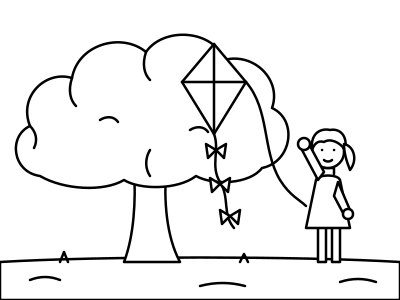
    Nora got a red kite for her birthday. On a windy day, she ran to the park with Grandpa. The kite flew high. Then the string slipped from her hand! The kite got stuck in a tall tree. Nora wanted to cry. Grandpa said, "Let's wait." They sat on a bench and ate apples. After a while, a big gust of wind shook the tree, and the kite fell down. Nora hugged it. Waiting had worked.

    A red kite is stuck high in a tall tree while a girl points up at it.

    Retell the story with your five fingers.

    1. Thumb (characters):
    2. Pointer (setting):
    3. Middle (beginning):
    4. Ring (middle):
    5. Pinky (end):
    6. Palm (lesson):

    Write the word that points back: himself or ourselves.

    1. Grandpa made ________ a sandwich.
    2. We cleaned up the park by ________.
    How did it go? Great Okay Tricky

    Science practice · Week 22 · Monday

    I can tell that water can be solid ice or liquid.

    Ice race: guess which cube melts first. Then write the time each one melts.

    Where the ice isMy guess (1st, 2nd, 3rd)Time it melted
    1. Which ice cube melted first?
    2. What made the ice melt?
    3. What would make the water turn back into ice?

    Think about Earth.

    1. Name two places on Earth where water is ice or snow.

    You need: 3 ice cubes, 3 plates, a washcloth, a clock or timer

    How did it go? Great Okay Tricky