Week 22: Number Lines and Length Models · Retelling with Central Message Focus

    Quarter 3 · Detailed day-by-day lesson plans · Days 106–110

    0 of 15 lessons done this week

    Number Lines and Length Models Retelling with Central Message Focus

    Print

    Worksheets and answer keys

    Gather this week

    • Shop
    • Shop
    • Shop
    • Shop
    • Shop
    • Shop
    Everyday supplies (9)

    Writing prompt

    • Describe the parts of a plant and what each part does.
    Week 22 writing prompts

    Parent note

    This week's parent digest

    This week at a glance

    Week 22 places whole numbers on number lines to solve addition and subtraction. Readers retell stories with central-message focus, and writers practice reflexive pronouns.

    Parent tip

    Draw a sidewalk number line in chalk and 'jump' to add numbers.

    Materials this week

    Sidewalk chalk, blank number lines, familiar storybook

    Mathematics

    Number Lines and Length Models

    Measurement & Data · 2.MD.A.1

    Assessment: Represent whole numbers on a number line; solve addition/subtraction on number lines

    ELA

    Retelling with Central Message Focus

    Phonics: Reading fluency: accuracy, rate, expression

    Writing: Reflexive pronouns; adjective and adverb usage

    Science

    Earth's Systems: Water, Wind & Land

    2-ESS1-1, 2-ESS2-1, 2-ESS2-2, 2-ESS2-3

    Social Studies

    History: Past and Present

    Monday — Day 106

    140 minutes of instruction

    Math

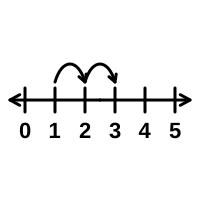
    Students will build a number line with equally spaced points and locate whole numbers on it (2.MD.B.6).

    Standards Addressed

    Activities

    10 min

    Warm-Up

    Lay a ruler on the table and ask your child to point to 4, then 9, then 12, and to explain how they knew where 9 was (count the marks, or 'one before 10'). Ask: 'What is the same about a ruler and a number line?'

    ruler
    15 min

    Mini-Lesson: A Ruler Is a Number Line

    Together, tape a 24-inch strip of paper to the floor and use the ruler to mark and label every inch from 0 to 20 so the spaces are all equal. Explain that 0 is where we start, each hop is one unit, and the numbers must be the same distance apart. Have your child place a paper clip on 7, a bean on 13, and a coin on 18, checking by counting hops from 0.

    paper strip 24 inches longmasking taperulermarkerpaper clipdried beancoin
    15 min

    Practice: Where Does It Go?

    On paper, your child draws a number line from 0 to 20 with tick marks 1 centimeter apart using the ruler, then places dots for 3, 8, 11, 15, and 19 and labels them. Next they draw a second line from 0 to 100 marked by tens and place 30, 70, and 90. Support: give them a pre-drawn line with only 0, 10, and 20 labeled. Stretch: on the 0 to 100 line, estimate where 45 and 82 belong.

    paperrulerpencil
    5 min

    Wrap-Up

    Ask: 'Why do the spaces on a number line have to be equal?' Your child writes 'A number line is like a ruler with equal spaces' in their journal.

    math journalpencil

    Materials Needed

    rulerpaper strip 24 inches longmasking tapemarkerpaper clipdried beancoinpapermath journalpencil

    English Language Arts

    Students will retell a story in order, including the central message, and read aloud with accuracy (RL.2.2, RF.2.4b).

    Standards Addressed

    Activities

    15 min

    Read-Aloud

    Read 'Owl Moon' by Jane Yolen all the way through, slowly, in a near-whisper to match the story. Before reading, note that last week's books were about real penguins and this week's book is a story, so you will retell it instead of asking fact questions. Afterward, ask, 'What did the child have to do to see the owl?'

    Owl Moon by Jane Yolen (library)
    10 min

    Mini-Lesson: Retelling with Five Fingers

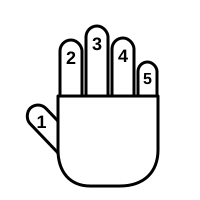
    Hold up a hand: thumb for characters, pointer for setting, middle for beginning, ring for middle, pinky for end, and the palm for the lesson. Retell 'Owl Moon' together, touching each finger. Write the six parts on a card for the week.

    index cardmarker
    15 min

    Guided Reading

    Your child reads a story at their level for 12 minutes and retells it to you using the five-finger card. Notice whether they include the ending and the lesson, and prompt for whichever is missing.

    leveled storybookfive-finger card
    15 min

    Writing Workshop: Reflexive Pronouns

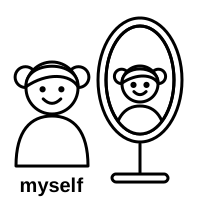
    Write 'myself, yourself, himself, herself, itself, ourselves, yourselves, themselves' on chart paper. Explain that these point back to the person doing the action: 'The child kept herself quiet.' Your child writes four sentences about 'Owl Moon' using four different reflexive pronouns, then circles the noun each one points back to.

    chart papermarkerpaperpencil
    10 min

    Word Study: Words from Owl Moon

    Write 'shadow, meadow, silent, whisper, shrugged, echo, disappeared, stained, threaded, watching.' Read each word, clap the syllables, and find it in the book. Have your child read the list three times, aiming to read it faster and smoother each time.

    papermarkerOwl Moon by Jane Yolen

    Materials Needed

    Owl Moon by Jane Yolen (library)leveled storybookindex cardchart papermarkerpaperpencil

    Science

    Students will identify where water exists on Earth as solid ice and as liquid, and observe how water changes between the two (2-ESS2-3).

    Standards Addressed

    Activities

    5 min

    Science Question of the Week

    Point to the white areas at the top and bottom of the globe. Ask: 'Is that land or water?' (It is water, frozen solid.) Remind your child that last week's maps showed blue for liquid water, and ask where else water might be hiding as ice or snow. Write their list.

    globe or world mapnotebook
    20 min

    Investigation: Ice Race

    Set three same-size ice cubes on three plates: one on the counter, one in a sunny window or under a lamp, one wrapped in a washcloth. Predict which will melt first and record the time each turns fully to liquid. While waiting, look at photos in a library book such as 'Ice Is Nice!' from the Cat in the Hat's Learning Library or a National Geographic Kids reader about polar animals and name where ice is found: glaciers, ice caps, frozen lakes, snow on mountains.

    3 ice cubes3 plateswashclothlamp or sunny windowtimernotebooklibrary book about ice or polar regions
    5 min

    Wrap-Up

    Your child records the melt order and writes: 'Water can be solid (ice) or liquid. Heat makes ice melt.' Ask: 'What would make liquid water turn back into ice?'

    notebookpencil

    Materials Needed

    globe or world map3 ice cubes3 plateswashclothlamp or sunny windowtimernotebookpencillibrary book about ice or polar regions
    Open Monday on its own page
    Social Studies

    Reading About Our World: Two Peoples at Plymouth

    Read it aloud first while your child follows along. Then read it together, and let your child read the parts they can. Talk about the words in the word box.

    The Wampanoag people have lived in the land that is now Massachusetts for thousands of years. Long ago, they fished, hunted and grew corn, beans and squash.

    In 1620, a ship called the Mayflower sailed from England. It carried about 100 people. Many of them wanted to worship in their own way. Today we often call them the Pilgrims.

    The settlers arrived as winter began. They built homes at a place they named Plymouth. The first winter was very hard, and about half of the settlers died.

    In the spring, the Wampanoag leader Massasoit made an agreement of peace with the settlers. A man named Tisquantum, also called Squanto, spoke English. He showed the settlers how to grow corn.

    The two groups saw things differently. The settlers saw a new home. The Wampanoag saw strangers building on their land. As more settlers came, they took more land, and the peace did not last.

    The Wampanoag Nation is still here today. Wampanoag people live in Massachusetts and keep their language and traditions alive.

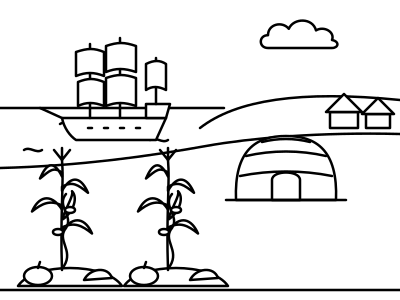
    A sailing ship near the shore at Plymouth, a Wampanoag wetu home, and gardens of corn, beans and squash.

    Word box

    settler:
    a person who moves to a new place to live
    nation:
    a group of people with their own land, leaders and ways of life
    agreement:
    a promise that two groups make to each other
    tradition:
    a way of doing something that is passed down over time

    Questions

    1. Who lived near Plymouth before the settlers came?
    2. How did Tisquantum help the settlers?
    3. How did the settlers and the Wampanoag see things differently?

    Weekly check

    Math

    Weekly Check

    • I can show numbers on a number line with equal spaces.
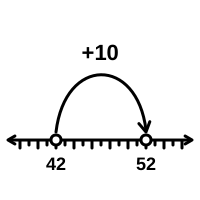
    • I can add and subtract by jumping on a number line.
    1. Draw a number line from 0 to 10 with equal spaces. Put a dot on 6.
    2. 20, 30, 40, ____, 60
    3. Use a number line: 38 + 24 = ____
    4. Use a number line: 75 − 29 = ____
    5. A ribbon is 53 cm. Rosa cuts off 17 cm. Show it on a number line. How much is left?
    6. Which way do you jump to add?leftright

    ELA

    Weekly Check

    • I can retell a story and tell its central message.
    • I can use words like myself and themselves, and tell adjectives from adverbs.

    Leo's Sandcastle

    Leo built a big sandcastle at the beach. A wave came and knocked it down. Leo was sad. His sister Ada said, "Let's build it again, farther from the water." They worked together. The new castle stayed up all day.

    1. Who are the characters?
    2. Where does the story happen?
    3. What happens at the end?
    4. What is the central message?
    5. Leo dried ________ with a towel.
    6. Is gently an adjective or an adverb?adjectiveadverb
    7. Is wet an adjective or an adverb?adjectiveadverb

    Science

    Weekly Check

    • I can tell where water is found as a solid and as a liquid.
    • I can describe where most of Earth's water is found.
    1. Name two places where water is solid.
    2. Name two places where water is liquid.
    3. Where is most of Earth's water?
    4. Ocean water is ________.saltyfresh
    5. Is a glacier solid or liquid water?solidliquid
    6. When ice gets warm, it melts into ________.

    Social Studies

    Weekly Check

    • I can tell why settlers came to a new land.
    • I can tell how the Wampanoag and the settlers saw things differently.
    1. Give one reason settlers came to a new land.
    2. Who already lived near Plymouth when the English settlers came?
    3. What is an explorer?
    4. Was the land new to the Wampanoag?yesno
    5. Tell one way the Wampanoag and the settlers saw things differently.

    Specials

    Music · Form & Listening Skills · All Specials

    This Week's Specials Page

    Music · Week 22

    I can hear the A and B parts of a song.

    Look: Form

    1. Songs have parts. We name them with letters.
    2. If a part comes back, it gets the same letter.
    3. AB form: one part, then a new part. ABA form: one part, a new part, then the first part again.

    Sing "Twinkle, Twinkle, Little Star" with a grown-up. Make a different move for each part: sway for A, march for B. Move in a clear, safe space with room to spread your arms.

    1. Did the first part come back at the end? Circle one.yesno
    2. So the form is ____. Circle one.ABABA

    Listen and draw. A grown-up plays "In the Hall of the Mountain King" by Edvard Grieg.

    1. Draw what you imagine while you listen.
    2. The music gets faster and louder. How did that make you feel?

    You need: crayons, a recording of In the Hall of the Mountain King

    How did it go? Great Okay Tricky

    Home Connection

    This week at home

    • Math

      Hopping forward and back on a number line

    • ELA

      Retelling stories and finding what they teach

    • Science

      Water on Earth can be ice or liquid

    • Social Studies

      The same event can look different to different people

    Three things to celebrate this week

    We did blank of 4 activities.

    Suggested Daily Schedule

    8:30–9:00 AM30 minMorning Meeting / Calendar / Read-Aloud
    9:00–9:30 AM30 minPhonics / Word Study / Spelling
    9:30–10:15 AM45 minReading Workshop
    10:15–10:35 AM20 minSnack and Outdoor Play / Movement Break
    10:35–11:05 AM30 minWriting Workshop
    11:05–11:50 AM45 minMathematics
    11:50 AM–12:35 PM45 minLunch and Free Play
    12:35–1:05 PM30 minScience OR Social Studies (alternating)
    1:05–1:35 PM30 minSpecials: PE / Art / Music / Health (rotating)
    1:35–2:00 PM25 minIndependent Reading / Enrichment