Quarter 3Week 22TuesdayDay 107 of 180

    Week 22, Tuesday: Represent addition as hops forward on a number line · Identify the central message of a story

    Day 107 · 3 lessons · 140 min

    Math

    Students will represent addition as hops forward on a number line and record the equation (2.MD.B.6).

    Standards Addressed

    Activities

    10 min

    Warm-Up

    On the floor number line from yesterday, your child stands on 0 and takes 6 hops, then 5 more hops, saying each number. Ask: 'Where did you land? What equation did you just do with your feet?' (6 + 5 = 11).

    floor number line from Monday
    15 min

    Mini-Lesson: Hops Forward

    Draw a number line from 0 to 30 on paper and show 12 + 9: start at 12, draw an arc of 8 to land on 20, then an arc of 1 to land on 21, writing 12 + 9 = 21. Then show 14 + 15 with a big hop of 10 to 24 and a hop of 5 to 29. Say: 'Bigger hops are faster, but every hop has to be counted.'

    paperpencilruler
    15 min

    Practice: Hop and Record

    Your child solves six problems on drawn number lines, labeling each hop: 7 + 6, 15 + 8, 23 + 10, 36 + 14, 48 + 25, 57 + 30. For the last two, they choose hops of tens and ones and write the sum next to the line.

    paperpencilruler
    5 min

    Wrap-Up

    Ask: 'When you added 48 + 25, what hops did you choose and why?' Your child draws one favorite number line hop in their journal.

    math journalpencil

    Materials Needed

    floor number line from Mondaypaperpencilrulermath journal

    English Language Arts

    Students will identify the central message of a story and read aloud at an appropriate rate (RL.2.2, RF.2.4b).

    Standards Addressed

    Activities

    15 min

    Shared Reading

    Reread 'Owl Moon' with your child reading the short lines ('I didn't ask what kinds of things hide behind black trees') and you reading the longer ones. Stop at the last page and ask, 'What does the author want us to learn about hoping and waiting?' Write the central message in your child's words on the five-finger card.

    Owl Moon by Jane Yolenfive-finger card
    10 min

    Mini-Lesson: Not Too Fast, Not Too Slow

    Read one page of 'Owl Moon' three ways: racing, robot-slow, and just right. Ask which one sounded like a real person and why. Say: 'Rate means speed. Read like you are talking to a friend.'

    Owl Moon by Jane Yolen
    15 min

    Independent Reading

    Your child reads their leveled story for 12 minutes, then reads one page aloud to you at a 'just right' rate. Time it lightly with a kitchen timer and note the seconds so they can try to match it tomorrow.

    leveled storybookkitchen timer
    15 min

    Writing Workshop: Retelling Owl Moon

    Your child writes a retelling of 'Owl Moon' in six sentences, one per finger: characters, setting, beginning, middle, end, lesson. Require one reflexive pronoun somewhere in it. Support: give the six sentence starters ('The characters are...', 'The story happens...'). Stretch: add a seventh sentence that tells how the child felt at the end and why.

    paperpencilfive-finger card
    10 min

    Word Study: Phrases with Irregular Words

    Write phrases on strips: 'said the owl,' 'we were quiet,' 'come along,' 'some snow,' 'once again,' 'my friend,' 'because it was cold.' Your child reads each strip smoothly as one chunk, not word by word, then reads all seven in under a minute.

    paper stripsmarkerkitchen timer

    Materials Needed

    Owl Moon by Jane Yolenfive-finger cardleveled storybookkitchen timerpaper stripsmarkerpaperpencil

    Social Studies

    Students will describe the arrival of European explorers from the point of view of the Taino people who already lived there (D2.His.2.K-2, D2.His.14.K-2).

    This week's reading: Two Peoples at Plymouth

    Standards Addressed

    Activities

    10 min

    Read-Aloud and Discussion

    Read 'Encounter' by Jane Yolen, told by a Taino boy who watches Columbus's ships arrive in 1492. Ask: 'Who was living on the island first? What did the boy notice that the grown-ups did not? Why might the same event be a happy story for one person and a sad story for another?'

    Encounter by Jane Yolen (library)
    15 min

    Hands-On Activity: Two Points of View

    Fold a sheet in half and label the sides 'A sailor on the ship' and 'A Taino child on the shore.' Your child draws what each person saw the morning the ships arrived and writes one sentence of what each might have been thinking. Discuss: 'The word explorer means someone who goes to a place new to them, but the place was not new to the people living there.'

    papercrayonspencil
    5 min

    Quick Write

    Your child writes: 'When the ships came, the Taino people ___. I think ___.' Accept honest feelings; the goal is understanding, not blame.

    notebookpencil

    Materials Needed

    Encounter by Jane Yolen (library)papercrayonspencilnotebook

    Today's Practice

    One page for your child for each lesson. Answers are for grown-ups.

    Math practice · Week 22 · Tuesday

    I can add by hopping forward on a number line.

    Look: 16 + 7

    1. Start at 16.
    2. Hop 4 to land on 20. Then hop 3 to land on 23.
    3. 4 + 3 = 7 hops in all. 16 + 7 = 23.

    Draw a number line. Hop forward and label each hop. Write the sum.

    1. 8 + 7 = ____
    2. 17 + 6 = ____
    3. 26 + 10 = ____
    4. 34 + 23 = ____
    5. 45 + 27 = ____
    6. 59 + 30 = ____

    Challenge

    • What hops did you choose for 45 + 27? Why?
    How did it go? Great Okay Tricky

    ELA practice · Week 22 · Tuesday

    I can tell the central message and read at a just-right speed.

    Look: Find the message

    1. Ana falls off her bike again and again. She keeps trying. At last she rides to the end of the street.
    2. Ask: What did Ana learn?
    3. Message: Keep trying and you can do it.

    Two Seeds

    Ben and Mia each planted a seed in a pot. Ben checked his pot every hour. "Why won't it grow?" he said. He dug up the seed to look at it. Mia gave her pot water and waited. After two weeks, a green sprout came up in Mia's pot. Ben's pot stayed bare. So Ben planted a new seed. This time, he waited too.

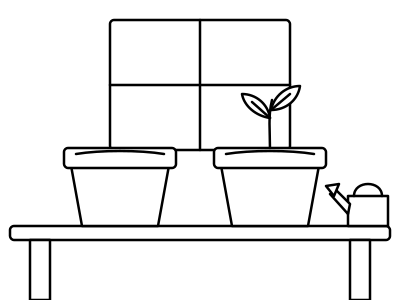
    Two flower pots sit by a window; one is bare and one has a green sprout.

    Think about the whole story.

    1. What is the central message?Good things take time, so be patient.Pots are fun to paint.Always plant two seeds.
    2. What part of the story shows the message?
    3. Read the story aloud like you are talking to a friend. Color a star when it sounds just right.

    Write a word from the box.

    • myself
    • himself
    • themselves
    • yourself
    1. I tied my shoes by ________.
    2. The kids built the fort by ________.
    3. Did you draw that by ________?
    4. Ben looked at ________ in the mirror.
    How did it go? Great Okay Tricky

    Social Studies practice · Week 22 · Tuesday

    I can tell how the Taino and the sailors saw the same day.

    Ships Arrive

    In 1492, ships from Spain sailed to islands in the Caribbean Sea. Christopher Columbus led them. The Taino people had lived on these islands for a very long time. To the sailors, the islands were new. To the Taino, the islands were home. Many people in the Caribbean today have Taino families in their past.

    Fold your page in half. Draw on each side.

    1. What a sailor on the ship saw:
    2. What a Taino child on the shore saw:

    Answer.

    1. Who lived on the islands first?
    2. Why might the same day feel exciting to one person and scary to another?
    3. When the ships came, the Taino people ________. I think ________.
    How did it go? Great Okay Tricky