Quarter 3Week 23TuesdayDay 112 of 180

    Week 23, Tuesday: Read and set times to the nearest 5 minutes · Find key details that support the main topic

    Day 112 · 3 lessons · 140 min

    Math

    Students will read and set times to the nearest 5 minutes on an analog clock by skip counting by fives (2.MD.C.7).

    Standards Addressed

    Activities

    10 min

    Warm-Up

    Your child sets the paper clock to 6:00 and 6:30 from yesterday. Then point to each number on the clock face in order while they skip count by 5s: '5, 10, 15... 55, 60.' Ask: 'How many minutes is a whole trip around?'

    paper clock
    15 min

    Mini-Lesson: Counting the Minutes

    Write the minute count next to each number on the paper clock in small pencil (1 is 5, 2 is 10, and so on to 11 is 55). Set the minute hand on 4 and hour hand just past 2 and count together: '5, 10, 15, 20. It is 2:20.' Repeat for 9:45 (minute hand on 9, hour hand almost at 10) and 7:05 (minute hand on 1). Point out that the hour hand keeps creeping toward the next number as minutes pass.

    paper clockpencil
    15 min

    Practice: Set and Read

    Call out ten times for your child to set: 1:15, 4:40, 10:25, 6:55, 8:10, 12:35, 3:50, 9:05, 11:20, 5:45. For each, they count by 5s aloud before moving the hands. Support: leave the minute-count labels on the clock. Stretch: erase the labels and set 2:35 and 7:50 without them.

    paper clockpencileraser
    5 min

    Wrap-Up

    Ask: 'If the minute hand is on the 8, how many minutes is that?' (40). Your child draws a clock showing 4:40 in their journal and writes the time under it.

    math journalpencil

    Materials Needed

    paper clockpencilerasermath journal

    English Language Arts

    Students will find key details that support the main topic and write an opinion with reasons connected by linking words (RI.2.2, W.2.1).

    Standards Addressed

    Activities

    15 min

    Shared Reading

    Read the second half of 'Weather Words and What They Mean' (fronts, storms, forecasting). Your child reads the bold weather words and their definitions. Pick the thunderstorm page and ask, 'What is the main topic, and what are two key details that tell more about it?'

    Weather Words and What They Mean by Gail Gibbons
    10 min

    Mini-Lesson: Key Details Hold Up the Topic

    Draw a table with a top and three legs. Write the main topic of one page on the top and a key detail on each leg. Kick away a leg by covering it and ask, 'Does the table still stand? Which details matter most?'

    papermarker
    15 min

    Independent Reading

    Your child reads their nonfiction book for 12 minutes and draws a table for one page: the main topic on top and three key details on the legs. They read the table to you.

    leveled nonfiction bookpaperpencil
    15 min

    Writing Workshop: Linking Words

    Write 'because, also, and, so, for example' on a card. Your child turns yesterday's three reasons into sentences, each starting with or containing a linking word: 'I think snow is the best weather because you can build a fort. Also, school might be canceled. For example, last winter we...' Read it aloud and circle each linking word.

    linking word cardyesterday's opinion webpaperpencil
    10 min

    Word Study: Prefixes and Suffixes

    Write 'unclear, rewrite, prewash, careful, helpless, quickly, kindness, sadly, colder, coldest.' Your child boxes the base word and underlines the prefix or suffix, then tells what each part adds ('un' means not, 'est' means the most). Dictate 'The coldest day was unclear and windy.'

    paperpencil

    Materials Needed

    Weather Words and What They Mean by Gail Gibbonsleveled nonfiction booklinking word cardyesterday's opinion webpapermarkerpencil

    Social Studies

    Students will explain how an invention solved a problem and changed daily life, using Benjamin Franklin's inventions as examples (D2.His.1.K-2, D2.His.9.K-2).

    Standards Addressed

    Activities

    10 min

    Read-Aloud and Discussion

    Read 'Now & Ben: The Modern Inventions of Benjamin Franklin' by Gene Barretta, which shows each invention then and now on facing pages. Ask: 'What problem did the lightning rod solve? Which of Ben's ideas do we still use today? How does the book show past and present at the same time?'

    Now & Ben by Gene Barretta (library)
    15 min

    Hands-On Activity: Problem and Invention Match

    Write six problems on cards (rooms are dark at night, food spoils, it is hard to talk to someone far away, walking is slow, clothes are dirty, we cannot see tiny things) and six inventions on other cards (light bulb, refrigerator, telephone, bicycle, washing machine, microscope). Your child matches each problem to its invention and then picks one to draw 'before the invention' and 'after.'

    12 index cardsmarkerpapercrayons
    5 min

    Quick Write

    Your child writes: 'Before the ___, people had to ___. Now we can ___.'

    notebookpencil

    Materials Needed

    Now & Ben by Gene Barretta (library)12 index cardsmarkerpapercrayonsnotebookpencil

    Today's Practice

    One page for your child for each lesson. Answers are for grown-ups.

    Math practice · Week 23 · Tuesday

    I can tell time to 5 minutes.

    Look: The long hand is on 7

    1. Count by 5s for each number: 5, 10, 15, 20, 25, 30, 35.
    2. The short hand is just past 3.
    3. It is 3:35.

    Read the clue. Count by 5s. Write the time.

    1. The short hand is just past 3. The long hand is on 5.
    2. The short hand is just past 9. The long hand is on 2.
    3. The short hand is almost at 5. The long hand is on 11.
    4. The short hand is between 7 and 8. The long hand is on 8.
    5. The long hand is on 9. How many minutes is that?

    Draw a clock. Show the time.

    1. 2:15
    2. 11:50
    How did it go? Great Okay Tricky

    ELA practice · Week 23 · Tuesday

    I can find key details that hold up the main topic.

    Look: A table of details

    1. Top of the table: owls.
    2. Legs: Most owls hunt at night. Owls have big eyes. Owls have soft feathers.
    3. Each leg is a detail that tells more about owls.

    Snow

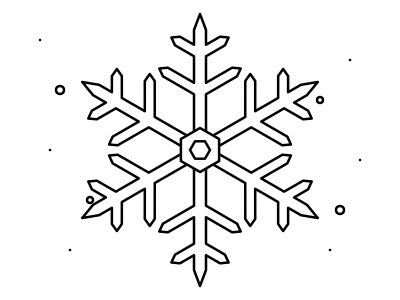
    Snow forms when it is very cold in the clouds. Tiny bits of ice stick together to make snowflakes. Every snowflake has six sides or six points. Snow can pile up deep on the ground. When the air warms up, the snow melts into water.

    A snowflake with six points.

    Draw a table. Write the main topic on the top and a key detail on each leg.

    1. Table top (main topic):
    2. Legs (three key details):

    Box the base word. Underline the prefix or suffix.

    1. unhappy
    2. repaint
    3. helpful
    4. slowest

    Challenge

    • Finish: I like snow because ________. Also, ________.
    How did it go? Great Okay Tricky

    Social Studies practice · Week 23 · Tuesday

    I can tell how an invention solved a problem.

    Write the invention that solves each problem.

    • light bulb
    • refrigerator
    • telephone
    • bicycle
    • washing machine
    • microscope
    1. Rooms are dark at night.
    2. Food spoils.
    3. It is hard to talk to someone far away.
    4. Walking is slow.
    5. Clothes are dirty.
    6. We cannot see tiny things.

    Pick one invention. Finish the sentences.

    1. Before the ________, people had to ________. Now we can ________.

    Challenge

    • What problem did Benjamin Franklin's lightning rod solve?
    How did it go? Great Okay Tricky