Week 23: Telling Time to the Nearest 5 Minutes · Main Topic and Key Details (Review)

    Quarter 3 · Detailed day-by-day lesson plans · Days 111–115

    0 of 15 lessons done this week

    Telling Time to the Nearest 5 Minutes Main Topic and Key Details (Review)

    Print

    Worksheets and answer keys

    Gather this week

    • Shop
    • Shop
    • Shop
    • Shop
    • Shop
    Everyday supplies (16)

    Writing prompt

    • Write a story where a vegetable becomes a hero.
    Week 23 writing prompts

    Parent note

    This week's parent digest

    This week at a glance

    Week 23 tells time on analog and digital clocks to the nearest five minutes. Readers review main topic and key details, and writers add linking words to opinion drafts.

    Parent tip

    Use a real analog clock — point to the minute hand and count by 5s together.

    Materials this week

    Real analog clock, digital timer, nonfiction review article

    Mathematics

    Telling Time to the Nearest 5 Minutes

    Measurement & Data · 2.MD.A.1

    Assessment: Read analog and digital clocks; write times; solve elapsed time problems

    ELA

    Main Topic and Key Details (Review)

    Phonics: Review decoding strategies

    Writing: Opinion writing with linking words (because, also)

    Science

    Earth's Systems: Water, Wind & Land

    2-ESS1-1, 2-ESS2-1, 2-ESS2-2, 2-ESS2-3

    Social Studies

    History: Past and Present

    Monday — Day 111

    140 minutes of instruction

    Math

    Students will build a paper clock and tell time to the hour and half hour, identifying the hour and minute hands (2.MD.C.7).

    Standards Addressed

    Activities

    10 min

    Warm-Up

    Draw a number line from 0 to 60 marked by fives and have your child skip count along it by 5s aloud. Then bend a string in a circle and say: 'Imagine this number line curled around. That is what a clock is.'

    paperpencilstring
    15 min

    Mini-Lesson: Build a Clock

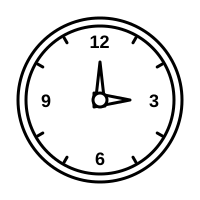
    Trace a dinner plate on cardstock, write 12 at the top, 6 at the bottom, 3 and 9 on the sides, then fill in the other numbers evenly. Cut a short wide hour hand and a long thin minute hand from cardstock and attach both at the center with a brad. Show 3:00 (minute hand on 12, hour hand on 3) and 3:30 (minute hand on 6, hour hand halfway between 3 and 4), saying each time aloud.

    cardstock or paper platedinner plate to tracebrad (paper fastener)scissorsmarker
    15 min

    Practice: Show Me the Time

    Call out times and your child sets the paper clock: 7:00, 11:00, 2:30, 8:30, 12:00, 5:30. Then switch: they set a time and you read it. Finally, they draw two clocks in their journal showing 4:00 and 9:30 with the hour hand drawn correctly (pointing straight at the hour, or halfway past it).

    paper clockmath journalpencil
    5 min

    Wrap-Up

    Ask: 'Which hand is short? What does it tell us?' (the hour). 'Which hand is long?' (the minute hand). Your child writes 'short hand = hour, long hand = minutes.'

    math journalpencil

    Materials Needed

    paperpencilstringcardstock or paper platedinner plate to tracebrad (paper fastener)scissorsmarkermath journal

    English Language Arts

    Students will identify the main topic of a multi-paragraph informational text and the focus of each paragraph (RI.2.2).

    Standards Addressed

    Activities

    15 min

    Read-Aloud

    Introduce 'Weather Words and What They Mean' by Gail Gibbons and read the first half (temperature, air pressure, moisture, wind). Remind your child that last week you retold stories; this week you go back to nonfiction and find the main topic, the one big thing a text is about. After each spread, ask, 'What is this page mostly about, in three words or fewer?'

    Weather Words and What They Mean by Gail Gibbons (library)
    10 min

    Mini-Lesson: Main Topic Is the Umbrella

    Draw an umbrella and write 'weather' on top. Under it, draw raindrops labeled 'temperature,' 'wind,' 'clouds,' 'storms.' Say: 'The main topic is the umbrella. Each paragraph or page is one raindrop under it.'

    papermarker
    15 min

    Guided Reading

    Your child reads a nonfiction book at their level for 12 minutes and draws their own umbrella for it: the main topic on top and three raindrops for three pages. Check that each raindrop belongs under the umbrella.

    leveled nonfiction bookpaperpencil
    15 min

    Writing Workshop: Choosing an Opinion

    Pose the question 'Which is the best kind of weather?' Your child talks through two or three choices, picks one, and writes the opinion sentence: 'I think ___ is the best weather.' Then they list three reasons in a quick web; explain that this week each reason will get a linking word.

    paperpencil
    10 min

    Word Study: Open and Closed Syllables

    Write 'blizzard, thunder, humid, cloudy, frozen, pilot, cabin, tornado.' Show that a closed syllable ends in a consonant and has a short vowel (bliz-zard, cab-in) and an open syllable ends in a vowel and says its name (fro-zen, pi-lot). Your child splits each word with a pencil line and reads it.

    paperpencil

    Materials Needed

    Weather Words and What They Mean by Gail Gibbons (library)leveled nonfiction bookpapermarkerpencil

    Science

    Students will observe and record daily weather, build a simple wind tool, and describe wind as moving air that can change the land (2-ESS2-1, 2-ESS1-1).

    This week's reading: Watching the Weather

    Standards Addressed

    Activities

    5 min

    Science Question of the Week

    Ask: 'Last week we saw ice and water move sand. Can you see wind? How do you know it is there?' Set up a weather log with five rows (Mon to Fri) and columns for sky, temperature (warm, cool, cold), wind (none, light, strong), and rain.

    notebookpencilruler
    20 min

    Investigation: Wind Sock

    Tape crepe paper or plastic-bag strips around the rim of a paper cup with the bottom cut out, punch two holes, and tie on a string handle. Take it outside, hold it up in an open spot, and watch which way the strips blow; use a compass app or the position of the sun to name the direction the wind is coming from. Fill in today's row of the weather log together.

    paper cupscissorscrepe paper or plastic bag stripstapestringhole punch or pencil tip
    5 min

    Wrap-Up

    Say: 'Wind is air that is moving.' Ask your child to name one fast wind event (a storm knocking down a tree) and one slow one (wind wearing away a rock over many years).

    notebook

    Materials Needed

    notebookpencilrulerpaper cupscissorscrepe paper or plastic bag stripstapestringhole punch or pencil tip
    Open Monday on its own page
    Science

    Reading About Our World: Watching the Weather

    Read it aloud first while your child follows along. Then read it together, and let your child read the parts they can. Talk about the words in the word box.

    Weather is what the air outside is like. It can be hot or cold, rainy or dry, calm or windy.

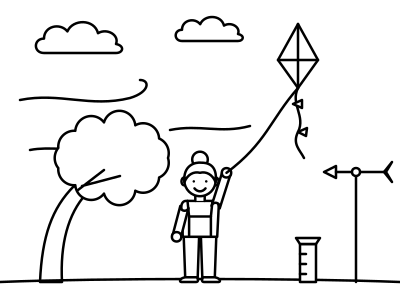
    Wind is moving air. You cannot see wind, but you can see what it does. It bends trees, pushes clouds and lifts kites. A breeze is a gentle wind. A strong wind can knock down branches.

    Weather changes from day to day, but it also has patterns. A pattern is something that happens again and again. In many places, summers are hot and winters are cold.

    People who study weather use tools. A thermometer measures how hot or cold the air is. A rain gauge measures how much rain falls. A wind vane shows which way the wind is blowing.

    Weather scientists study patterns to tell what the weather will probably be tomorrow. That is called a forecast. What is the weather like today?

    On a windy day a girl flies a kite, a tree bends in the wind, and a wind vane and a rain gauge stand nearby.

    Word box

    weather:
    what the air outside is like at a certain time and place
    wind:
    moving air
    pattern:
    something that happens again and again
    forecast:
    a guess about what the weather will be, based on patterns

    Questions

    1. What is the main topic of this text?
    2. What is one key detail about wind?
    3. What tool measures how hot or cold the air is?

    Weekly check

    Math

    Weekly Check

    • I can tell and write time to the nearest 5 minutes.
    • I can tell whether a time is a.m. or p.m.
    1. The long hand is on 4. The short hand is just past 6. Write the time.
    2. The long hand is on 10. The short hand is almost at 2. Write the time.
    3. Draw a clock that shows 8:35.
    4. Walk the dog after dinner at 7:05.a.m.p.m.
    5. Brush teeth before school at 7:45.a.m.p.m.
    6. Soccer starts at 4:10 p.m. and lasts 30 minutes. When does it end?

    ELA

    Weekly Check

    • I can tell the main topic and key details of a text.
    • I can use strategies to read a word I don't know.

    Hail

    Hail is ice that falls from a storm cloud. Strong winds carry raindrops high up, where the cloud is very cold. The drops freeze. They can go up and down many times and grow bigger. Most hailstones are small, about the size of a pea.

    1. What is the main topic?
    2. Write one key detail.
    3. Write another key detail.
    4. Split and read: hailstones
    5. Cover the prefix. What is the base word in unfrozen?
    6. What does rewrite mean?

    Science

    Weekly Check

    • I can describe weather with words like sunny, windy, rainy and cold.
    • I can describe a weather pattern, like hot summers and cold winters.

    Our Weather Log

    Monday: sunny and warm. Tuesday: sunny and warm. Wednesday: rainy and cool. Thursday: sunny and windy. Friday: sunny and warm.

    1. What weather happened most this week?
    2. Which day was rainy?
    3. Which word means moving air?windrainsnow
    4. Use two weather words to tell about today.
    5. In many places, summer is ________ and winter is ________.

    Social Studies

    Weekly Check

    • I can name an invention and tell how it changed people's lives.
    • I can compare how a job was done before and after an invention.
    1. Name an invention. Tell how it changed people's lives.
    2. Before the washing machine, how did people wash clothes?
    3. Before cars, how did people travel far?
    4. Before the light bulb, how did people light their homes at night?
    5. Name a job a machine does now that people once did by hand.

    Specials

    PE · Kicking, Dribbling & Ball Control · All Specials

    This Week's Specials Page

    PE · Week 23

    I can dribble a ball with control.

    Look: Dribbling

    1. Hand dribble: push the ball down with your finger pads, not a slap.
    2. Foot dribble: tap the ball softly so it stays close to your feet.
    3. Go slow first. Speed comes later.

    Dribble course. Outside or in a big clear space, set up 4 shoes or cones in a line. Weave in and out. Put a check when you finish.

    1. Foot dribble through the course.
    2. Hand dribble through the course.
    3. How many hand dribbles can you do in a row standing still? ____

    Think about it.

    1. Which was easier? Circle one.hand dribblefoot dribble
    2. What helps the ball stay close to you?

    You need: a playground ball or soccer ball, 4 shoes or cones

    How did it go? Great Okay Tricky

    Home Connection

    This week at home

    • Math

      Telling time to five minutes, a.m. and p.m.

    • ELA

      Finding the main topic and key details

    • Science

      Watching weather and measuring the moving wind

    • Social Studies

      Inventions solve problems and change how people live

    Three things to celebrate this week

    We did blank of 4 activities.

    Suggested Daily Schedule

    8:30–9:00 AM30 minMorning Meeting / Calendar / Read-Aloud
    9:00–9:30 AM30 minPhonics / Word Study / Spelling
    9:30–10:15 AM45 minReading Workshop
    10:15–10:35 AM20 minSnack and Outdoor Play / Movement Break
    10:35–11:05 AM30 minWriting Workshop
    11:05–11:50 AM45 minMathematics
    11:50 AM–12:35 PM45 minLunch and Free Play
    12:35–1:05 PM30 minScience OR Social Studies (alternating)
    1:05–1:35 PM30 minSpecials: PE / Art / Music / Health (rotating)
    1:35–2:00 PM25 minIndependent Reading / Enrichment