Quarter 3Week 23ThursdayDay 114 of 180

    Week 23, Thursday: Apply time-telling to simple elapsed-time problems · State the main topic and key details of a text

    Day 114 · 3 lessons · 140 min

    Math

    Students will apply time-telling to simple elapsed-time problems by counting hops of 5 minutes and hours on the paper clock (2.MD.C.7).

    Standards Addressed

    Activities

    10 min

    Warm-Up

    Set the paper clock to 2:00 and ask: 'What time will it be in 1 hour? In 2 hours?' Move only the hour hand to show 3:00 and 4:00. Then set 2:00 and ask what time it will be in 5 minutes, in 10 minutes, in 15 minutes, moving the minute hand one number each time.

    paper clock
    15 min

    Mini-Lesson: How Much Later?

    Read: 'Soccer practice starts at 4:00 p.m. and lasts 30 minutes. What time does it end?' Start the clock at 4:00 and count six 5-minute hops with the minute hand while the hour hand creeps to halfway: 4:30. Then read: 'The movie starts at 6:15 and ends at 7:15. How long is it?' Show that the minute hand made one full trip, so 1 hour.

    paper clockpaperpencil
    15 min

    Practice: Time Stories

    Your child uses the paper clock to solve four problems and writes the answer time. 1: 'Reading starts at 9:10 a.m. and lasts 20 minutes. When does it end?' (9:30 a.m.). 2: 'Dinner is at 6:00 p.m. It is 5:45 p.m. How many minutes until dinner?' (15). 3: 'A bike ride starts at 1:00 and ends at 3:00. How long was it?' (2 hours). 4: 'The bus comes at 8:05 a.m. Leo leaves the house at 7:50 a.m. How many minutes does he have?' (15).

    paper clockpaperpencil
    5 min

    Wrap-Up

    Look at a real clock and ask: 'What time is it now? What time will it be in 15 minutes?' Your child writes both times in their journal with a.m. or p.m.

    real clockmath journalpencil

    Materials Needed

    paper clockreal clockpapermath journalpencil

    English Language Arts

    Students will state the main topic and key details of a text in writing and revise an opinion piece to strengthen linking words (RI.2.2, W.2.1, W.2.5).

    Standards Addressed

    Activities

    15 min

    Shared Reading

    Reread the pages about clouds in 'Weather Words and What They Mean.' Your child reads the cloud names (cirrus, cumulus, stratus) and one fact for each. Together, write the main topic of the spread and three key details in a table drawing.

    Weather Words and What They Mean by Gail Gibbonspaperpencil
    10 min

    Mini-Lesson: Say It in One Sentence

    Model the frame 'This text is mostly about ___. One key detail is ___. Another key detail is ___.' Use it for the cloud pages. Say: 'If you can say the main topic and two details in three sentences, you understood the text.'

    papermarker
    15 min

    Independent Reading

    Your child reads their nonfiction book for 12 minutes and writes the three-sentence frame for one page. Check that the two details actually appear on the page.

    leveled nonfiction bookpaperpencil
    15 min

    Writing Workshop: Revising the Weather Opinion

    Your child rereads the weather opinion from Tuesday and revises it: every reason gets a linking word, the piece gets a closing sentence ('That is why I think...'), and one reason gets a 'for example' detail. Then edit with CUPS from Week 19.

    weather opinion draftlinking word cardCUPS cardcolored pencil
    10 min

    Word Study: Vowel Team Review with Weather Words

    Write 'rain, sleet, snow, cloud, storm, bright, freeze, breeze, hail, gray.' Your child underlines the vowel team in each and sorts the words by sound (long a, long e, long o, /ow/, long i). Dictate 'The gray cloud brought rain and hail.'

    paperpencil

    Materials Needed

    Weather Words and What They Mean by Gail Gibbonsleveled nonfiction bookweather opinion draftlinking word cardCUPS cardcolored pencilpapermarkerpencil

    Social Studies

    Students will describe how an inventor used wind to solve a problem and design their own invention to solve a problem at home (D2.His.1.K-2, D2.His.9.K-2).

    Standards Addressed

    Activities

    10 min

    Review and Extend

    Read the picture book edition of 'The Boy Who Harnessed the Wind' by William Kamkwamba and Bryan Mealer, about a boy in Malawi who built a windmill from scrap to pump water for his village. Ask: 'What problem did William's village have? Where did he get his ideas? How does this connect to the wind we measured yesterday?'

    The Boy Who Harnessed the Wind (picture book edition) by William Kamkwamba and Bryan Mealer (library)
    15 min

    Project Work: My Invention Blueprint

    Your child chooses one small problem at home (the dog's water bowl runs dry, shoes get lost, the light switch is too high) and draws an invention to fix it with labeled parts, a name, and a sentence about how it works. Encourage them to use something from this unit if they can: wind, flowing water, or a map. Add it to the Important Americans trading cards from Week 20 as an 'Inventor: Me' card.

    large paperpencilcrayonsindex card
    5 min

    Share Progress

    Your child pitches the invention in one minute like William explaining his windmill. Ask: 'How would life at home be different after your invention?'

    completed blueprint

    Materials Needed

    The Boy Who Harnessed the Wind (picture book edition) by William Kamkwamba and Bryan Mealer (library)large paperpencilcrayonsindex card

    Today's Practice

    One page for your child for each lesson. Answers are for grown-ups.

    Math practice · Week 23 · Thursday

    I can find how much time has passed.

    Look: Start at 4:00. Wait 20 minutes.

    1. Put the minute hand on 12.
    2. Hop 4 numbers by 5s: 5, 10, 15, 20.
    3. Now it is 4:20.

    Use your paper clock. Write the answer.

    1. Art starts at 10:00 a.m. and lasts 25 minutes. When does it end?
    2. Lunch is at 12:00 p.m. It is 11:40 a.m. How many minutes until lunch?
    3. A game starts at 2:00 and ends at 5:00. How long is the game?
    4. A show starts at 7:30 p.m. and lasts 1 hour. When does it end?
    5. Ella starts reading at 3:15 p.m. She reads for 15 minutes. When does she stop?

    Challenge

    • Look at a real clock. What time is it now? What time will it be in 15 minutes?

    You need: your paper clock

    How did it go? Great Okay Tricky

    ELA practice · Week 23 · Thursday

    I can say the main topic and two key details.

    Look: Topic and two details

    1. This text is mostly about frogs.
    2. One key detail is that frogs hatch from eggs.
    3. Another key detail is that most frogs eat bugs.

    Thunderstorms

    A thunderstorm is a storm with lightning and thunder. Lightning is a giant spark of electricity in the sky. Thunder is the loud sound lightning makes when it heats the air. You see lightning before you hear thunder because light moves faster than sound. When you hear thunder, go inside.

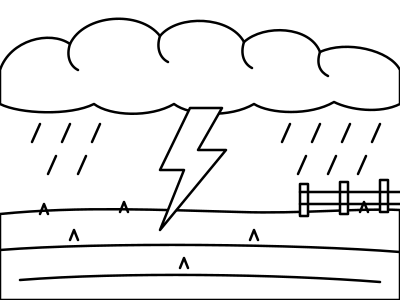
    A bolt of lightning flashes from dark storm clouds over a field.

    Finish each sentence.

    1. This text is mostly about ________.
    2. One key detail is ________.
    3. Another key detail is ________.

    Underline the vowel team in each word.

    1. gray
    2. beach
    3. boat
    4. shout

    Challenge

    • Join the two sentences with a linking word: I like rain. It makes puddles.
    How did it go? Great Okay Tricky

    Social Studies practice · Week 23 · Thursday

    I can design an invention to solve a problem.

    Think about the book you read today.

    1. What problem did William Kamkwamba's village in Malawi have?
    2. What did William build from scrap parts?

    My invention blueprint. Draw it and label its parts.

    1. My drawing:
    2. My invention is called ________.
    3. The problem it solves is ________.
    4. It works like this: ________
    How did it go? Great Okay Tricky