Quarter 4Week 28WednesdayDay 138 of 180

    Week 28, Wednesday: Connect partitioned rectangles to repeated addition · Use text features in a Gail Gibbons nonfiction book

    Day 138 · 3 lessons · 140 min

    Math

    Students will connect partitioned rectangles to repeated addition by adding the squares in each row (2.G.A.2, 2.OA.C.4).

    Standards Addressed

    Activities

    10 min

    Warm-Up

    Spiral to Week 18 arrays: set out 3 rows of 4 dried beans and ask for the repeated addition sentence: 4 + 4 + 4 = 12. Ask, 'How is this like the rectangles we cut into squares?'

    15 min

    Mini-Lesson

    Draw a rectangle partitioned into 3 rows of 5. Model writing 5 + 5 + 5 = 15 for the rows, then 3 + 3 + 3 + 3 + 3 = 15 for the columns. Say, 'Both ways count every square once, so both equal 15.'

    15 min

    Practice

    Your child partitions rectangles into 2 rows of 6, 4 rows of 3, and 5 rows of 2, then writes a repeated addition sentence for the rows of each and finds the total. Support: give the rectangles pre-partitioned and have them write only the addition sentences. Stretch: ask them to write both the row sentence and the column sentence for each and explain why the totals match.

    5 min

    Wrap-Up

    Ask, 'If I add one more row to the 2 rows of 6, how many squares?' Have your child add 6 to 12 without redrawing.

    Materials Needed

    dried beansrulerpaperpencil

    English Language Arts

    Students will use text features in a Gail Gibbons nonfiction book to gather facts about rain forest layers and add notes from two more sources (RI.2.5, W.2.8).

    Standards Addressed

    Activities

    15 min

    Read-Aloud: Nature's Green Umbrella

    Read selected spreads from 'Nature's Green Umbrella: Tropical Rain Forests' by Gail Gibbons: where rain forests are on the map, the four layers (forest floor, understory, canopy, emergent), and why rain forests matter. Ask: 'Is this author's purpose the same as Lynne Cherry's?' and compare with a stem.

    Nature's Green Umbrella: Tropical Rain Forests by Gail Gibbons
    10 min

    Mini-Lesson: Text Features for Research

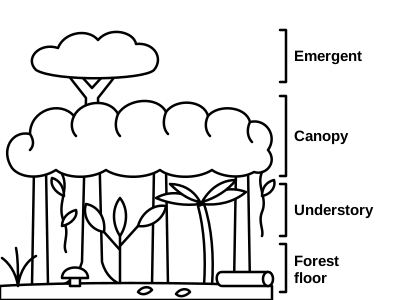
    Hunt for text features: labels, a diagram, captions, and a map. Show how the layer diagram gives a fact faster than a paragraph, and have your child read the labels from bottom to top.

    Nature's Green Umbrella
    15 min

    Guided Reading: Notes From Source 2

    Your child takes three notes in the Source 2 box, at least one from a diagram or label. Tie to science: 'This week's science topic is protecting habitats. Find one thing the book says harms rain forests.'

    Nature's Green Umbrellawriting notebookpencil
    15 min

    Writing Workshop: Source 3 Fact Sheet

    Write these facts on five index cards and hand them over as Source 3: rain forests cover only a small part of Earth's land; more than half of all kinds of plants and animals live in rain forests; rain forest trees give off oxygen; people cut rain forests for wood, farms, and roads; protected parks and planting new trees help. Your child reads all five and writes notes on two in the Source 3 box. Support: you read the cards aloud and your child chooses two. Stretch: your child ranks all five from most to least important and explains the top choice.

    index cardsmarkerwriting notebookpencil
    10 min

    Phonics: Big Words From the Book

    Word cards from the Gibbons text: understory, canopy, tropical, equator, humid, animals, protect, habitat, umbrella, emergent. Clap the syllables, draw a box around each syllable, and read the word slowly, then smoothly. Write 'canopy' and 'habitat' in the notebook.

    index cardsmarkerwriting notebook

    Materials Needed

    Nature's Green Umbrella: Tropical Rain Forests by Gail Gibbonswriting notebookpencilindex cardsmarker

    Science

    Students will design and test a simple device that keeps litter or oil out of the model pond (K-2-ETS1-1, 2-LS4-1).

    Standards Addressed

    Activities

    5 min

    Review

    Reread Monday's problem statement. Ask: 'What could we build so the litter never reaches the water?' Brainstorm three ideas in 2 minutes: a fence, a screen, a net, a lid, a sign.

    20 min

    Deeper Investigation: Build a Pond Protector

    Your child sketches one design, then builds it from household scraps: a screen of mesh produce bag over the pond, a fence of craft sticks pushed into the soil, or a floating boom of a string of cotton balls to catch oil. Test it: drop 5 pieces of litter from a foot above and pour 1 spoon of oil at the edge. Count how many pieces the protector stopped. Adjust once and retest. Support: build the mesh screen together first. Stretch: your child tries two different designs and records which stopped more litter.

    mesh produce bagcraft stickscotton ballsstringtapebottle caps and wrappersspoon of cooking oilnotebook
    5 min

    Data Discussion

    Compare Test 1 and Test 2 counts. Ask: 'Which part of your design worked? What did the oil do that litter did not?' Note that real oil booms are floating tubes that work like the cotton ball string.

    Materials Needed

    shoebox pond from Mondaymesh produce bagcraft stickscotton ballsstringtapebottle caps and wrappersspoon of cooking oilnotebookpencil

    Today's Practice

    One page for your child for each lesson. Answers are for grown-ups.

    Math practice · Week 28 · Wednesday

    I can add the squares in each row to find the total.

    Look: 3 rows of 2

    1. Each row has 2 squares.
    2. Add one 2 for each row: 2 + 2 + 2.
    3. 2 + 2 + 2 = 6 squares.

    Draw and split each rectangle. Write an addition sentence for the rows. Find the total.

    1. 2 rows of 7
    2. 3 rows of 6
    3. 5 rows of 3
    4. 4 rows of 6

    Challenge

    • Write the column sentence for 3 rows of 6. Does it give the same total?
    How did it go? Great Okay Tricky

    ELA practice · Week 28 · Wednesday

    I can use text features to find facts.

    Look: Find a fact with labels

    1. A plant diagram has labels: flower, leaf, stem, roots.
    2. Which part is under the ground? Read the labels from the bottom up.
    3. The bottom label says roots. Fact: roots grow under the ground.

    Layers of the Rain Forest

    A rain forest has four layers. The forest floor is dark because little sunlight gets down there. The understory has small trees and bushes. The canopy is like a green umbrella made of treetops, and many animals live there. The emergent layer is made of the tallest trees, which poke up above the canopy.

    A rain forest diagram labels four layers: emergent, canopy, understory and forest floor.

    The four layers, from the ground to the top.

    Use the page above.

    1. Write the four layers from the bottom to the top.
    2. Why is the forest floor dark?
    3. Which text feature helps you see the layers fastest?the diagramthe heading
    4. Underline the caption.

    Clap the syllables. Write how many.

    1. canopy
    2. understory
    3. tropical

    Challenge

    • Write one note from this page for your Source 2 box.
    How did it go? Great Okay Tricky

    Science practice · Week 28 · Wednesday

    I can design and test a pond protector.

    Plan it.

    1. Sketch your pond protector. Label its parts.

    Test it. Drop 5 pieces of litter. Count how many your protector stopped.

    TestPieces stopped (out of 5)What happened to the oil?
    1. What did you change after Test 1?
    2. Which part of your design worked best?
    3. What did the oil do that the litter did not?

    You need: the model pond, mesh produce bag, craft sticks or cotton balls and string

    How did it go? Great Okay Tricky