Week 28: Partitioning Rectangles into Rows and Columns · Author's Purpose (Review)

    Quarter 4 · Detailed day-by-day lesson plans · Days 136–140

    0 of 15 lessons done this week

    Partitioning Rectangles into Rows and Columns Author's Purpose (Review)

    Print

    Worksheets and answer keys

    Gather this week

    • Shop
    • Shop
    • Shop
    Everyday supplies (9)

    Writing prompt

    • Write about your community. What buildings, helpers, and places matter most?
    Week 28 writing prompts

    Parent note

    This week's parent digest

    Specials this week

    Supplements

    This week at a glance

    Week 28 partitions rectangles into rows and columns, connecting to repeated addition. Readers review author's purpose, and writers gather research from provided sources.

    Parent tip

    Cut a brownie pan into equal rows and columns — then count.

    Materials this week

    Grid paper, sample text set, source materials

    Mathematics

    Partitioning Rectangles into Rows and Columns

    Data & Geometry · 2.MD.D.9

    Assessment: Partition rectangles; count equal squares; connect to repeated addition

    ELA

    Author's Purpose (Review)

    Phonics: Apply decoding to grade-level text

    Writing: Research

    Science

    Biodiversity & Interdependence

    2-LS2-1, 2-LS2-2, 2-LS4-1

    Social Studies

    Economics: Needs, Wants & Choices

    Monday — Day 136

    140 minutes of instruction

    Math

    Students will partition a rectangle into rows and columns of same-size squares and count the total (2.G.A.2).

    Standards Addressed

    Activities

    10 min

    Warm-Up

    Spiral from Week 27: show a cracker box and ask, 'Is this a cube? How many faces does it have?' Then hold up one square cracker and ask, 'How many sides? How many vertices?'

    15 min

    Mini-Lesson

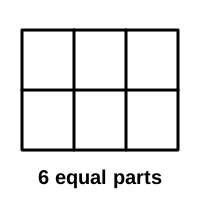
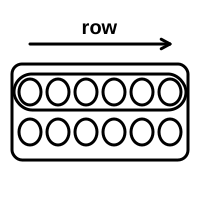
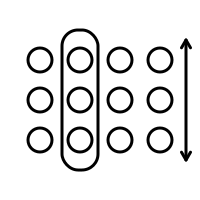
    Lay square crackers on a sheet of paper in 2 rows of 4 and trace around the outside to make a rectangle. Explain that rows go across and columns go up and down. Say, 'This rectangle has 2 rows and 4 columns. Let's count the squares: 8.'

    15 min

    Practice

    Your child uses square crackers or sticky notes to fill rectangles you draw: 3 rows of 3, 2 rows of 5, and 4 rows of 2. For each they write the number of rows, the number of columns, and the total squares.

    5 min

    Wrap-Up

    Ask, 'What must be true about all the squares inside one rectangle?' (Same size, no gaps, no overlaps.) Eat one cracker to celebrate.

    Materials Needed

    square crackers or square sticky notespaperpencil

    English Language Arts

    Students will determine why Lynne Cherry wrote 'The Great Kapok Tree' and begin a research notebook on why rain forests matter (RI.2.6, W.2.7).

    Standards Addressed

    Activities

    15 min

    Read-Aloud: The Great Kapok Tree

    Say: 'Last week every character had a point of view. In this book, every animal does.' Read 'The Great Kapok Tree' by Lynne Cherry, pausing after the boa, the bee, and the monkeys to ask, 'What does this animal want the man to understand?' Keep a running list of the animals that whisper.

    The Great Kapok Tree by Lynne Cherrypaperpencil
    10 min

    Mini-Lesson: Author's Purpose

    Review PIE: authors write to persuade, inform, or entertain, and often more than one. Read the author's note and the map at the front of the book and decide together which purpose fits best, pointing to two pages as proof.

    The Great Kapok Treechart papermarker
    15 min

    Guided Reading: What the Tree Gives

    Reread the tree frog, jaguar, and sloth pages. On a chart titled 'What the Kapok Tree Gives,' your child writes one line per animal ('The jaguar says: food, because animals live in the tree') using a stem conversation to agree on each entry.

    The Great Kapok Treechart papermarker
    15 min

    Writing Workshop: Research Launch

    Write the research question at the top of a notebook page: 'Why do rain forests matter, and how can people protect them?' Explain the three sources: Source 1 is the animals' speeches in 'The Great Kapok Tree,' Source 2 is a Gail Gibbons book on Wednesday, Source 3 is a fact sheet you will give. Your child draws three labeled boxes for notes.

    writing notebookpencilruler
    10 min

    Phonics: Closed-Syllable Words

    Word cards: forest, insect, blossom, basket, rabbit, sudden, trumpet, velvet, magnet, picnic. Your child draws a line between the two consonants in the middle, reads each part, and blends. Note that a closed syllable ends in a consonant and the vowel is short.

    index cardsmarker

    Materials Needed

    The Great Kapok Tree by Lynne Cherrypaperpencilchart papermarkerwriting notebookrulerindex cards

    Science

    Students will identify what a habitat provides (food, water, shelter, space) and observe how removing one part affects the living things there (2-LS4-1, K-2-ETS1-1).

    Standards Addressed

    Activities

    5 min

    Science Question of the Week

    Point to last week's paper chain. Ask: 'If someone paved over the flower bed, which links would break?' Write this week's question: 'How can people protect the habitats living things need?' Review that a habitat gives food, water, shelter, and space.

    20 min

    Investigation: Shoebox Habitat and the Litter Problem

    Build a small pond habitat in a shoebox lid or baking pan: a bowl of water for the pond, soil and grass clippings for the bank, twigs and rocks for shelter, and 6 plastic or paper animals (frog, duck, fish, dragonfly, turtle, heron). Then introduce a problem: drop in 5 pieces of 'litter' (bottle caps, a plastic bag scrap, a candy wrapper) and pour in a spoon of cooking oil to show a spill. Your child describes what each animal loses: the frog cannot find its rock, the duck's feathers get oily. Photograph or draw before and after.

    shoebox lid or baking pansmall bowl of watersoilgrass clippingstwigsrocks6 toy or paper animalsbottle caps and wrappersspoon of cooking oil
    5 min

    Wrap-Up

    Ask: 'What is the problem here? Who does it hurt?' Write a clear problem statement together: 'Litter and oil get into the pond and hurt the animals that live there.' Explain that engineers start every project by naming the problem clearly.

    index cardpencil

    Materials Needed

    shoebox lid or baking pansmall bowl of watersoilgrass clippingstwigsrocks6 toy or paper animalsbottle caps and wrappersspoon of cooking oilindex cardpencil
    Open Monday on its own page
    Social Studies

    Reading About Our World: Saving and Spending

    Read it aloud first while your child follows along. Then read it together, and let your child read the parts they can. Talk about the words in the word box.

    When you get money, you have a choice. You can spend it, or you can save it.

    To spend means to use money to buy something. People spend money on needs, like food and shoes. They also spend money on wants, like toys and games.

    To save means to keep money to use later. Many people save for a goal. A goal is something you want to get or do. Maybe you want a new bike. The bike costs more money than you have today. If you save a little each week, you can buy it later.

    Some children keep their savings in a piggy bank at home. Many grown-ups keep their savings in a bank. A bank keeps money safe.

    Saving takes patience. Patience means waiting calmly for something. It can be hard to wait! But reaching a goal feels good. What would you like to save for?

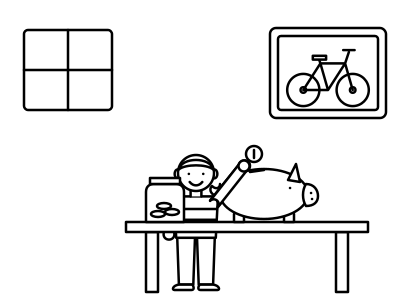
    A boy drops a coin into his piggy bank to save for the bike in the picture on the wall.

    Word box

    spend:
    to use money to buy something
    save:
    to keep money to use later
    goal:
    something you want to get or do
    patience:
    waiting calmly for something

    Questions

    1. What is the author's purpose: to inform, to entertain or to persuade?
    2. What is a goal?
    3. Why might someone save money instead of spending it?

    Weekly check

    Math

    Weekly Check

    • I can split a rectangle into rows and columns of same-size squares.
    • I can count the squares to find how many in all.
    1. Draw a rectangle with 4 rows and 3 columns of equal squares. How many squares?
    2. A rectangle has 5 rows of 4 squares. How many squares?
    3. Write an addition sentence for 3 rows of 3.
    4. A rectangle has 1 row of 6 squares. How many squares?
    5. Write an addition sentence for 2 rows of 9.
    6. Must the squares in a rectangle be the same size?yesno

    ELA

    Weekly Check

    • I can tell an author's purpose.
    • I can find facts about a topic in two sources.

    Two Sources About Frogs

    Source 1: A frog starts life as an egg in the water. Frogs eat insects. Source 2: Frogs catch insects with long, sticky tongues. Many frogs live near ponds.

    1. Why was a funny story about a frog who sings written?to informto entertainto persuade
    2. Why was a poster that says Save the frogs! written?to informto entertainto persuade
    3. Why were Source 1 and Source 2 written?to informto entertainto persuade
    4. Write one fact from Source 1.
    5. Write one fact from Source 2.
    6. What fact do both sources tell?

    Science

    Weekly Check

    • I can explain why habitats need protecting.
    • I can name ways people help protect habitats.
    1. Name the four things a habitat gives.
    2. Why do habitats need protecting?
    3. Circle the choice that helps a habitat.leaving trash by a creekplanting native flowerspouring oil in a pond
    4. Name two ways people can protect a habitat.
    5. What is the first step an engineer takes?

    Social Studies

    Weekly Check

    • I can explain the difference between saving and spending.
    • I can make a plan to save for a goal.
    1. What does saving mean?
    2. What does spending mean?
    3. Lucy puts 3 dollars in her bank for a game. Is she saving or spending?savingspending
    4. A book costs 8 dollars. Jamal saves 2 dollars each week. How many weeks will it take?
    5. Make a plan: My goal is ____. I will save ____ each week.

    Specials

    Health · Germs, Hygiene and Staying Well · All Specials

    This Week's Specials Page

    Health · Week 28

    I can wash my hands the right way.

    Look: Handwashing steps

    1. Wet your hands and add soap.
    2. Scrub palms, backs, between fingers and under nails. Hum the ABC song twice.
    3. Rinse, then dry with a clean towel.

    Glitter germs. A grown-up puts a little glitter or cocoa powder on your hands. Shake hands with someone, then touch a doorknob.

    1. Where did the "germs" go? Circle all you see.the other handthe doorknobmy clothes
    2. Now wash with the steps above. Did all the glitter come off? Circle one.yesalmostno

    When should you wash? Make a tally mark each time you wash your hands today.

    1. My handwashing tally:
    2. Name two times you should always wash your hands.
    3. When you cough or sneeze, cover it with your ____. Circle one.handelbow

    You need: glitter or cocoa powder, soap and water, a towel

    How did it go? Great Okay Tricky

    Home Connection

    This week at home

    • Math

      Splitting rectangles into rows and columns of squares

    • ELA

      Authors write to inform, entertain or persuade

    • Science

      People can protect the habitats living things need

    • Social Studies

      Saving now helps us buy bigger things later

    Three things to celebrate this week

    We did blank of 4 activities.

    Suggested Daily Schedule

    8:30–9:00 AM30 minMorning Meeting / Calendar / Read-Aloud
    9:00–9:30 AM30 minPhonics / Word Study / Spelling
    9:30–10:15 AM45 minReading Workshop
    10:15–10:35 AM20 minSnack and Outdoor Play / Movement Break
    10:35–11:05 AM30 minWriting Workshop
    11:05–11:50 AM45 minMathematics
    11:50 AM–12:35 PM45 minLunch and Free Play
    12:35–1:05 PM30 minScience OR Social Studies (alternating)
    1:05–1:35 PM30 minSpecials: PE / Art / Music / Health (rotating)
    1:35–2:00 PM25 minIndependent Reading / Enrichment