Quarter 1Week 9ThursdayDay 44 of 180

    Week 9, Thursday: Apply addition and subtraction within 1000 to word · Create their own text features for a piece

    Day 44 · 3 lessons · 140 min

    Math

    Students apply addition and subtraction within 1000 to word problems and check answers with the opposite operation (2.NBT.B.7, 2.OA.A.1).

    Standards Addressed

    Activities

    10 min

    Warm-Up

    Estimate first: for 298 + 405, ask, 'About how much? Is it more or less than 700?' Then solve (703). Do the same with 612 - 189 (about 400, exactly 423).

    paperpencil
    15 min

    Mini-Lesson

    Read aloud: 'A school library has 348 fiction books and 275 nonfiction books. How many books in all?' Draw a bar model, solve with a base-ten drawing (623). Then: 'The library lends out 156. How many stay on the shelves?' (467). Show the check: 467 + 156 should equal 623, and draw it to confirm.

    paperpencil
    15 min

    Practice

    Your child solves three problems with drawings and a check: 'A jar holds 425 beans, 180 are added, how many now?' (605); 'A road is 730 meters long, 465 are paved, how many meters are not paved?' (265); 'Two boxes hold 218 and 394 paper clips, how many total?' (612). Support: give a partly drawn base-ten picture for the first problem. Stretch: write your own problem with a three-digit answer that needs two regroupings.

    paperpencildried beans
    5 min

    Wrap-Up

    Ask, 'Why does adding back the number you subtracted get you to where you started?' Have your child show it with 5 beans: take 2 away, add 2 back.

    dried beans

    Materials Needed

    paperpencildried beans

    English Language Arts

    Students create their own text features for a piece of writing and complete a sequenced narrative with a closing (RI.2.5, W.2.3).

    Standards Addressed

    Activities

    15 min

    Read-Aloud

    Reread the section of 'Sharks' about shark senses. Cover each caption with a sticky note and have your child write a new caption for the photo, then compare with the author's. Talk about what a good caption does: names what is in the picture and adds one fact.

    National Geographic Kids Readers: Sharks by Anne Schreibersticky notespencil
    10 min

    Mini-Lesson

    Show that writers add features to help readers. Take last week's animal paragraph from the writing notebook and model adding a heading above it and a caption under the diagram. Ask, 'Which feature would help a reader who is in a hurry?'

    writing notebookpencil
    15 min

    Guided Reading

    Give your child a mini 'Scavenger Hunt' list for the 'Sharks' book: find a fact using the index, a word meaning using the glossary, a section using the table of contents, and a picture fact using a caption. Your child writes each fact and the feature used beside it.

    National Geographic Kids Readers: Sharks by Anne Schreiberwriting notebookpencil
    15 min

    Writing Workshop

    Your child writes the Last box: how the story ended and one sentence about how they felt ('I felt proud when the seed finally sprouted.'). Then reread the whole narrative from the top and add one detail about what someone said or did.

    writing notebookpencil
    10 min

    Phonics

    Teach the consonant-le ending, where the last syllable is a consonant plus 'le.' Read and divide before the consonant: table, little, puzzle, bubble, apple, turtle, middle, candle, purple, jungle. Have your child write three of them from dictation and clap the two syllables.

    whiteboard or papermarkerwriting notebookpencil

    Materials Needed

    National Geographic Kids Readers: Sharks by Anne Schreibersticky notespencilwriting notebookwhiteboard or papermarker

    Social Studies

    Students locate landforms and bodies of water on a map and describe how they shape where people live and travel (D2.Geo.2.K-2, D2.Geo.3.K-2).

    Standards Addressed

    Activities

    10 min

    Review and Extend

    Look at a map of your state (an atlas from the library or a printed map). Find the biggest river, a lake, and any mountains or hills, tracing each with a finger. Ask, 'Why do you think so many cities sit next to rivers?' Guide toward water for drinking, boats, and farming.

    state map or atlas
    15 min

    Project Work: Landform Map

    Your child draws an imaginary island on paper with at least five features: a mountain, a river running to the sea, a lake, a plain, and a hill. Add a key using brown triangles for mountains, blue lines for rivers, and green for plains, plus a compass rose and a title. Draw a small town where it makes the most sense and explain why.

    paperpencilcrayonsruler
    5 min

    Share Progress

    Your child presents the island map: 'My town is next to the river because ______.' Ask which direction the mountain is from the town.

    island map

    Materials Needed

    state map or atlaspaperpencilcrayonsruler

    Today's Practice

    One page for your child for each lesson. Answers are for grown-ups.

    Math practice · Week 9 · Thursday

    I can solve story problems and check with the opposite operation.

    Look: check your answer

    1. Solve: 518 − 243 = 275.
    2. Check by adding back: 275 + 243 = 518.
    3. You got back to where you started, so the answer is right.

    Draw a bar model. Solve. Then check with the opposite operation.

    1. A farm picked 364 red apples and 258 green apples. How many apples in all?
    2. Mia's school has 512 library books. It lends out 247. How many are still on the shelves?
    3. A trail is 480 meters long. Omar has walked 195 meters. How many meters are left?
    4. Kenji has 309 stickers. He gets 146 more. How many stickers now?

    Challenge

    • Write your own story problem with a three-digit answer. Solve it.
    How did it go? Great Okay Tricky

    ELA practice · Week 9 · Thursday

    I can add a heading and a caption to help a reader.

    Look: puddle → pud|dle

    1. Find the consonant + le at the end: dle.
    2. Draw a line before it: pud|dle.
    3. Read each part: pud-dle, puddle.

    ________

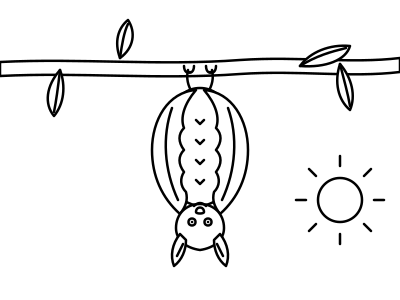
    Bats sleep in the day. At night, they wake up and fly out to hunt. Many bats eat bugs. When a bat rests, it hangs upside down by its feet.

    A bat rests upside down, hanging by its feet from a branch.

    Be the author. Add text features to the page above.

    1. Write a heading on the line above the page.
    2. Write a caption for the picture.
    3. Which word would you make bold? Why?

    Draw a line before the consonant + le. Read each part.

    1. giggle
    2. handle
    3. bottle
    4. cable
    How did it go? Great Okay Tricky

    Social Studies practice · Week 9 · Thursday

    I can make a map with landforms and a key.

    Draw an island map. Show a mountain, a river that runs to the sea, a lake, a plain and a hill. Add a key, a compass rose, a title and a town.

    1. My island map

    Think and write.

    1. What symbol did you use for a mountain on your key?
    2. My town is next to the ________ because ________.
    3. Which direction is the mountain from your town?
    How did it go? Great Okay Tricky