Week 12: Unit 2 Review: Place Value & Operations · Describing Connections in a Text

    Quarter 2 · Detailed day-by-day lesson plans · Days 56–60

    0 of 15 lessons done this week

    Unit 2 Review: Place Value & Operations Describing Connections in a Text

    Print

    Worksheets and answer keys

    Unit test

    Gather this week

    • Shop
    • Shop
    • Shop
    • Shop
    • Shop
    • Shop
    • Shop
    • Shop
    Everyday supplies (13)

    Writing prompt

    • Imagine you found a tiny door in your wall. Where does it lead?
    Week 12 writing prompts

    Parent note

    This week's parent digest

    Specials this week

    Supplements

    Unit 2 tests

    This week at a glance

    Week 12 reviews place value, skip counting, and operations within 1000. Readers describe connections within a text, and writers revise, edit, and publish informational pieces.

    Parent tip

    Celebrate the published writing piece with a family read-aloud night.

    Materials this week

    Mixed-review pages, published writing, family audience

    Mathematics

    Unit 2 Review: Place Value & Operations

    Addition & Subtraction Within 100 · 2.NBT.B.5

    Assessment: Mixed assessment: skip-counting, comparing, adding and subtracting within 1000

    ELA

    Describing Connections in a Text

    Phonics: Reading with purpose and understanding

    Writing: Revise and edit informational pieces; publish

    Science

    Plants, Animals & Habitats

    2-LS2-1, 2-LS2-2, 2-LS4-1, K-2-ETS1-2

    Social Studies

    Maps, Geography & Our World

    Monday — Day 56

    140 minutes of instruction

    Math

    Students review place value and skip-counting by 5s, 10s, and 100s from any number to prepare for the unit assessment (2.NBT.A.1, 2.NBT.A.2, 2.NBT.A.3).

    Standards Addressed

    Activities

    10 min

    Warm-Up

    Spiral from Week 11: your child reads their fridge index card explanation aloud, then solves 46 + 38 that way (84). Then skip-count by 5s from 35 to 100 while touching each number on the hundreds chart.

    index cardsprinted hundreds chart
    15 min

    Mini-Lesson

    Write 627. Your child builds it with straw bundles (6 hundreds, 2 tens, 7 ones), writes it in expanded form (600 + 20 + 7), and in words (six hundred twenty-seven). Then skip-count by 10s from 627 to 727 and by 100s from 627 to 927, writing each number and circling the digit that changes.

    straws bundled by tenrubber bandspaperpencil
    15 min

    Practice

    Your child completes three tasks: (1) draw 408 and 480 in base-ten pictures and explain the difference; (2) fill in the blanks 215, 220, ___, 230, ___, ___ and 340, 350, ___, ___, 380 and 150, 250, ___, ___, 550; (3) write 5 hundreds 13 tens 4 ones as a standard number (634).

    paperpencil
    5 min

    Wrap-Up

    Ask, 'Why is 5 hundreds 13 tens 4 ones the same as 634?' Have your child show the 10 tens regrouping to a hundred with straws.

    straws bundled by ten

    Materials Needed

    index cardsprinted hundreds chartstraws bundled by tenrubber bandspaperpencil

    English Language Arts

    Students describe the connection between a series of scientific ideas in a text (cause and effect) and revise the All About book for clear order (RI.2.3, W.2.2, W.2.8).

    Standards Addressed

    Activities

    15 min

    Read-Aloud

    Say, 'Last week you saw how pictures and words connect. This week we look at how ideas connect: one thing causes another.' Read the first half of 'Where Do Polar Bears Live?' by Sarah L. Thomson from the Let's-Read-and-Find-Out Science series, through the pages about hunting seals on the ice. Each time you read a 'because' or 'so,' stop and say the two connected ideas out loud.

    Where Do Polar Bears Live? by Sarah L. Thomson
    10 min

    Mini-Lesson

    Draw a chain of three links on chart paper and label it 'Ideas that connect.' Fill it from the book: thick fur and fat keep the bear warm, so the bear can live on the ice, so the bear can hunt seals there. Explain that nonfiction authors link ideas with words like because, so, then, and as a result.

    chart papermarker
    15 min

    Guided Reading

    Reread the pages about the bear's body. Your child finds two more cause-and-effect pairs and writes each as a chain on an index card ('Wide paws' arrow 'walks on snow without sinking'). Read each card back as a full sentence using 'so' or 'because.'

    Where Do Polar Bears Live? by Sarah L. Thomsonindex cardspencil
    15 min

    Writing Workshop

    Begin revising the All About book. Your child reads all three sections aloud and decides on the best order (most books start with what the plant or animal looks like or where it lives). Number the pages, then add one connecting sentence between two sections using 'because' or 'so' ('Bees visit flowers because they need nectar.').

    folderpencil
    10 min

    Word Study

    Reading with purpose starts with knowing the words. Preview and read these words from the polar bear book, discussing meaning: Arctic, seal, blubber, glacier, cub, den, ice, melt, hunt, tundra. Have your child use three of them in one sentence about a polar bear.

    index cardsmarker

    Materials Needed

    Where Do Polar Bears Live? by Sarah L. Thomsonchart papermarkerindex cardspencilfolder

    Science

    Students review what plants need by comparing two seedlings grown under different conditions and restate evidence-based claims from the unit (2-LS2-1).

    Standards Addressed

    Activities

    5 min

    Science Question of the Week

    Say, 'This week we look back at everything we learned about plants, animals, and habitats. Our question: What can we prove about how living things get what they need?' Reread the four questions of the week from the notebook (Weeks 7 to 11).

    science notebook
    20 min

    Investigation: Seedling Check-Up

    Bring out the Week 7 soil cups (or start two fresh cups with bean sprouts from a bag, one watered and one not, if the old cups are gone). Measure each plant's height in centimeters, count the leaves, and describe the color. Read 'The Tiny Seed' by Eric Carle and pause at each danger the seed faces; ask which need was missing each time (too cold, no soil, no water, eaten).

    soil cupsrulerThe Tiny Seed by Eric Carlenotebook
    5 min

    Wrap-Up

    Your child writes the unit's first claim: 'Plants need water and light. My evidence is ______.'

    notebookpencil

    Materials Needed

    science notebooksoil cupsrulerThe Tiny Seed by Eric Carlepencil
    Open Monday on its own page
    Social Studies

    Reading About Our World: Natural Resources All Around Us

    Read it aloud first while your child follows along. Then read it together, and let your child read the parts they can. Talk about the words in the word box.

    A natural resource is something from nature that people use. Water, trees, soil, air and sunlight are natural resources. Rocks are too.

    People need water to drink, cook and wash. Farmers use water to grow crops.

    Trees give us wood. People use wood to build houses and make furniture. Wood is also used to make paper. So the paper in your notebook began as a tree!

    Soil helps plants grow. Farmers plant seeds in soil. The seeds grow into food, like corn, beans and wheat. Wheat is made into flour, and flour is made into bread.

    We need to take care of natural resources so they last. We can turn off the water while we brush our teeth. We can recycle paper. We can plant new trees.

    Look around your home. What came from a natural resource?

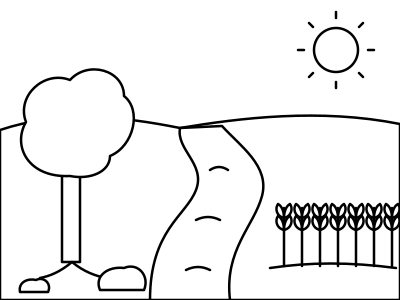
    A tree, a river, the sun, rocks and a field of wheat growing in the soil show natural resources.

    Word box

    natural resource:
    something from nature that people use
    soil:
    the top layer of the ground, where plants grow
    crops:
    plants that farmers grow for food
    recycle:
    to make something used into something new

    Questions

    1. How is the paper in your notebook connected to a tree?
    2. Put in order: bread, wheat, flour.
    3. Name one way to take care of natural resources.

    Weekly check

    Math

    Weekly Check

    • I can add and subtract within 1000.
    • I can use place value to check my answer.
    1. 527 + 286 = ____
    2. 345 + 167 = ____
    3. 650 − 213 = ____
    4. 904 − 378 = ____
    5. Check your answer to 904 − 378 by adding: ____ + 378 = ____
    6. Lee says 612 minus 385 is 337. Use place value to check. Is Lee right? What is the answer?

    ELA

    Weekly Check

    • I can tell how ideas in a text are connected (what happened first, what caused something).
    • I can revise my writing to make it clearer.

    Beavers Build Dams

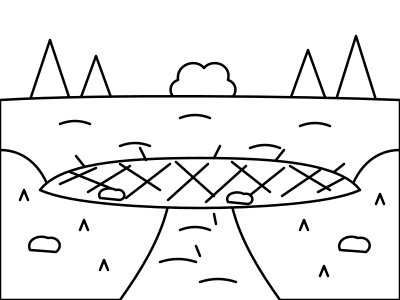
    A beaver cuts down small trees with its sharp teeth. It uses the sticks and mud to build a dam across a stream. The dam blocks the water, so a pond forms behind it. The pond gives the beaver a safe place to build its home.

    A beaver dam of sticks and mud stretches across a stream, with a pond behind it.
    1. What does a beaver use to build a dam?
    2. What happens because the dam blocks the water?
    3. Finish the chain: beaver builds a dam → ________ → ________
    4. Make it clearer. Add a detail: The beaver swam.
    5. Fix the capital and end mark: beavers have flat tails

    Science

    Weekly Check

    • I can explain how plants and animals depend on each other.
    • I can use this unit's words (pollen, seed, pollinate) correctly.
    1. Plants give animals ________ and ________.
    2. How does a bee help a flower?
    3. What does pollinate mean?
    4. What part of a plant makes seeds?the rootthe flowerthe stem
    5. What would happen to a rabbit if all the grass and plants near it were gone?

    Social Studies

    Weekly Check

    • I can describe communities and natural resources.
    • I can use this unit's geography words correctly.
    1. A big city is an ________ community.
    2. What does a compass rose show?
    3. Which one is a landform?a valleya river
    4. Which one can grow back?cottonmetal
    5. What is a continent?
    6. Name one natural resource and one way people use it.

    Specials

    Health · Food, Water and Energy · All Specials

    This Week's Specials Page

    Health · Week 12

    I can choose water when I am thirsty.

    Water tracker. Make a tally mark for each cup of water you drink each day this week.

    MonTueWedThuFri
    1. Which day did you drink the most cups of water?
    2. When does your body feel thirsty? Name one time.

    Kitchen helper. With a grown-up, wash and mix a fruit bowl or salad.

    1. Draw your bowl. How many colors did you use?
    2. Food gives your body energy for ____. Circle all that fit.playlearninggrowing

    You need: a cup, fruit or vegetables to wash (with a grown-up)

    How did it go? Great Okay Tricky

    Home Connection

    This week at home

    • Math

      Showing what I learned about big numbers

    • ELA

      How ideas connect, and making my writing better

    • Science

      Plants and animals need each other to live

    • Social Studies

      Maps, communities and resources: what I learned

    Three things to celebrate this week

    We did blank of 4 activities.

    Suggested Daily Schedule

    8:30–9:00 AM30 minMorning Meeting / Calendar / Read-Aloud
    9:00–9:30 AM30 minPhonics / Word Study / Spelling
    9:30–10:15 AM45 minReading Workshop
    10:15–10:35 AM20 minSnack and Outdoor Play / Movement Break
    10:35–11:05 AM30 minWriting Workshop
    11:05–11:50 AM45 minMathematics
    11:50 AM–12:35 PM45 minLunch and Free Play
    12:35–1:05 PM30 minScience OR Social Studies (alternating)
    1:05–1:35 PM30 minSpecials: PE / Art / Music / Health (rotating)
    1:35–2:00 PM25 minIndependent Reading / Enrichment