Quarter 2Week 12FridayDay 60 of 180

    Week 12, Friday: Complete a mixed Unit 2 assessment · Describe connections between ideas in a text

    Day 60 · 3 lessons · 140 min

    Math

    Students complete a mixed Unit 2 assessment covering skip-counting, comparing, and adding and subtracting within 1000 (2.NBT.A.2, 2.NBT.A.4, 2.NBT.B.5, 2.NBT.B.7, 2.NBT.B.8).

    Activities

    10 min

    Warm-Up

    Confidence check: your child rates each Unit 2 skill from 1 to 3 (skip-counting, comparing, adding within 100, adding four numbers, adding and subtracting within 1000, 10 and 100 more or less, explaining). Spend the remaining minutes on the skill rated lowest with one example problem.

    paperpencil
    15 min

    Review Mini-Lesson

    Rapid review of one example per skill: skip-count by 5s from 65 to 100; compare 738 and 783; solve 57 + 29 (86) with any strategy; add 21 + 19 + 33 + 27 (100); solve 624 - 258 (366) with a drawing; find 10 less and 100 more than 495 (485, 595). Your child leads, you coach.

    paperpencilprinted hundreds chart
    15 min

    Weekly Assessment

    Mixed assessment in four parts: (1) skip-count by 10s from 463 to 523 and by 100s from 218 to 718; (2) compare 604 and 640, 951 and 915, 377 and 377 with symbols; (3) solve 48 + 37, 83 - 46, 16 + 24 + 35 + 25, 367 + 458, 802 - 359 showing strategies or drawings; (4) write 10 more, 10 less, 100 more, 100 less for 596 and 305.

    paperpencilstraws bundled by tenloose straws
    5 min

    Wrap-Up

    Check together (part 3: 85, 37, 100, 825, 443; part 4: 606, 586, 696, 496 and 315, 295, 405, 205). Add the paper to the portfolio folder and celebrate the end of Unit 2. Preview next week: word problems with drawings and equations.

    folder

    Materials Needed

    paperpencilprinted hundreds chartstraws bundled by tenloose strawsfolder

    Assessment

    Mixed assessment: skip-counting, comparing, adding and subtracting within 1000

    English Language Arts

    Students describe connections between ideas in a text on a unit assessment and publish and present the All About book (RI.2.3, W.2.2, W.2.7).

    Standards Addressed

    Activities

    10 min

    Reading Celebration

    Lay out all six weeks of mentor texts and have your child pick a favorite, then name one skill from the unit it helped with (questions, main topic, text features, purpose, images, or connections). Look back at last week's diagram feedback sticky note and check that the revision happened.

    From Seed to Plant by Gail GibbonsWhat Do You Do with a Tail Like This? by Steve Jenkins and Robin PageNational Geographic Kids Readers: Sharks by Anne SchreiberMonarch Butterfly by Gail GibbonsThe Honey Makers by Gail GibbonsWhere Do Polar Bears Live? by Sarah L. Thomson
    15 min

    Reading Response or Assessment

    Your child reads the melting-ice spread of 'Where Do Polar Bears Live?' independently and answers in writing: What is the main topic of these pages? Write the chain of connected ideas using 'because' and 'so.' What is the author's purpose? Which picture helped most and what did it add? Score for a complete chain with at least three links and a correct purpose.

    Where Do Polar Bears Live? by Sarah L. Thomsonwriting notebookpencil
    15 min

    Publishing and Author's Chair

    Your child reads the whole All About book from the Author's Chair to the family, showing each diagram. The audience uses the table of contents to ask for one section to be read again and asks one question that the glossary answers. Place the book on a shelf with the mentor texts.

    finished All About book
    10 min

    Phonics Check

    Unit check: dictate ten words that mix the unit's patterns and have your child write and read them: careful, sadness, because, tiger, candle, sunflower, migrated, through, buzzed, habitat. Record results for planning Unit 3.

    writing notebookpencil
    15 min

    Independent Reading

    Your child reads a self-chosen book for 15 minutes with a purpose they name before starting ('I want to find out how ______'). At the end they say whether the purpose was met and what they will read next week when the unit changes to stories and poems.

    self-chosen book

    Materials Needed

    From Seed to Plant by Gail GibbonsWhat Do You Do with a Tail Like This? by Steve Jenkins and Robin PageNational Geographic Kids Readers: Sharks by Anne SchreiberMonarch Butterfly by Gail GibbonsThe Honey Makers by Gail GibbonsWhere Do Polar Bears Live? by Sarah L. Thomsonwriting notebookpencilfinished All About bookself-chosen book

    Assessment

    Unit 2 assessment: read the melting-ice spread of Where Do Polar Bears Live? and write the main topic, a chain of connected ideas, the author's purpose, and how an image helped; publish and present the All About research book; ten-word cumulative phonics check.

    Science

    Students summarize the unit by stating three claims with evidence about plant needs, habitats, and interdependence, and celebrate with a plant and animal poster (2-LS2-1, 2-LS2-2, 2-LS4-1).

    Standards Addressed

    Activities

    10 min

    Drawing Conclusions

    Your child completes three claim cards, one per index card: 'Plants need ______ (evidence: seed bags),' 'Different habitats have different living things (evidence: ______),' and 'Plants and animals depend on each other (evidence: ______).' Read each aloud and ask, 'Which experiment proved this?'

    3 index cardspencilscience notebook
    15 min

    Art Connection: Unit Poster

    Fold a large paper into four sections labeled Plant Parts, Animal Parts, Habitats, Seeds and Pollen. Your child draws one favorite thing from the unit in each section (the celery straws, the beak tools, the shoebox habitat, the bee test) and adds one sentence under each. Glue the three claim cards along the bottom.

    large papercrayons or markersglueclaim cards
    5 min

    Week Reflection

    Ask, 'Six weeks ago we studied matter. Now we studied living things. What is one thing living things do that a rock never does?' Your child writes one sentence and reads the poster aloud to a family member.

    notebookpencil

    Materials Needed

    3 index cardspencilscience notebooklarge papercrayons or markersgluenotebook

    Assessment

    Child states three unit claims and matches each to a specific investigation as evidence.

    Today's Practice

    One page for your child for each lesson. Answers are for grown-ups.

    Math practice · Week 12 · Friday

    Get ready: I can skip-count, compare, add and subtract.

    Warm up.

    1. 185, 190, ____, ____, 205
    2. 817 ____ 871 (write >, < or =)
    3. 10 less than 603 = ____ 100 more than 603 = ____

    Solve. Show your strategy.

    1. 25 + 17 + 33 + 15 = ____
    2. 72 − 38 = ____
    3. 458 + 276 = ____
    How did it go? Great Okay Tricky

    ELA practice · Week 12 · Friday

    Get ready: I can tell how ideas connect and make writing clearer.

    Leaves in Fall

    In the fall, the days get shorter and colder. Many trees stop making food in their leaves. The green color fades, so yellow and orange colors show. Then the leaves drop to the ground.

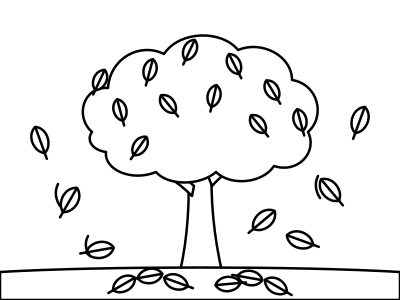
    A tree drops its yellow and orange leaves to the ground in the fall.

    Finish the chain.

    1. Days get shorter and colder → trees stop making food → ________ → leaves drop
    2. Why do yellow and orange show?

    Make each sentence clearer. Add a detail that tells where, when or how.

    1. The dog ran.
    2. We ate lunch.
    How did it go? Great Okay Tricky

    Science practice · Week 12 · Friday

    I can tell three things I proved about living things.

    Finish each claim card with your evidence.

    1. Plants need ________. My evidence: ________.
    2. Different habitats have different living things. My evidence: ________.
    3. Plants and animals depend on each other. My evidence: ________.

    Think and write.

    1. What is one thing living things do that a rock never does?
    2. Plan your poster. Draw one favorite thing for each part: Plant Parts, Animal Parts, Habitats, Seeds and Pollen.

    You need: a large sheet of paper, 3 index cards

    How did it go? Great Okay Tricky