Quarter 2Week 13MondayDay 61 of 180

    Week 13, Monday: Solve add-to and put-together word problems · Notice how rhyme and repeated beats give a poem its

    Day 61 · 3 lessons · 140 min

    Math

    Students will solve add-to and put-together word problems with the result unknown by drawing a bar model and writing an equation with a symbol for the unknown (2.OA.A.1).

    Standards Addressed

    Activities

    10 min

    Warm-Up

    Spiral from Week 12: write 47 + 25 and 300 + 400 on the board and have your child solve each mentally, then explain the strategy out loud. Ask, 'What did you do first?' and have them name one strategy from last week (make a ten, add the tens then the ones).

    15 min

    Mini-Lesson

    Read this problem aloud: 'Maya had 38 stickers. Her grandmother gave her 17 more. How many stickers does Maya have now?' Draw one long bar split into a part labeled 38 and a part labeled 17, with a ? bracket over the whole bar. Say, 'The parts are inside, the whole is the question mark.' Write 38 + 17 = ? and solve it together (38 + 17 = 55). Name this an 'add-to' problem because something was added to what Maya already had.

    15 min

    Practice

    Give two problems on index cards: 'Leo read 24 pages on Monday and 19 pages on Tuesday. How many pages did he read in all?' and 'There are 36 red beans and 28 white beans in the jar. How many beans are in the jar?' For each, your child draws the bar model, writes the equation with a ? for the unknown, and solves (43 and 64). Use dried beans to check the second one by counting groups of ten.

    5 min

    Wrap-Up

    Ask, 'How did you know both parts go inside the bar?' Have your child point to where the ? went and say, 'The whole was unknown.' Add the words add-to and put-together to a math word wall card.

    Materials Needed

    index cardsdried beanspaperpencilwhiteboard or large paper

    English Language Arts

    Students will notice how rhyme and repeated beats give a poem its rhythm and will state an opinion about a poem (RL.2.4, W.2.1).

    Standards Addressed

    Activities

    15 min

    Read-Aloud

    Open 'Where the Sidewalk Ends' by Shel Silverstein and read 'Sick' aloud with big expression, then read the title poem 'Where the Sidewalk Ends' slowly. Remind your child that last week they described how ideas connect in a nonfiction book; say that this week they will listen for how words connect through sound. Ask: 'Which lines made you laugh, and which lines sounded like a drum?'

    Where the Sidewalk Ends by Shel Silverstein
    10 min

    Mini-Lesson

    Write 'rhythm' and 'rhyme' on an index card. Reread the first eight lines of 'Sick' and tap the table on the strong beats (Peggy ANN McKAY) so your child hears the pattern, then have them tap along on the second read. Circle the rhyming pairs (today/McKay, mumps/bumps) on a copy or list them on paper.

    index cardspaperpencil
    15 min

    Guided Reading

    Let your child choose 'Hug O' War' or 'Boa Constrictor' and read it aloud to you twice, once for the words and once for the beat. Stop to ask what the poem is really about (a game where everyone wins; being swallowed a little at a time) and how the sounds make it funnier. Support: read each line first and have your child echo it. Stretch: have your child find the two lines that rhyme but are farthest apart on the page.

    Where the Sidewalk Ends by Shel Silverstein
    15 min

    Writing Workshop

    Start an opinion piece about the poems: your child writes the sentence frame 'My favorite poem in this book is ____ because ____.' Model with your own choice first, then have them draft one paragraph naming the poem and one reason. Keep this draft in a Writing Folder; it grows all week.

    writing paperpencilfolder
    10 min

    Phonics: Word Families

    Introduce the -ack and -ick families. Write and read together: back, pack, sack, snack, track, crack, black, quack; kick, lick, pick, stick, trick, quick, brick, thick. Have your child sort the 16 cards into the two families and read each column fast.

    index cardsmarker

    Materials Needed

    Where the Sidewalk Ends by Shel Silversteinindex cardsmarkerwriting paperpencilfolder

    Science

    Students will explain what engineers do and use a simple problem to identify a need that a design could solve (K-2-ETS1-1).

    This week's reading: What Do Engineers Do?

    Standards Addressed

    Activities

    5 min

    Science Question of the Week

    Ask: 'What is an engineer, and what do engineers make?' Remind your child that last unit they built a model of a seed carrier, and say that today they will learn the name for that kind of thinking. Write the word 'engineer' on an index card and read it together.

    20 min

    Investigation

    Walk through the house and hunt for ten things an engineer designed: a doorknob, a zipper, a faucet, a spoon, a chair. For each one ask, 'What problem does this solve?' and write the problem in a few words on a sticky note stuck to the object (spoon: 'soup runs off a fork'). Finish with the Index Card Tower Challenge: using only 20 index cards and no tape, build the tallest free-standing tower you can in 8 minutes and measure it with a ruler.

    20 index cardssticky notesrulerpencil
    5 min

    Wrap-Up

    Say: 'Engineers ask what the problem is, then design and test a solution.' Have your child say the sentence back and name one object from the hunt and the problem it solves. Start an Engineering Notebook (a folder or stapled paper) and record the tower height on page one.

    Materials Needed

    20 index cardssticky notesrulerpencilfolder or stapled paper for an Engineering Notebook

    Today's Practice

    One page for your child for each lesson. Answers are for grown-ups.

    Math practice · Week 13 · Monday

    I can use a bar model to solve adding stories.

    Look: Kim has 29 shells. She finds 16 more. How many now?

    1. Draw one long bar. Write the two parts inside: 29 and 16.
    2. The whole is missing. Put a ? over the whole bar. Write 29 + 16 = ?
    3. Add: 29 + 16 = 45. Kim has 45 shells.

    Draw a bar model. Write an equation with a ?. Then solve.

    1. Aiden has 37 blocks. His aunt gives him 25 more. How many blocks does he have now?
    2. A box has 46 red apples and 18 green apples. How many apples are in the box?
    3. Priya had 33 stickers. Her friend gave her 28 more. How many stickers does she have now?
    4. A farm has 54 hens and 27 ducks. How many birds are on the farm?

    Challenge

    • Write add-to or put-together next to each problem.
    How did it go? Great Okay Tricky

    ELA practice · Week 13 · Monday

    I can hear rhyme and rhythm in a poem.

    Look: -ack or -ick?

    1. Say stack. Listen to the end: -ack.
    2. Say kick. The end is -ick.
    3. Words with the same end rhyme: stack, back; kick, pick.

    Quick Snack

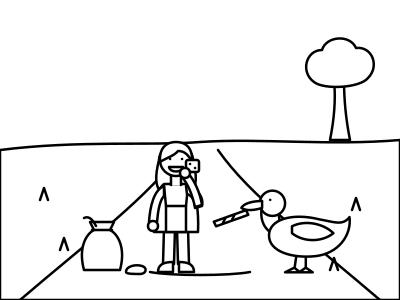
    Tick, tock, tick! It is time for a snack. I pack up my sack and I run down the track. My duck gives a quack and he nibbles a stick. We munch and we crunch and we eat it up quick!

    A child munches a cracker and a duck nibbles a snack stick together on a track.

    Read the poem two times. Tap the beat the second time.

    1. Circle two words that rhyme with snack.
    2. Underline the word that rhymes with stick.
    3. Why do you think the poem starts with "Tick, tock, tick"?

    Sort each word. Circle -ack or -ick.

    1. black-ack-ick
    2. brick-ack-ick
    3. crack-ack-ick
    4. thick-ack-ick
    5. trick-ack-ick

    Challenge

    • Finish: My favorite poem so far is ____ because ____.
    How did it go? Great Okay Tricky

    Science practice · Week 13 · Monday

    I can tell what an engineer does.

    Engineer hunt. Find things at home that someone designed. Write the problem each one solves.

    Thing I foundProblem it solves
    1. An engineer is a person who ____.

    Tower challenge: use 20 index cards and no tape. You have 8 minutes.

    1. My tower was ____ inches tall.
    2. What helped your tower stand up, or what made it fall?

    You need: 20 index cards, a ruler

    How did it go? Great Okay Tricky