Quarter 2Week 18MondayDay 86 of 180

    Week 18, Monday: Build rectangular arrays with up to 5 rows · Identify the lesson of a folktale

    Day 86 · 3 lessons · 140 min

    Math

    Students will build rectangular arrays with up to 5 rows and 5 columns, describe them by rows and columns, and count the total (2.OA.C.4).

    Standards Addressed

    Activities

    10 min

    Warm-Up

    Spiral from Week 17: hand your child 12 beans and ask, 'Odd or even? Prove it.' Then say, 'Instead of two rows, make three equal rows.' Let them arrange 3 rows of 4 and notice it looks like a neat rectangle.

    15 min

    Mini-Lesson

    Lay out 3 rows of 4 beans. Trace a finger across each row: 'Rows go across, like reading.' Trace down each column: 'Columns go up and down, like pillars.' Say, 'This is an array: 3 rows, 4 in each row, 12 in all.' Build a 2 by 5 array and a 4 by 3 array and describe each the same way. Show that an egg carton is a 2 by 6 array.

    15 min

    Practice

    Give array cards to build with beans: 2 rows of 3, 4 rows of 4, 3 rows of 5, 5 rows of 2, 1 row of 5. For each, your child builds it, writes 'rows: __, in each row: __, total: __,' and counts. Then hunt the kitchen for arrays (muffin tin, ice cube tray, tiles, a window with panes) and record two.

    5 min

    Wrap-Up

    Ask, 'What makes an arrangement an array?' Listen for 'equal rows and straight columns.' Add array, row, and column to the word wall.

    Materials Needed

    dried beansindex cardsegg carton or muffin tinpaperpencil

    English Language Arts

    Students will identify the lesson of a folktale and read prose aloud with accuracy and expression (RL.2.2, RF.2.4b).

    Standards Addressed

    Activities

    15 min

    Read-Aloud

    Read 'Stone Soup' by Marcia Brown. Say that last week they compared fact books; this week they will meet the oldest kind of story, the folktale, which people told out loud long before it was written down. Ask: 'Did the soldiers trick the villagers, or teach them something?'

    Stone Soup by Marcia Brown
    10 min

    Mini-Lesson

    Introduce three genre words on a card: folktale (an old story passed down by telling), fable (a short story with animals that teaches a lesson), and moral (the lesson). Write the moral of Stone Soup together in one sentence, such as 'When everyone shares a little, there is enough for all.'

    index cardspencil
    15 min

    Guided Reading

    Reread the part where the villagers bring one ingredient at a time. Your child reads the villagers' lines with a different voice for each, and you keep a list of what goes into the pot. Ask why the soldiers say 'a stone soup would be better with' instead of just asking for food.

    Stone Soup by Marcia Brownpaperpencil
    15 min

    Writing Workshop

    Introduce formal and informal English. Your child writes the same message two ways: a note to a friend about Stone Soup ('This book is so cool, you gotta read it!') and a note to a librarian ('I recommend Stone Soup because it teaches sharing'). Talk about which words changed and why.

    writing paperpencilfolder
    10 min

    Phonics: Fluency

    Read story words fast and smooth: soldiers, village, hungry, hidden, stone, pot, barley, delicious, feast, clever. Your child reads the list three times while you time it, then reads one sentence from the book that contains two of the words with expression.

    index cardsmarkertimerStone Soup by Marcia Brown

    Materials Needed

    Stone Soup by Marcia Brownindex cardspencilmarkerpaperwriting paperfoldertimer

    Science

    Students will retrace every step of the engineering design process using their own project as the example (K-2-ETS1-1, K-2-ETS1-2, K-2-ETS1-3).

    Standards Addressed

    Activities

    5 min

    Science Question of the Week

    Ask: 'What are the steps an engineer follows, in order?' Let your child try from memory, then check against the notebook: ask, imagine, plan, build, test, improve, share. Note that last Friday's Design C sketch was another 'improve' step.

    20 min

    Investigation

    Make a Design Process Path on a long strip of paper: seven stepping stones labeled with the steps, and under each glue a copy or small drawing of the matching notebook page (the problem statement, the brainstorm list, the final plan, the prototype photo, the Test Sheet, the before-and-after comic, the recommendation). Then build Design C from Friday's sketch in the remaining time, using the best parts of A and B.

    long strip of paperglue stickscissorsmarkersrecycling-bin materialstapeEngineering Notebook
    5 min

    Wrap-Up

    Walk the path together, saying one sentence per stone about what you did. Ask: 'Which stone would you skip if you were in a hurry, and what would go wrong if you did?'

    Materials Needed

    long strip of paperglue stickscissorsmarkersrecycling-bin materialstapeEngineering Notebook

    Today's Practice

    One page for your child for each lesson. Answers are for grown-ups.

    Math practice · Week 18 · Monday

    I can build an array and tell its rows and columns.

    Look: 3 rows of 2

    1. Rows go across, like reading.
    2. Columns go up and down.
    3. 3 rows, 2 in each row, 6 in all.

    Draw each array with dots. Fill in the numbers.

    1. 2 rows of 4. Total: ____
    2. 4 rows of 5. Total: ____
    3. 5 rows of 5. Total: ____
    4. 1 row of 3. Total: ____

    Find an array at home, like an egg carton or a muffin tin.

    1. What I found: ____ Rows: ____ In each row: ____ Total: ____

    Challenge

    • What makes a group of objects an array?
    How did it go? Great Okay Tricky

    ELA practice · Week 18 · Monday

    I can tell the lesson of a folktale and read it with expression.

    Look: find the lesson

    1. Story: Rabbit shared her carrots with Mole. Later, Mole dug Rabbit a safe hole.
    2. Ask: What did the characters learn?
    3. Lesson: Kindness comes back to you.

    The Plum Tree

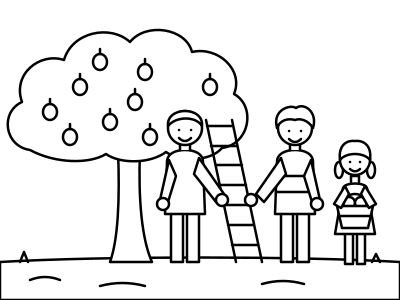
    Long ago, a village had one tall tree full of plums. The plums grew too high to reach. Each family tried alone, but no one could get a plum. Then a girl said, "Let us work together." One family brought a ladder. One brought a basket. Two strong men held the ladder still. Soon every family had sweet plums to eat.

    Villagers hold a ladder steady under a tall plum tree while a girl holds a basket.

    Use the story above.

    1. What is the lesson (the moral) of this folktale?
    2. What did each family try first?
    3. Read the story aloud three times. Color a star each time.

    Write about the story two ways.

    1. Informal, to a friend: ____
    2. Formal, to a librarian: I recommend ____ because ____.
    How did it go? Great Okay Tricky

    Science practice · Week 18 · Monday

    I can put the steps of the design process in order.

    Write the steps in order. Use the word bank.

    • ask
    • imagine
    • plan
    • build
    • test
    • improve
    • share
    1. 1. ____ 2. ____ 3. ____ 4. ____ 5. ____ 6. ____ 7. ____
    2. Which step was your Design C sketch?planimproveshare

    Build Design C. Then think.

    1. Draw Design C.
    2. Which step would you skip if you were in a hurry? What would go wrong?

    You need: your Design C sketch, cardboard, paper and tape

    How did it go? Great Okay Tricky