Quarter 2Week 18TuesdayDay 87 of 180

    Week 18, Tuesday: Write a repeated addition equation to find the total · Identify the moral of a fable and read it aloud

    Day 87 · 3 lessons · 140 min

    Math

    Students will write a repeated addition equation to find the total in an array by adding the rows (2.OA.C.4).

    Standards Addressed

    Activities

    10 min

    Warm-Up

    Skip-count by 2s to 20, by 5s to 50, and by 3s to 15 (3, 6, 9, 12, 15) while pointing to rows of beans as you count. Ask, 'Why does counting by 5s work for 5 beans in each row?'

    15 min

    Mini-Lesson

    Build 3 rows of 4 beans. Touch each row and say '4 plus 4 plus 4.' Write 4 + 4 + 4 = 12 and say, 'Each row is an addend. Three rows means three 4s.' Build 4 rows of 2 and write 2 + 2 + 2 + 2 = 8. Build 2 rows of 5 and write 5 + 5 = 10. Emphasize: 'The number of rows tells you how many times to write the addend.'

    15 min

    Practice

    Draw 6 arrays on a page using dots (3 by 3, 2 by 4, 5 by 3, 4 by 5, 1 by 4, 3 by 2). Your child writes a repeated addition equation for each by rows and finds the total (9, 8, 15, 20, 4, 6). Then reverse it: give the equation 5 + 5 + 5 + 5 = 20 and have your child build the array with beans.

    5 min

    Wrap-Up

    Ask, 'How many 3s did you add for 5 rows of 3?' Listen for 'five 3s, that is 15.' Ask what skip-count matched.

    Materials Needed

    dried beansarray page with dot arrayspaperpencil

    English Language Arts

    Students will identify the moral of a fable and read it aloud with expression and appropriate rate (RL.2.2, RF.2.4b).

    Standards Addressed

    Activities

    15 min

    Shared Reading

    Read 'The Tortoise and the Hare' (Jerry Pinkney's picture book version or any Aesop collection). Your child reads the Hare's boasting lines with a bragging voice and the Tortoise's with a slow, steady one. Ask: 'What is the moral? Is it the same lesson as Stone Soup?'

    The Tortoise and the Hare by Jerry Pinkney or an Aesop's Fables collection
    10 min

    Mini-Lesson

    Start a Morals chart with columns Story and Moral. Add Stone Soup and The Tortoise and the Hare, then read two more one-page Aesop fables ('The Lion and the Mouse', 'The Boy Who Cried Wolf') and add their morals in your child's words. Point out that fables say the moral right at the end, and folktales make you figure it out.

    an Aesop's Fables collectionpaperpencil
    15 min

    Independent Reading

    Your child rereads 'The Tortoise and the Hare' alone, then reads the race scene aloud to you at a speed that matches each animal: rushing for the Hare, slow and steady for the Tortoise. Ask them to explain why changing speed helps a listener understand.

    The Tortoise and the Hare by Jerry Pinkney or an Aesop's Fables collection
    15 min

    Writing Workshop

    Your child writes a short fable of their own with two animals and a moral at the end (three to six sentences). Model the frame: a boastful animal, a quiet animal, a contest, a surprise, and 'The moral is'.

    writing folderpencil
    10 min

    Phonics: Fluency

    Phrase reading: write these phrases on strips and have your child read each smoothly as one chunk, not word by word: slow and steady, ran ahead, took a nap, crossed the finish line, laughed at the tortoise, wins the race. Then they read two strips in a row with no pause between.

    paper stripsmarker

    Materials Needed

    The Tortoise and the Hare by Jerry Pinkney or an Aesop's Fables collectionStone Soup by Marcia Brownpaperpencilwriting folderpaper stripsmarker

    Social Studies

    Students will review what government does, how leaders are chosen, and what national symbols mean, and explain why people follow shared rules (D2.Civ.1.K-2, D2.Civ.5.K-2, D2.Civ.8.K-2, D2.Civ.10.K-2).

    This week's reading: Holidays We Share

    Activities

    10 min

    Read-Aloud and Discussion

    Read 'I Pledge Allegiance' by Bill Martin Jr. and Michael Sampson, which explains the pledge one phrase at a time. Stop at 'republic' and 'liberty and justice for all' and connect them to the unit: a republic means we choose our leaders by voting, and justice was the word from 'We the Kids'. Ask: 'Which parts of the pledge are about symbols, and which are about promises?'

    I Pledge Allegiance by Bill Martin Jr. and Michael Sampson (library)
    15 min

    Hands-On Activity

    Play Civics Bingo: make a 3 by 3 board with the words government, mayor, governor, president, vote, ballot, flag, eagle, symbol. You read a clue ('the leader of a state', 'a paper you mark to choose') and your child covers the matching word with a dried bean; three in a row wins and then the roles swap so your child reads clues to you.

    paper for a bingo boardmarkerdried beans
    5 min

    Quick Write

    Your child writes two sentences: 'A government ___.' and 'I can be a good citizen by ___.' Support: provide word bank cards from the bingo board. Stretch: add a third sentence explaining why a community needs rules everyone follows, even people who voted the other way.

    Materials Needed

    I Pledge Allegiance by Bill Martin Jr. and Michael Sampson (library)paper for a bingo boardmarkerdried beanspencilwriting paper

    Today's Practice

    One page for your child for each lesson. Answers are for grown-ups.

    Math practice · Week 18 · Tuesday

    I can write a repeated addition equation for an array.

    Look: 2 rows of 5

    1. Each row has 5.
    2. 2 rows means two 5s: 5 + 5.
    3. 5 + 5 = 10.

    Draw the array. Add the rows. Write the total.

    1. 4 rows of 3: ____ + ____ + ____ + ____ = ____
    2. 5 rows of 2: ____ = ____
    3. 2 rows of 2: ____ = ____
    4. 5 rows of 4: ____ = ____

    Now go the other way.

    1. Draw the array for 3 + 3 + 3 + 3 + 3 = ____.

    Challenge

    • How many 4s do you add for 4 rows of 4? What is the total?
    How did it go? Great Okay Tricky

    ELA practice · Week 18 · Tuesday

    I can tell the moral of a fable and read it at the right speed.

    Look: find the moral

    1. Fable: Squirrel saved nuts for winter. Grasshopper only played.
    2. When the cold came, Squirrel had food. Grasshopper did not.
    3. Moral: Get ready today for what comes tomorrow.

    The Rooster and the Wren

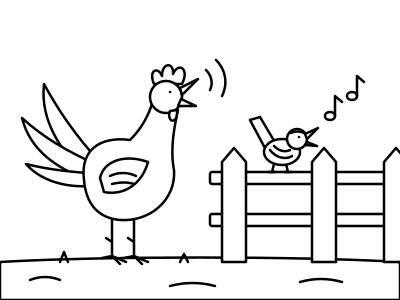
    A proud rooster said, "I am the best singer on the farm!" He crowed so loudly that he never stopped to listen. A little wren practiced her song each day, soft and sweet. When the farm children picked a song for their party, they did not pick the rooster. They picked the wren. The moral is: practice does more than bragging.

    A proud rooster crows loudly while a small wren sings on a fence.

    Use the fable above.

    1. Who brags in this fable?
    2. Underline the moral.
    3. Is the moral the same as Stone Soup's lesson?yesno
    4. Read the rooster's line in a bragging voice. Read the wren's part softly. Put a check here.

    Start your own fable with two animals.

    1. A boastful ____ and a quiet ____ had a contest. ____
    2. The moral is ____.
    How did it go? Great Okay Tricky

    Social Studies practice · Week 18 · Tuesday

    I can explain what government does and what our symbols mean.

    Read the clue. Write the word from the word bank.

    • mayor
    • governor
    • president
    • ballot
    • vote
    • eagle
    1. the leader of a town or city
    2. the leader of a state
    3. the leader of our country
    4. a paper you mark to choose
    5. the bird that is a symbol of our country

    Finish the sentences.

    1. A government ____.
    2. I can be a good citizen by ____.

    Challenge

    • Why do we follow rules even when our side lost the vote?
    How did it go? Great Okay Tricky