Quarter 3Week 24TuesdayDay 117 of 180

    Week 24, Tuesday: Count mixed coins by starting with the largest value · Describe how a character responds to meeting someone

    Day 117 · 3 lessons · 140 min

    Math

    Students will count mixed coins by starting with the largest value and skip counting, finding totals within $1 (2.MD.C.8).

    Standards Addressed

    Activities

    10 min

    Warm-Up

    Pull five random coins from the jar, one at a time, and have your child name each and its value. Then ask: 'If we wanted to count all five together, which coin should we start with?' (the biggest value).

    jar of coins
    15 min

    Mini-Lesson: Biggest First

    Lay out 1 quarter, 2 dimes, 1 nickel, and 3 pennies. Order them from largest value to smallest and count aloud, touching each: '25, 35, 45, 50, 51, 52, 53. That is 53¢.' Repeat with 2 quarters, 1 dime, 2 nickels, 4 pennies (50, 60, 65, 70, 71, 72, 73, 74¢). Write each total with the ¢ symbol.

    jar of coinspaperpencil
    15 min

    Practice: Coin Handfuls

    Your child grabs a small handful from the jar (adjust to keep totals under $1), sorts biggest to smallest, counts aloud, and writes the total. Do this 5 times and record each on a chart. Support: give exact sets to count, such as 3 dimes, 2 nickels, 2 pennies (42¢). Stretch: count a handful that includes 3 quarters and reaches close to $1, such as 3 quarters, 2 dimes, 1 nickel (100¢, which is $1.00).

    jar of coinschart paperpencil
    5 min

    Wrap-Up

    Ask: 'Why is it easier to start with quarters instead of pennies?' Your child writes 'Count the biggest coins first' in their journal with one example.

    math journalpencil

    Materials Needed

    jar of coinschart paperpapermath journalpencil

    English Language Arts

    Students will describe how a character responds to meeting someone new and use newly learned words in conversation (RL.2.3, L.2.6).

    Standards Addressed

    Activities

    15 min

    Shared Reading

    Read Chapter 5, 'Charlotte.' Your child reads Charlotte's short lines ('Salutations!') and you read the rest. Add a row to the chart: Event: Charlotte explains she drinks blood. Response: Wilbur is worried. Clue: find the sentence together.

    Charlotte's Web by E. B. WhiteEvent Response Clue chart
    10 min

    Mini-Lesson: Figure Out the Word from the Sentence

    Reread the line where Charlotte explains 'salutations' means greetings. Say: 'Sometimes the author tells you the meaning right there. Other times you use the sentences around it.' Try 'bloodthirsty' and 'cruel' with clues from the page.

    Charlotte's Web by E. B. White
    15 min

    Independent Reading

    Your child reads their leveled story for 12 minutes and picks two words they figured out from context. They tell you the word, their guess, and the clue.

    leveled storybooksticky notes
    15 min

    Writing Workshop: Word Collector Grows

    Add 'salutations, bloodthirsty, cruel, trapped' to the Word Collector with book sentences and own sentences. Then your child writes a four-sentence paragraph about how Wilbur felt when he met Charlotte, using at least two collected words. Support: give the opening 'When Wilbur met Charlotte, he felt...' and a word bank. Stretch: use four collected words and one adjective and adverb from Week 22.

    Word Collector bookletpaperpencilCharlotte's Web by E. B. White
    10 min

    Word Study: Splitting Between Consonants

    Write 'rabbit, basket, button, Wilbur, Templeton, Lurvy' and 'spider, tiny, music, silent, Fern.' Show that when two consonants sit between vowels you split between them (rab-bit) and when one consonant sits between vowels you usually split before it (spi-der). Your child marks the split and reads each word.

    paperpencil

    Materials Needed

    Charlotte's Web by E. B. WhiteEvent Response Clue chartleveled storybooksticky notesWord Collector bookletpaperpencil

    Social Studies

    Students will review how one place changes over time and sequence events from long ago to now using a real street-through-time text (D2.His.1.K-2, D2.His.2.K-2, D2.His.9.K-2).

    This week's reading: Getting Around, Then and Now

    Activities

    10 min

    Read-Aloud and Discussion

    Read selected spreads from 'A Street Through Time' by Anne Millard (DK), which shows the same riverside spot at many points in history. Stop at three or four pages and ask: 'What do people use for houses now? How do they travel? What invention just appeared?' Connect to 'The Little House' from Week 19.

    A Street Through Time by Anne Millard (library)
    15 min

    Hands-On Activity: Unit Timeline

    Stretch a piece of string across the table and clip on cards in order as your child places them: Wampanoag and Taino people living on the land (thousands of years ago), Columbus's ships (1492), Sarah Morton's village (1627), Ben Franklin's lightning rod (1752), George Washington Carver's farm science (early 1900s), Ruby Bridges walks to school (1960), William Kamkwamba's windmill (2002), me (today). Read it left to right and ask which events were 'long ago' and which were 'not so long ago.'

    string8 index cardsclothespins or paper clipsmarker
    5 min

    Quick Write

    Your child writes: 'The oldest event on our timeline is ___. The newest is ___. One thing that changed between them is ___.'

    notebookpencil

    Materials Needed

    A Street Through Time by Anne Millard (library)string8 index cardsclothespins or paper clipsmarkernotebookpencil

    Today's Practice

    One page for your child for each lesson. Answers are for grown-ups.

    Math practice · Week 24 · Tuesday

    I can count mixed coins, biggest first.

    Look: 1 quarter, 1 dime, 2 nickels, 1 penny

    1. Put the coins in order from biggest value to smallest.
    2. Count on: 25, 35, 40, 45, 46.
    3. The total is 46¢.

    Put the coins in order. Count on. Write the total with ¢.

    1. 1 quarter, 3 dimes, 2 pennies = ____¢
    2. 2 quarters, 2 dimes, 1 nickel = ____¢
    3. 4 dimes, 3 nickels, 1 penny = ____¢
    4. 3 quarters, 1 nickel, 4 pennies = ____¢
    5. 1 quarter, 1 dime, 1 nickel, 1 penny = ____¢

    Grab a small handful of coins. Draw them. Count them.

    1. My handful:

    Challenge

    • Which set on this page is closest to $1.00?

    You need: a jar of coins

    How did it go? Great Okay Tricky

    ELA practice · Week 24 · Tuesday

    I can tell how characters respond and use clues to learn words.

    Look: Clues for a new word

    1. Read: The kitten was so famished that it ate the whole bowl fast.
    2. Clue: it ate the whole bowl fast.
    3. Famished means very hungry.

    The New Girl

    Dev saw a new girl at the park. She sat alone on a bench. She looked timid, like she was too shy to talk. Dev felt a little shy too, but he walked over. "Hi, I'm Dev. Do you want to swing?" The girl smiled a big smile. "Yes!" she said. Her name was Rosa. By the end of the day, they were friends.

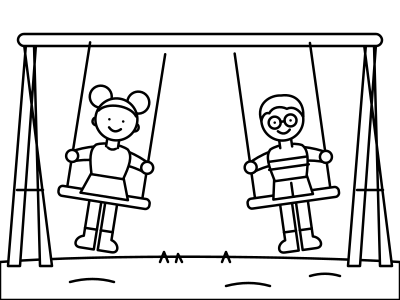
    Two children play on swings.

    Use the story.

    1. How does Dev respond when he sees the new girl?
    2. How does Rosa respond?
    3. What does timid mean? What clue helped you?

    Draw a line to split each word. Read it.

    1. tiger
    2. happen
    3. pencil
    4. hotel
    How did it go? Great Okay Tricky

    Social Studies practice · Week 24 · Tuesday

    I can put events in order from long ago to now.

    Number the events from oldest (1) to newest (5).

    1. Ruby Bridges walks to her new school (1960).
    2. Columbus's ships reach the Taino islands (1492).
    3. William Kamkwamba builds a windmill (2002).
    4. English settlers build a village at Plymouth (1620).
    5. Benjamin Franklin makes the lightning rod (1750s).

    Finish the sentences.

    1. The oldest event is ________. The newest is ________.
    2. One thing that changed between them is ________.
    How did it go? Great Okay Tricky