Week 24: Money: Coins and Dollar Bills · Character Responses and Story Lessons

    Quarter 3 · Detailed day-by-day lesson plans · Days 116–120

    0 of 15 lessons done this week

    Money: Coins and Dollar Bills Character Responses and Story Lessons

    Print

    Worksheets and answer keys

    Unit test

    Gather this week

    • Shop
    • Shop
    • Shop
    Everyday supplies (8)

    Writing prompt

    • Tell about a time something didn't go as planned. What did you learn?
    Week 24 writing prompts

    Parent note

    This week's parent digest

    Unit 4 tests

    This week at a glance

    Week 24 works with coins and dollar bills in word problems. In ELA, children study how characters respond to events and what stories teach, while building vocabulary.

    Parent tip

    Let your child pay for one small item in cash this week.

    Materials this week

    Real coins and bills, story with strong character arc

    Mathematics

    Money: Coins and Dollar Bills

    Measurement & Data · 2.MD.A.1

    Assessment: Identify coins; solve word problems involving dollar bills, quarters, dimes, nickels, pennies

    ELA

    Character Responses and Story Lessons

    Phonics: Multisyllabic word strategies review

    Writing: Vocabulary

    Science

    Earth's Systems: Water, Wind & Land

    2-ESS1-1, 2-ESS2-1, 2-ESS2-2, 2-ESS2-3

    Social Studies

    History: Past and Present

    Monday — Day 116

    140 minutes of instruction

    Math

    Students will identify pennies, nickels, dimes, and quarters by name and value and count a group of one coin type (2.MD.C.8).

    Standards Addressed

    Activities

    10 min

    Warm-Up

    Set the paper clock to 10:15 as a quick review from last week. Then dump a handful of coins from the coin jar on the table and ask: 'How could we sort these?' Sort by kind into four piles without naming values yet.

    paper clockjar of coins
    15 min

    Mini-Lesson: Meet the Coins

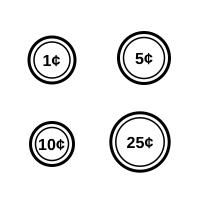
    Hold up one of each coin and name it with its value: penny 1¢ (copper, smallest value), nickel 5¢ (thick, smooth edge), dime 10¢ (smallest size but worth more than a nickel), quarter 25¢ (biggest). Write the values on four index cards as 1¢, 5¢, 10¢, 25¢ and place the matching coin on each. Point out the trick that size does not tell value: the dime is tiny but worth 10¢.

    one penny, nickel, dime, and quarter4 index cardsmarker
    15 min

    Practice: Count One Kind

    Your child counts groups of a single coin and writes the total with the ¢ symbol: 7 pennies (7¢), 6 nickels counting by 5s (30¢), 8 dimes counting by 10s (80¢), 3 quarters counting 25, 50, 75 (75¢). Then they make 40¢ three different ways using one coin type each time (40 pennies, 8 nickels, 4 dimes).

    jar of coinspaperpencil
    5 min

    Wrap-Up

    Ask: 'Which is worth more, a dime or a nickel? How do you know?' Your child draws the four coins in their journal with their values written as 1¢, 5¢, 10¢, and 25¢.

    math journalpencil

    Materials Needed

    paper clockjar of coins4 index cardsmarkerpapermath journalpencil

    English Language Arts

    Students will describe how a character responds to a major event and begin collecting vocabulary from reading (RL.2.3, L.2.6).

    Standards Addressed

    Activities

    15 min

    Read-Aloud

    Read Chapter 4 of 'Charlotte's Web,' 'Loneliness.' Before reading, ask your child to recall last week's opinion about whether Wilbur should have escaped, then say that this week you will watch how Wilbur responds to what happens to him. Stop at the end and ask, 'It rained all day and nobody would play. What did Wilbur do, say, and feel?'

    Charlotte's Web by E. B. White
    10 min

    Mini-Lesson: Event, Response, Clue

    Make a three-column chart: Event, How the Character Responds, Clue in the Text. Fill the first row together: Event: rain ruins Wilbur's plans. Response: he cries and feels friendless. Clue: 'Wilbur burst into tears.' Keep the chart up all week.

    chart papermarker
    15 min

    Guided Reading

    Your child reads a story at their level for 12 minutes and adds one row to a mini version of the chart for their own character. Check that the clue is a real sentence or phrase from the book.

    leveled storybookpaperpencil
    15 min

    Writing Workshop: Starting a Word Collector

    Fold three sheets into a 'Word Collector' booklet. Explain that this week your child will gather words from the books they read and use them in their own writing. Start with three from Chapter 4: 'lonely, friendless, dreary.' For each, they write the word, the sentence it came from, and a new sentence of their own.

    3 sheets folded into a bookletpencilCharlotte's Web by E. B. White
    10 min

    Word Study: Chunking Long Words

    Write 'loneliness, friendship, tremendous, miserable, appetite, spider, interesting, salutations.' Model chunking 'lone-li-ness' with a finger under each part and blending. Your child chunks and reads the rest, then finds 'loneliness' in the chapter title.

    papermarker

    Materials Needed

    Charlotte's Web by E. B. Whiteleveled storybookchart papermarkerWord Collector bookletpaperpencil

    Science

    Students will review the unit by building a single model that shows land, liquid water, ice, and wind acting on Earth's surface (2-ESS1-1, 2-ESS2-1, 2-ESS2-2, 2-ESS2-3).

    Activities

    5 min

    Science Question of the Week

    Lay out the collage, the pan map, the paper plate Earth, and the wind painting from the last five weeks. Ask: 'What is the one big idea all of these share?' Guide toward: water, ice, and wind shape the land, some changes fast and some slow.

    saved projects from Weeks 19 to 23
    20 min

    Investigation: Whole Earth Pan

    Build the pan landscape one last time with a mountain, river groove, lake, and a bare and a planted slope. Run all three forces: pour a cup of water down the mountain, slide a gravel ice cube down one side, and blow through a straw across a dry patch. After each, your child says what moved, whether it was fast or slow, and whether the change was made by liquid water, ice, or wind.

    baking pandamp sand or soilgrass clippings or paper towelcup of watergravel ice cube (freeze the night before)drinking strawtowel
    5 min

    Wrap-Up

    Your child draws the final pan and labels three places where the land changed, with the cause of each. Say: 'Earth's surface is always changing.'

    paperpencil

    Materials Needed

    saved projects from Weeks 19 to 23baking pandamp sand or soilgrass clippings or paper towelcup of watergravel ice cube (freeze the night before)drinking strawtowelpaperpencil
    Open Monday on its own page
    Social Studies

    Reading About Our World: Getting Around, Then and Now

    Read it aloud first while your child follows along. Then read it together, and let your child read the parts they can. Talk about the words in the word box.

    Long ago, most people went places on foot. Some rode horses. Families moved their things in wagons pulled by horses or oxen. A long trip could take weeks or even months.

    Then people invented new ways to travel. Trains with steam engines could go much faster than wagons. In 1869, workers finished the first railroad that crossed the United States.

    In 1903, Orville and Wilbur Wright flew the first airplane with an engine. Their first flight lasted only 12 seconds!

    Cars changed travel too. At first, few families could buy one. Then Henry Ford found a faster way to build cars, so they cost less. Soon many more families had a car.

    Today people travel by car, bus, train and plane. A trip that once took months can take just a few hours. How did you travel the last time you went somewhere?

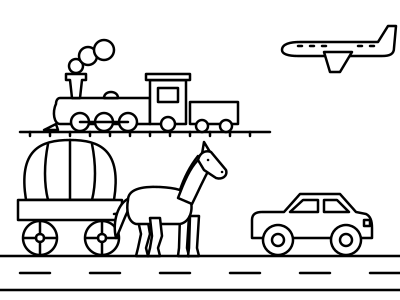
    Travel then and now: a horse pulls a covered wagon, a car drives on the road, a steam train passes and a jet plane flies above.

    Word box

    invent:
    to make something new that was never made before
    wagon:
    a cart with four wheels, often pulled by animals
    engine:
    a machine that makes something move
    travel:
    to go from one place to another

    Questions

    1. How did most people travel long ago?
    2. Who flew the first airplane with an engine?
    3. Why could more families buy cars after Henry Ford's idea?

    Weekly check

    Math

    Weekly Check

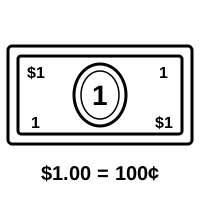
    • I can find the value of a group of coins and dollar bills.
    • I can solve money word problems using the $ and ¢ signs.
    1. 2 quarters, 1 dime, 3 pennies = ____¢
    2. 1 quarter, 4 dimes, 2 nickels = ____¢
    3. One $5 bill and two $1 bills = $____
    4. Kim has 3 dimes and 2 nickels. How much money does she have?
    5. Raj buys a pencil for 30¢. He pays with 2 quarters. What is his change?
    6. Eva has $6. She earns $4 more. How much does she have now?

    ELA

    Weekly Check

    • I can tell how characters respond to events and what lesson a story teaches.
    • I can read long words by breaking them into syllables.

    Pip Digs

    Pip the puppy dug a hole in the garden and ruined the flowers. Grandma was upset. Pip hung his head and hid behind the shed. Then he brought Grandma a stick and wagged his tail. Grandma laughed and hugged him. The next day, Pip dug only in his sandbox.

    1. What event happens at the start?
    2. How does Pip respond when Grandma is upset?
    3. What lesson does the story teach?
    4. Split into syllables: garden
    5. Split into syllables: tomorrow
    6. Split into syllables: basketball

    Science

    Weekly Check

    • I can describe Earth's land, water and weather.
    • I can explain how wind and water change land.
    1. Name one land feature and one water feature.
    2. Name two kinds of weather.
    3. How can moving water change land?
    4. How can wind change land?
    5. A flood washes away a road.fastslow
    6. A river carves a canyon.fastslow

    Social Studies

    Weekly Check

    • I can compare the past and the present.
    • I can tell about important people, events and inventions from this unit.
    1. Tell one way travel long ago was different from today.
    2. Put in order from oldest to newest: Ruby Bridges walks to school, Columbus's ships arrive, settlers come to Plymouth.
    3. Who made the lightning rod?Benjamin FranklinRuby BridgesWilliam Kamkwamba
    4. Name one important person from this unit and tell what they did.
    5. Name one thing that is the same now as long ago.

    Specials

    Health · Safety at Home and Outdoors · All Specials

    This Week's Specials Page

    Health · Week 24

    I can cross the street safely and wear my helmet.

    Look: Crossing the street

    1. Stop at the curb with a grown-up.
    2. Look left, then right, then left again. Listen for cars.
    3. When it is clear, walk across. Do not run.

    Safe or not safe? Circle one.

    1. Wearing a helmet on a bikesafenot safe
    2. Running into the street after a ballsafenot safe
    3. Buckling a seat belt in the carsafenot safe
    4. Swimming with no grown-up watchingsafenot safe

    Show what you know.

    1. Write the crossing steps in order: stop, look ____, ____, ____, listen, walk.
    2. Draw yourself wearing a helmet the right way: low on your forehead with the strap buckled.
    How did it go? Great Okay Tricky

    Home Connection

    This week at home

    • Math

      Counting coins and dollars to buy things

    • ELA

      How characters respond shows the story's lesson

    • Science

      Water, ice and wind change Earth's land

    • Social Studies

      Comparing how people lived long ago and today

    Three things to celebrate this week

    We did blank of 4 activities.

    Suggested Daily Schedule

    8:30–9:00 AM30 minMorning Meeting / Calendar / Read-Aloud
    9:00–9:30 AM30 minPhonics / Word Study / Spelling
    9:30–10:15 AM45 minReading Workshop
    10:15–10:35 AM20 minSnack and Outdoor Play / Movement Break
    10:35–11:05 AM30 minWriting Workshop
    11:05–11:50 AM45 minMathematics
    11:50 AM–12:35 PM45 minLunch and Free Play
    12:35–1:05 PM30 minScience OR Social Studies (alternating)
    1:05–1:35 PM30 minSpecials: PE / Art / Music / Health (rotating)
    1:35–2:00 PM25 minIndependent Reading / Enrichment