Week 34: Measurement and Data Review · Author's Reasoning Review

    Quarter 4 · Detailed day-by-day lesson plans · Days 166–170

    0 of 15 lessons done this week

    Measurement and Data Review Author's Reasoning Review

    Print

    Worksheets and answer keys

    Gather this week

    • Shop
    • Shop
    • Shop
    Everyday supplies (18)

    Writing prompt

    • Explain how the weather changes during the year where you live.
    Week 34 writing prompts

    Parent note

    This week's parent digest

    This week at a glance

    Week 34 reviews length, time, money, and graphs in a single packet. In ELA, children review author's reasoning and conduct peer editing on writing pieces.

    Parent tip

    Time a family walk and chart it on a small bar graph.

    Materials this week

    Measurement review, peer-editing checklist

    Mathematics

    Measurement and Data Review

    Review, Word Problems & Consolidation · All Grade 2 CCSS-M Standards

    Assessment: Length measurement, time, money, graphs review

    ELA

    Author's Reasoning Review

    Phonics: Self-selected reading and discussion

    Writing: Peer editing and revision conference

    Science

    Review, Projects & Science Fair

    Review of all Grade 2 science standards; K-2-ETS1-1, K-2-ETS1-3 (science fair)

    Social Studies

    Review, Projects & Celebration

    Monday — Day 166

    140 minutes of instruction

    Math

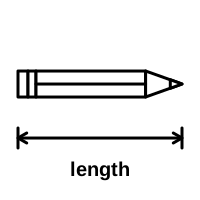
    Students will measure lengths with rulers and tape measures in inches and centimeters, estimate first, and compare two measurements (2.MD.A.1, 2.MD.A.2, 2.MD.A.3, 2.MD.A.4).

    Activities

    10 min

    Warm-Up

    Ten quick facts from last week's pile. Then ask: 'Which would you use to measure a book, a table, and the hallway: a ruler, a yardstick, or a tape measure? Why?'

    fact cardsrulertape measure
    15 min

    Mini-Lesson

    Review measuring (first taught Weeks 19 and 20). Measure the kitchen table together: estimate first in inches, then measure with the tape measure starting at the zero mark, and record. Measure the same edge in centimeters and ask why the centimeter number is bigger. This is the picnic table skill.

    tape measureruler with cm and inchespaperpencil
    15 min

    Practice

    Your child measures six objects, estimating first: a spoon, a book, a shoe, a chair seat, a window ledge, and a door width. Record estimate, inches, and centimeters in a table. Then answer: 'How much longer is the door than the book?' with a subtraction equation.

    tape measurerulerrecording tablepencil
    5 min

    Wrap-Up

    Ask: 'Which estimate was closest? What helped you estimate?' File the table in the portfolio.

    folder

    Materials Needed

    fact cardsruler with cm and inchestape measurepaperpencilrecording tablefolder

    English Language Arts

    Students will identify the point of view of a first-person narrator and read his words in his voice (RL.2.6, first taught in Week 6), and begin revising their Author's Celebration piece (W.2.5, first taught in Week 19).

    Standards Addressed

    Activities

    15 min

    Read-Aloud

    Read the opening short chapters of The One and Only Ivan by Katherine Applegate ('hello', 'name', 'patience', 'how I look', 'the exit 8 big top mall and video arcade'). Say: 'Ivan tells his own story. In Week 6 we called this point of view.' Stop after 'I am Ivan. I am a gorilla' and ask: 'Who is talking? How do you know?'

    The One and Only Ivan by Katherine Applegate
    10 min

    Mini-Lesson

    Write 'I' and 'he' on two cards. Read one line from Ivan and one line from Amelia Bedelia and have your child hold up the card that matches. Say: 'When the narrator says I, we only know what that character knows and feels. Ivan says his glass wall is a good thing. Do we agree?'

    index cards
    15 min

    Guided Reading

    Your child rereads the chapter 'how I look' and lists three things Ivan says about himself, then writes what a visitor at the mall might say about Ivan instead. Compare the two lists (Week 13 words-and-phrases review: notice Ivan's short, plain sentences).

    The One and Only Ivan by Katherine Applegatereading notebookpencil
    15 min

    Writing Workshop

    Author's Celebration, revision day one (Week 19 review). Your child reads their chosen piece aloud to you once, then marks three places with a caret where a reader would want more: a feeling, a detail you could see or hear, or a line of talk. They write the new words on sticky notes and tuck them in place.

    10 min

    Word Study

    Self-selected reading vocabulary (Week 24 review). Your child brings the library book they are reading on their own, finds two words they think are interesting or new, and writes each with a guess at its meaning and the sentence it came from. Discuss the guesses together.

    library book of choicereading notebook

    Materials Needed

    The One and Only Ivan by Katherine Applegateindex cardsreading notebookpencilchosen piecesticky noteslibrary book of choice

    Science

    Students will carry out their science fair experiment with three trials for each condition and record results in a data table (2-PS1-2, K-2-ETS1-3).

    Standards Addressed

    Activities

    5 min

    Science Question of the Week

    Say: 'Last week you planned. Today you test.' Your child reads the question, the prediction, and the numbered steps aloud, then names the one thing that changes and two things kept the same.

    20 min

    Investigation

    Run the experiment following the steps exactly, with your child doing the hands-on part and you holding the timer or tape measure. Do Trial 1 for every condition before going back for Trial 2, so no condition gets extra practice. Your child writes each number in the data table right away. For the ice cube question, set up all wrappings at once and check every 5 minutes, recording the minute each cube is fully melted, so this may run past the lesson.

    shoebox of experiment materialsdata tablepenciltimertape measure or rulermeasuring spoon
    5 min

    Wrap-Up

    Look at the table. Ask: 'Which one is winning so far? Did anything surprising happen?' Write one sentence at the bottom of the table beginning 'Something I noticed was ____.'

    Materials Needed

    shoebox of experiment materialsScience Fair Plan page with data tablepenciltimertape measure or rulermeasuring spoon
    Open Monday on its own page
    Social Studies

    Reading About Our World: Our Town Needs a Garden

    Read it aloud first while your child follows along. Then read it together, and let your child read the parts they can. Talk about the words in the word box.

    I think every town should have a community garden. A community garden is a piece of land where neighbors grow plants together. Here are my reasons.

    First, a garden gives people fresh food. Neighbors can grow tomatoes, beans and carrots. They can pick them and eat them the same day.

    Second, a garden helps neighbors get to know each other. People work side by side. They share tools and give each other tips.

    Third, a garden helps nature. Flowers feed bees and butterflies. Bees carry pollen from flower to flower. This helps many plants make fruit and seeds.

    A garden takes work. Neighbors must water, pull weeds and share the space fairly. But I think the good things are worth the work. What would you plant in a community garden?

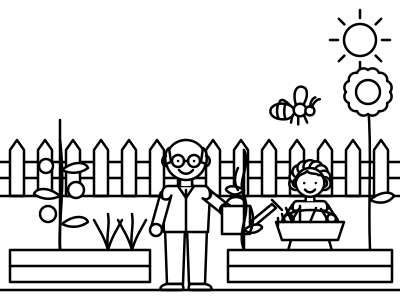
    Neighbors work in a community garden: a man waters bean plants and a girl carries a basket, with tomatoes, carrots and a sunflower growing in the beds.

    Word box

    opinion:
    what someone thinks or feels about something
    reason:
    why someone thinks something
    neighbor:
    a person who lives near you
    pollen:
    a yellow powder in flowers that helps plants make seeds

    Questions

    1. What is the author's opinion?
    2. Name two reasons the author gives.
    3. What fact does the author use to show that a garden helps nature?

    Weekly check

    Math

    Weekly Check

    • I can tell time to the nearest 5 minutes and use a.m. and p.m.
    • I can measure length, count money and read a graph.
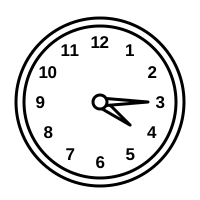
    1. The minute hand is on 4. The hour hand is between 10 and 11. What time is it?
    2. You eat lunch at 12:15. Is that a.m. or p.m.?a.m.p.m.
    3. You wake up at 7:30. Is that a.m. or p.m.?a.m.p.m.
    4. A rope is 52 inches. A string is 17 inches. How much longer is the rope?
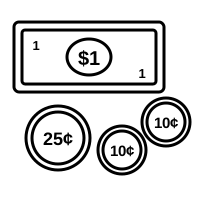
    5. 1 dollar, 2 quarters, 1 nickel, 3 pennies = ____
    6. Books read: Ada 6, Ben 9, Cy 4. How many more books did Ben read than Cy?
    7. How many books did they read in all?

    ELA

    Weekly Check

    • I can tell an author's reasons and the evidence for them.
    • I can check a piece of writing for capitals, end marks and spelling.

    Kids Should Help Cook

    Kids should help cook dinner. First, cooking uses math. You count scoops and measure cups. Second, kids learn how to make healthy food. Third, it is a fun way to spend time with family.

    1. What is the author's point?
    2. Write one reason the author gives.
    3. What evidence shows that cooking uses math?
    4. Fix the capitals and end mark: we ate soup on friday
    5. Fix the spelling: I like to cook with my frend.
    6. Add the end mark: Can you pass the salt

    Science

    Weekly Check

    • I can do an experiment and record what I observe.
    • I can show my results in a bar graph.

    Maya's Test

    Maya let the same toy car roll down the same ramp onto three surfaces. She wrote down how far it rolled. Carpet: 30 cm. Tile: 85 cm. Wood: 70 cm.

    1. What did Maya change?
    2. Name one thing she kept the same.
    3. Which surface let the car roll farthest?
    4. How much farther did it roll on tile than on carpet?
    5. Make a bar graph of Maya's results.
    6. Why should a scientist write each number down right away?

    Social Studies

    Weekly Check

    • I can carry out a plan to help my community.
    • I can tell how our action helped.
    1. What comes first?make a plando the project
    2. Jada's family picked up 24 pieces of litter in the park. How does this help?
    3. Name one way to thank someone who helped.
    4. Write one way your project helped.
    5. What does responsibility mean?
    6. What would you do differently next time?

    Specials

    Music · Performance & Music Celebration · All Specials

    This Week's Specials Page

    Music · Week 34

    I can plan and perform songs for my family.

    Plan your concert. Pick 3 songs you learned this year (such as "Yankee Doodle," "Hot Cross Buns" or "Twinkle, Twinkle, Little Star").

    SongInstrument or movementOne thing I learned
    1. Write your three songs in the table. Add an instrument or a move for each one.
    2. Write a program note for one song. Use a music word: beat, tempo, dynamics, pitch or form.

    After the concert.

    1. Draw your concert. Who came to listen?
    2. Which song went the best? Why?

    You need: homemade instruments from this year, paper for a program

    How did it go? Great Okay Tricky

    Home Connection

    This week at home

    • Math

      Measuring, telling time, counting money and reading graphs

    • ELA

      Finding reasons and fixing up my writing

    • Science

      Doing my test and graphing what happened

    • Social Studies

      Doing our project to help our community

    Three things to celebrate this week

    We did blank of 4 activities.

    Suggested Daily Schedule

    8:30–9:00 AM30 minMorning Meeting / Calendar / Read-Aloud
    9:00–9:30 AM30 minPhonics / Word Study / Spelling
    9:30–10:15 AM45 minReading Workshop
    10:15–10:35 AM20 minSnack and Outdoor Play / Movement Break
    10:35–11:05 AM30 minWriting Workshop
    11:05–11:50 AM45 minMathematics
    11:50 AM–12:35 PM45 minLunch and Free Play
    12:35–1:05 PM30 minScience OR Social Studies (alternating)
    1:05–1:35 PM30 minSpecials: PE / Art / Music / Health (rotating)
    1:35–2:00 PM25 minIndependent Reading / Enrichment