Week 35: Geometry and Problem-Solving Review · Speaking and Listening Showcase

    Quarter 4 · Detailed day-by-day lesson plans · Days 171–175

    0 of 15 lessons done this week

    Geometry and Problem-Solving Review Speaking and Listening Showcase

    Print

    Worksheets and answer keys

    Gather this week

    • Shop
    • Shop
    • Shop
    • Shop
    Everyday supplies (12)

    Writing prompt

    • What kind of friend do you want to be? Give examples.
    Week 35 writing prompts

    Parent note

    This week's parent digest

    This week at a glance

    Week 35 reviews shapes, partitioning, arrays, and word problems. ELA culminates in a speaking-and-listening showcase where children present narratives with audio recordings.

    Parent tip

    Host a 10-minute family showcase so your child can present their best piece.

    Materials this week

    Geometry review, recording app, audience

    Mathematics

    Geometry and Problem-Solving Review

    Review, Word Problems & Consolidation · All Grade 2 CCSS-M Standards

    Assessment: Shapes, partitioning, arrays, mixed word problems

    ELA

    Speaking and Listening Showcase

    Phonics: Fluency celebration

    Writing: Present narratives with audio recording

    Science

    Review, Projects & Science Fair

    Review of all Grade 2 science standards; K-2-ETS1-1, K-2-ETS1-3 (science fair)

    Social Studies

    Review, Projects & Celebration

    Monday — Day 171

    140 minutes of instruction

    Math

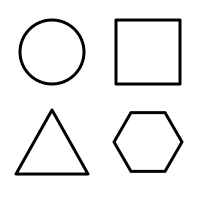
    Students will identify and draw triangles, quadrilaterals, pentagons, hexagons, and cubes by number of sides, angles, and faces (2.G.A.1).

    Standards Addressed

    Activities

    10 min

    Warm-Up

    Read 7:20 and 12:55 on the paper clock and total 2 quarters, 1 dime, 3 pennies (63 cents). Then go on a 60-second shape hunt: name five flat shapes in the room and how many sides each has.

    paper clockcoins
    15 min

    Mini-Lesson

    Review shape attributes (first taught Week 27). Draw a triangle, a square, a rectangle, a rhombus, a pentagon, and a hexagon. For each, count sides and corners (angles) aloud and record in a chart. Hold up a cereal box and a dice: count faces (6) and say why they are cubes or not (a cube has six square faces).

    paperpencilrulercereal boxdice or block
    15 min

    Practice

    Attribute riddles: your child draws the shape you describe with a ruler. 'I have 4 sides, all the same length, and 4 square corners.' 'I have 5 sides.' 'I have 3 sides and one square corner.' 'I have 6 sides.' 'I have 4 sides but they are not all equal.' Then they write two riddles for you.

    paperpencilruler
    5 min

    Wrap-Up

    Ask: 'Are all squares quadrilaterals? Are all quadrilaterals squares?' File the attribute chart in the portfolio.

    folder

    Materials Needed

    paper clockcoinspaperpencilrulercereal boxdice or blockfolder

    English Language Arts

    Students will follow agreed-upon rules for discussion and build on others' talk (SL.2.1a and SL.2.1b, first taught in Weeks 25 and 26) and read with expression, while illustrating their Author's Celebration piece.

    Standards Addressed

    Activities

    15 min

    Read-Aloud

    Read chapters 1 through 4 of Mercy Watson to the Rescue by Kate DiCamillo, using a slow, worried voice for Mr. Watson and a loud, bossy voice for Eugenia Lincoln. Before you start, review the Week 25 conversation rules on an index card: look at the speaker, wait your turn, say 'I agree' or 'I want to add'.

    Mercy Watson to the Rescue by Kate DiCamilloindex card
    10 min

    Mini-Lesson

    Hold a two-minute book talk with the rules in front of you. Start: 'I think Mercy only cares about toast.' Your child must respond with 'I agree because' or 'I disagree because' and then add one new idea (Week 26 building on talk). Switch roles once.

    15 min

    Guided Reading

    Your child rereads the page where the bed begins to sink through the floor, first in a flat voice, then with the expression the punctuation calls for (Week 22 review). Ask: 'Which reading sounds like Mr. and Mrs. Watson are really scared? What did you change?'

    Mercy Watson to the Rescue by Kate DiCamillo
    15 min

    Writing Workshop

    Author's Celebration, illustration day one. Your child finishes the second half of the final copy, then plans illustrations: one for the cover and one for each page, sketched lightly in pencil first. Remind them of Week 5: pictures should show something the words do not.

    chosen piece final copypencilcrayons or colored pencils
    10 min

    Phonics

    Fluency celebration, day one: phrasing. Copy two sentences from Mercy Watson onto a strip and mark scoops under each phrase. Your child reads the strip three times, faster and smoother each time, keeping the scoops together.

    strip of paperpencil

    Materials Needed

    Mercy Watson to the Rescue by Kate DiCamilloindex cardchosen piece final copypencilcrayons or colored pencilsstrip of paper

    Science

    Students will organize their plan, data, graph, and conclusion into a science fair poster with a clear left-to-right order (K-2-ETS1-3).

    This week's reading: Scientists Share What They Learn

    Standards Addressed

    Activities

    5 min

    Science Question of the Week

    Ask: 'Last week you found an answer. How do scientists share what they found?' Show a photo of a science fair poster or describe one: a big title, sections in order, a graph in the middle. Say: 'Your poster tells the story of your test to someone who was not there.'

    20 min

    Investigation

    Fold a large sheet of poster board or tape 3 pieces of paper side by side into three panels. Label 6 sections in this order: Question, Prediction, Materials, Steps, Results (the bar graph goes here), Conclusion. Your child glues in the pages from Weeks 33 and 34, rewriting anything messy on fresh paper, and writes the question across the top in big letters.

    poster board or 3 sheets of papertapeglue stickmarkerspages from Weeks 33 and 34
    5 min

    Wrap-Up

    Have your child point to each section and say what it is in one sentence. Ask: 'If someone reads only your graph, could they guess your answer?' Add a caption to the graph if not.

    Materials Needed

    poster board or 3 sheets of papertapeglue stickmarkersplan, data table, graph, conclusion pages
    Open Monday on its own page
    Science

    Reading About Our World: Scientists Share What They Learn

    Read it aloud first while your child follows along. Then read it together, and let your child read the parts they can. Talk about the words in the word box.

    When scientists finish an experiment, their work is not over. They share what they found.

    Sharing helps other people learn. It also lets other scientists try the same test. If they get the same results, everyone can trust the results more.

    Scientists share in many ways. They write reports. They give talks. They make charts and graphs, so others can see the results quickly.

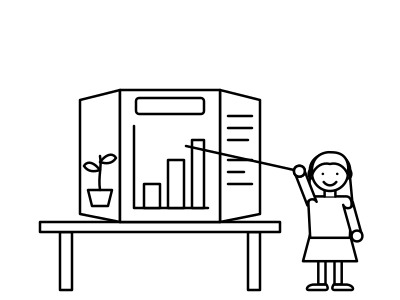
    At a science fair, you share, too. Your poster tells your audience what you did. It shows your question, your prediction, what you did, your results and what you learned. A bar graph can show your results at a glance.

    When you present, speak clearly and look at your audience. Be ready to answer questions. It is fine if your prediction was wrong! Scientists learn something from every test. Each result can lead to a new question.

    A girl presents her science fair poster, pointing to the bar graph of her results.

    Word box

    results:
    what you found out from a test
    present:
    to show and tell your work to others
    audience:
    the people who watch and listen
    graph:
    a drawing that shows numbers or results

    Questions

    1. Why do scientists share their results?
    2. Name two things a science fair poster shows.
    3. What should you do if your prediction was wrong?

    Weekly check

    Math

    Weekly Check

    • I can name and draw triangles, quadrilaterals, pentagons, hexagons and cubes.
    • I can tell a shape by counting its sides and angles.
    1. How many sides does a hexagon have?
    2. Draw a pentagon.
    3. I have 4 sides and 4 angles. What is my group name?
    4. How many angles does a triangle have?
    5. Which solid shape has 6 square faces?
    6. Draw a quadrilateral that is not a square.
    7. How many more sides does a hexagon have than a triangle?

    ELA

    Weekly Check

    • I can speak clearly and listen well when others share.
    • I can read aloud with accuracy, good speed and expression.
    1. What does a good listener do?looks at the speakertalks over the speakerplays with a toy
    2. What can you say to add to someone's idea?
    3. Which sentence should you read in an excited voice?We won the game.We won the game!Did we win the game?
    4. Draw scoops under the phrases: My big sister sang a song at the park.
    5. Why do readers read a page more than once?
    6. What does a speaker need so listeners can follow?

    Science

    Weekly Check

    • I can present my question, prediction, results and what I learned.
    • I can answer questions about my experiment.
    1. What goes first on a science fair poster?
    2. Where does the bar graph go?
    3. What is a conclusion?
    4. Someone asks, "What did you keep the same?" Write your answer.
    5. Why should you point to your graph when you talk?
    6. Tell one thing you learned from your experiment.

    Social Studies

    Weekly Check

    • I can use this year's social studies words.
    • I can use a map title, map key and compass rose.
    1. What does a map title tell?
    2. A map key shows a blue line. What might it stand for?
    3. Which direction is the opposite of north?eastsouthwest
    4. What is a citizen?
    5. What is a natural resource? Give an example.
    6. Is a mountain a landform?yesno

    Specials

    PE · Fitness Testing & Field Day · All Specials

    This Week's Specials Page

    PE · Week 35

    I can play field day games and cheer for others.

    Home field day. Play outside or in a big clear space. Put a check after each event.

    1. Sack or pillowcase hop to a line and back.
    2. Spoon and sock-ball walk to a line and back.
    3. Obstacle course: go over, under and around 3 things. Draw your course.

    Think about it.

    1. Which event was the most fun? Circle one.sack hopspoon walkobstacle course
    2. Write one thing you said to cheer someone on.
    3. Compare with Week 31. Try jumping jacks for 30 seconds again. Did you beat your personal best?yessamenot this time

    You need: an old pillowcase, a spoon and a rolled-up sock, safe things for an obstacle course (pillows, a chair, a rope on the ground)

    How did it go? Great Okay Tricky

    Home Connection

    This week at home

    • Math

      Shapes, equal shares and arrays all around us

    • ELA

      Speaking clearly and reading with a strong voice

    • Science

      Sharing my science fair results with others

    • Social Studies

      Maps and the big words I learned

    Three things to celebrate this week

    We did blank of 4 activities.

    Suggested Daily Schedule

    8:30–9:00 AM30 minMorning Meeting / Calendar / Read-Aloud
    9:00–9:30 AM30 minPhonics / Word Study / Spelling
    9:30–10:15 AM45 minReading Workshop
    10:15–10:35 AM20 minSnack and Outdoor Play / Movement Break
    10:35–11:05 AM30 minWriting Workshop
    11:05–11:50 AM45 minMathematics
    11:50 AM–12:35 PM45 minLunch and Free Play
    12:35–1:05 PM30 minScience OR Social Studies (alternating)
    1:05–1:35 PM30 minSpecials: PE / Art / Music / Health (rotating)
    1:35–2:00 PM25 minIndependent Reading / Enrichment