Week 33: Mixed Operations Practice · Comparing Stories and Versions

    Quarter 4 · Detailed day-by-day lesson plans · Days 161–165

    0 of 15 lessons done this week

    Mixed Operations Practice Comparing Stories and Versions

    Print

    Worksheets and answer keys

    Gather this week

    • Shop
    • Shop
    • Shop
    Everyday supplies (10)

    Writing prompt

    • If you could add one rule to your school day, what would it be? Why?
    Week 33 writing prompts

    Parent note

    This week's parent digest

    This week at a glance

    Week 33 mixes fluency, strategies, and word problems across operations. Readers compare stories and versions and practice collaborative storytelling with peers.

    Parent tip

    Tell a family story round-robin — each person adds one sentence.

    Materials this week

    Math review packet, story-comparison chart

    Mathematics

    Mixed Operations Practice

    Review, Word Problems & Consolidation · All Grade 2 CCSS-M Standards

    Assessment: Fluency within 20; strategies within 100; word problems

    ELA

    Comparing Stories and Versions

    Phonics: Advanced word patterns

    Writing: Collaborative storytelling and presentation

    Science

    Review, Projects & Science Fair

    Review of all Grade 2 science standards; K-2-ETS1-1, K-2-ETS1-3 (science fair)

    Social Studies

    Review, Projects & Celebration

    Monday — Day 161

    140 minutes of instruction

    Math

    Students will recall addition and subtraction facts within 20 from memory using make-a-ten and doubles strategies (2.OA.B.2).

    Standards Addressed

    Activities

    10 min

    Warm-Up

    Ask your child to show you 348 with beans grouped in hundreds, tens, and ones, then say 10 more. Then flash ten fact cards (6 + 8, 13 - 7, 9 + 4, 15 - 9, 7 + 8, 12 - 4, 5 + 9, 14 - 6, 8 + 8, 11 - 3) and sort them into 'know it' and 'still thinking' piles.

    dried beansfact cards
    15 min

    Mini-Lesson

    Review fluency strategies (first taught Week 15). Show 8 + 6 on two ten frames and move 2 counters to make a ten: 10 + 4 = 14. Show 7 + 8 as a near double: 7 + 7 + 1 = 15. For subtraction, show 13 - 5 as 'think addition': 5 + ? = 13, so 8. Your child explains each strategy back to you with the counters.

    two ten frames drawn on paper20 counters (beans or coins)
    15 min

    Practice

    Strategy sort: write 16 facts on index cards (9 + 7, 6 + 6, 14 - 8, 8 + 5, 7 + 6, 17 - 9, 4 + 9, 12 - 6, 8 + 9, 15 - 7, 5 + 6, 11 - 8, 9 + 9, 13 - 4, 7 + 9, 16 - 8). Your child sorts each into make-a-ten, doubles or near doubles, or think addition, then solves and records all 16.

    index cardspaperpencil
    5 min

    Wrap-Up

    Put the 'still thinking' pile in the portfolio folder pocket to practice each morning this week. Ask: 'Which strategy do you use most?'

    folder

    Materials Needed

    dried beansfact cardstwo ten frames drawn on paperindex cardspaperpencilfolder

    English Language Arts

    Students will describe how words and phrases carry meaning, including idioms taken literally (RL.2.4, first taught in Week 13), and begin a collaborative story.

    Standards Addressed

    Activities

    15 min

    Read-Aloud

    Read Amelia Bedelia by Peggy Parish. Each time Amelia takes an instruction literally (dust the furniture, draw the drapes, dress the chicken), stop and ask: 'What did Mrs. Rogers mean? What did Amelia think it meant?' Keep a tally of the mix-ups.

    Amelia Bedelia by Peggy Parish
    10 min

    Mini-Lesson

    Say: 'In Week 13 we learned that words and phrases can mean more than they say. Amelia is funny because she only hears the plain meaning.' Write 'draw the drapes' on the whiteboard with two pictures: one of a pencil sketch, one of curtains being closed. Label them literal and what people mean.

    whiteboard or papermarker
    15 min

    Guided Reading

    Your child rereads the pages about the chicken and the cake, then picks two more phrases from the book and draws the literal and the meant version for each in the reading notebook (Week 26 real-life word connections review).

    Amelia Bedelia by Peggy Parishreading notebookcrayons
    15 min

    Writing Workshop

    Collaborative storytelling begins. Together, invent a new helper character who takes everything literally, and brainstorm six household instructions they might get wrong (make the bed, run a bath, set the table). Use Week 25 conversation rules: one person talks at a time, and each idea gets a 'yes, and'. Write the character's name and the setting on a story-planning page.

    10 min

    Word Study

    Multiple-meaning word review from Week 16. Give your child these words and have them act out both meanings, then write a sentence for each: draw, dust, run, trip. Say: 'Readers choose the meaning that fits the sentence.'

    index cardspencil

    Materials Needed

    Amelia Bedelia by Peggy Parishwhiteboard or papermarkerreading notebookcrayonsindex cardspencilstory-planning page

    Science

    Students will explain what makes a question testable and choose a science fair question from a menu of safe, measurable investigations (K-2-ETS1-1).

    This week's reading: Asking a Testable Question

    Standards Addressed

    Activities

    5 min

    Science Question of the Week

    Ask: 'Last week you counted living things in two squares. Was that a question we could answer by looking and counting?' Explain: a testable question is one we can answer by doing a test and measuring something with a number. 'Which is prettier?' is not testable. 'Which rolls farther?' is.

    20 min

    Investigation

    Read the 6 science fair questions aloud and, for each, name what you would measure: (1) Which brand of paper towel soaks up the most water? (measure spoonfuls) (2) Which surface lets a toy car roll the farthest: carpet, tile or wood, or a smooth table? (measure centimeters) (3) Does a paper airplane with bigger wings fly farther than one with small wings? (measure steps or centimeters) (4) Which wrapping keeps an ice cube frozen the longest: foil, paper towel, a sock, or nothing? (measure minutes) (5) Which ball bounces highest when dropped from the same height: tennis ball, rubber bouncy ball, or ping-pong ball? (measure against a wall marked in centimeters) (6) Does sugar dissolve faster in cold water, room-temperature water, or warm tap water? (measure seconds with a timer). Your child picks one and writes it at the top of a fresh 'Science Fair Plan' page.

    Science Fair Plan pagepencilthe question menu written on an index card
    5 min

    Wrap-Up

    Ask your child to say the chosen question and finish the sentence 'I will measure ____ with a ____.' Post the question on the fridge for the next three weeks.

    Materials Needed

    paperpencilindex cardtape
    Open Monday on its own page
    Science

    Reading About Our World: Asking a Testable Question

    Read it aloud first while your child follows along. Then read it together, and let your child read the parts they can. Talk about the words in the word box.

    Every science investigation starts with a question. For a science fair, you need a question you can test.

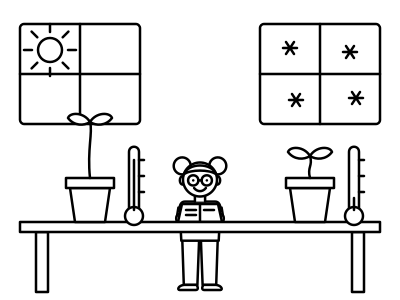
    A testable question can be answered by doing an experiment and observing what happens. "Do bean seeds sprout faster in a warm place or a cool place?" is testable. You can plant seeds in both places and watch.

    Some questions cannot be tested this way. "What is the prettiest flower?" is about an opinion. People will give different answers, and no test can prove who is right.

    In a good test, you change only one thing. In the bean test, you change only where the seeds are kept. The seeds, the soil and the water stay the same.

    Next, you make a prediction. A prediction is what you think will happen. Then you do the test, observe and write down what you see. What question would you like to test?

    A girl compares two bean plants: the one in the warm, sunny spot has grown taller than the one in the cool spot.

    Word box

    testable:
    able to be answered by doing a test
    experiment:
    a test done to answer a question
    observe:
    to watch closely and notice
    prediction:
    what you think will happen

    Questions

    1. What is a testable question?
    2. Why can't you test "What is the prettiest flower?"
    3. In the bean test, what is the one thing that changes?

    Weekly check

    Math

    Weekly Check

    • I can add and subtract within 100 using a strategy I choose.
    • I can tell which strategy I used and why.
    1. 45 + 38 = ____
    2. 63 − 27 = ____
    3. 29 + 56 = ____
    4. 90 − 42 = ____
    5. Solve 38 + 47. Write the strategy you used.
    6. Solve 76 − 39. Tell why you picked your strategy.
    7. A class has 64 crayons. 28 are broken. How many are not broken?

    ELA

    Weekly Check

    • I can compare two versions of the same story.
    • I can read words with igh, kn, wr and ph.

    Wren's Kite: Two Versions

    Version 1: Wren's kite flew high over the park. The wind grew strong, and the string broke. The kite got stuck in a tree. Wren's dad climbed a ladder and got it back. Version 2: Wren's kite flew high over the beach. A big gust snapped the string. The kite landed in the waves. A kind surfer swam out and brought it back.

    1. How are the two versions the same?
    2. How are the two versions different?
    3. Circle the real word.nitenightnigt
    4. Circle the real word.neelkneelknele
    5. Circle the real word.ritwritewirte
    6. Circle the real word.grafgraphgrafh

    Science

    Weekly Check

    • I can tell a testable question from one that can't be tested.
    • I can make a prediction for my test.
    1. Which shoe is the prettiest?testablenot testable
    2. Does a bean plant grow taller in the sun or in the shade?testablenot testable
    3. Which song is the best?testablenot testable
    4. Which crayon color melts fastest in a sunny window?testablenot testable
    5. Question: Which toy car rolls farthest? What would you measure?
    6. Write a prediction: Does ice melt faster in the sun or in the shade? I think ____ because ____.

    Social Studies

    Weekly Check

    • I can find a need in my community.
    • I can make a plan to help.
    1. Which is a community need?cleaning up litter in the parka new video game for mea bigger TV at home
    2. A food pantry has empty shelves. Which project helps?a canned-food drivea book driveplanting flowers
    3. A park has no flowers. What could you do?
    4. Name two things a good plan tells.
    5. Why is it good to ask others to help?

    Specials

    Art · Art and Storytelling: Year-End Showcase · All Specials

    This Week's Specials Page

    Art · Week 33

    I can tell a story with pictures.

    Story panels. Make up a story or pick a favorite. Draw one picture in each box. Write one sentence under each.

    1. Beginning: Who is in the story and where are they?
    2. Middle: What problem happens?
    3. End: How is the problem solved?

    Nature print.

    1. Find a leaf. Paint one side, or rub a crayon over it under paper. Press or rub it here to make a print.
    2. Could your leaf be part of your story? Tell how.

    You need: crayons or colored pencils, a leaf, paint (optional)

    How did it go? Great Okay Tricky

    Home Connection

    This week at home

    • Math

      Picking a smart way to add and subtract

    • ELA

      Comparing stories and sayings that mean something else

    • Science

      Asking a question I can test and measure

    • Social Studies

      Finding a need and planning to help

    Three things to celebrate this week

    We did blank of 4 activities.

    Suggested Daily Schedule

    8:30–9:00 AM30 minMorning Meeting / Calendar / Read-Aloud
    9:00–9:30 AM30 minPhonics / Word Study / Spelling
    9:30–10:15 AM45 minReading Workshop
    10:15–10:35 AM20 minSnack and Outdoor Play / Movement Break
    10:35–11:05 AM30 minWriting Workshop
    11:05–11:50 AM45 minMathematics
    11:50 AM–12:35 PM45 minLunch and Free Play
    12:35–1:05 PM30 minScience OR Social Studies (alternating)
    1:05–1:35 PM30 minSpecials: PE / Art / Music / Health (rotating)
    1:35–2:00 PM25 minIndependent Reading / Enrichment