Week 8: Adding Up to Four Two-Digit Numbers · Identifying the Main Topic of a Text

    Quarter 1 · Detailed day-by-day lesson plans · Days 36–40

    0 of 15 lessons done this week

    Adding Up to Four Two-Digit Numbers Identifying the Main Topic of a Text

    Print

    Worksheets and answer keys

    Gather this week

    • Shop
    • Shop
    • Shop
    • Shop
    Everyday supplies (14)

    Writing prompt

    • Write about a time you helped someone. How did it feel?
    Week 8 writing prompts

    Parent note

    This week's parent digest

    Specials this week

    Supplements

    This week at a glance

    Week 8 stretches addition to four two-digit addends with friendly grouping. In ELA, children identify a main topic and use facts to develop informational writing.

    Parent tip

    Add your family's ages together and look for friendly tens.

    Materials this week

    Index cards with numbers, nonfiction book, informational draft

    Mathematics

    Adding Up to Four Two-Digit Numbers

    Addition & Subtraction Within 100 · 2.NBT.B.5

    Assessment: Add 3–4 two-digit numbers; show grouping strategies

    ELA

    Identifying the Main Topic of a Text

    Phonics: Irregularly spelled words

    Writing: Use facts and definitions to develop points

    Science

    Plants, Animals & Habitats

    2-LS2-1, 2-LS2-2, 2-LS4-1, K-2-ETS1-2

    Social Studies

    Maps, Geography & Our World

    Monday — Day 36

    140 minutes of instruction

    Math

    Students add three two-digit numbers by looking for pairs that make a ten or a friendly number (2.NBT.B.6).

    Standards Addressed

    Activities

    10 min

    Warm-Up

    Revisit any circled problems from last Friday's assessment. Then play 'find the ten': say three one-digit numbers (7, 5, 3) and your child names the pair that makes ten and the total (7 + 3 = 10, plus 5 = 15). Try 6, 8, 2 and 4, 9, 6 and 5, 5, 8.

    paperpencil
    15 min

    Mini-Lesson

    Write 23 + 47 + 15 vertically. Point to the ones column: 3, 7, 5. Say, '3 and 7 make a ten, then 5 more is 15.' Write the 5, carry the ten to the tens column as one straw bundle, and add 2 + 4 + 1 + 1 = 8 tens: 85. Repeat with 36 + 28 + 14 (6 + 4 makes ten, total 78), building tens with straws each time.

    straws bundled by tenloose strawspaperpencil
    15 min

    Practice

    Your child solves 12 + 38 + 25, 41 + 19 + 27, 33 + 33 + 17, and 26 + 54 + 15, circling the pair of ones that makes a ten before adding (answers 75, 87, 83, 95). Build the third problem with straws to prove it.

    paperpencilstraws bundled by tenloose straws
    5 min

    Wrap-Up

    Ask, 'Does it matter which two numbers you add first?' Test it together on 12 + 38 + 25 by adding 12 + 25 first, then 38 (still 75).

    Materials Needed

    paperpencilstraws bundled by tenloose straws

    English Language Arts

    Students identify the main topic of a multi-paragraph nonfiction text and begin developing informational points with facts (RI.2.2, W.2.2).

    Standards Addressed

    Activities

    15 min

    Read-Aloud

    Say, 'Last week you asked questions about seeds and ants. This week we figure out what a whole book is mostly about.' Read 'What Do You Do with a Tail Like This?' by Steve Jenkins and Robin Page, letting your child guess each animal before turning the page. At the end ask, 'If you had to say in one sentence what this book is about, what would you say?'

    What Do You Do with a Tail Like This? by Steve Jenkins and Robin Page
    10 min

    Mini-Lesson

    Draw a table with one wide top (the main topic) and four legs (details). Explain that the main topic is what the whole book is mostly about, and details are the smaller facts that hold it up. Fill the top with 'Animals use body parts in special ways' and let your child supply four legs from the book (a chameleon's eyes, a skunk's tail, a platypus's nose, a mole's feet).

    chart papermarkerWhat Do You Do with a Tail Like This? by Steve Jenkins and Robin Page
    15 min

    Guided Reading

    Reread the 'nose' section together. Your child covers the answer page and reads only the question page, then says the main topic of just that section ('Different noses do different jobs'). Repeat with the 'ears' section. Write each section topic on a sticky note and stick it on the page.

    What Do You Do with a Tail Like This? by Steve Jenkins and Robin Pagesticky notespencil
    15 min

    Writing Workshop

    Return to last week's informational piece. Say, 'A fact tells something true; a definition tells what a word means.' Your child adds one definition sentence to the piece ('A whisker is a long stiff hair on a cat's face.') and underlines the word being defined.

    writing notebookpencil
    10 min

    Word Study

    Introduce the Dolch second-grade list as 'words we need to know by heart because sounding out does not always work.' Practice with flashcards: always, around, because, been, before, best, both, buy, call, cold. Have your child read each card, then trace the tricky part with a finger (the 'au' in because, the 'ee' in been) and write it once.

    index cardsmarkerwriting notebookpencil

    Materials Needed

    What Do You Do with a Tail Like This? by Steve Jenkins and Robin Pagechart papermarkersticky noteswriting notebookpencilindex cards

    Science

    Students identify the parts of a plant and explain how the stem carries water to the leaves (2-LS2-1, 2-LS4-1).

    Standards Addressed

    Activities

    5 min

    Science Question of the Week

    Check the two soil cups from last week and compare: the window cup should be green and taller, the cupboard cup pale and leggy. Say, 'Plants have parts that do jobs. This week's question: What are the parts of plants and animals, and what does each part do?'

    soil cups from Week 7index card
    20 min

    Investigation: Celery Straws

    Put half a cup of water in a clear glass and stir in 10 drops of red or blue food coloring. Stand a fresh celery stalk with leaves in the glass and predict where the color will go. While waiting, pull a full plant (a weed from outside, or a green onion from the grocery store) and have your child find and name roots, stem, leaves.

    celery stalk with leavesclear glassfood coloringwatergreen onion or weed
    5 min

    Wrap-Up

    Your child draws the green onion and labels roots, stem, leaves, then writes one job for each part: roots drink, stem carries, leaves catch light.

    notebookpencil

    Materials Needed

    soil cups from Week 7index cardcelery stalk with leavesclear glassfood coloringwatergreen onion or weednotebookpencil
    Open Monday on its own page
    Social Studies

    Reading About Our World: Seven Continents, Five Oceans

    Read it aloud first while your child follows along. Then read it together, and let your child read the parts they can. Talk about the words in the word box.

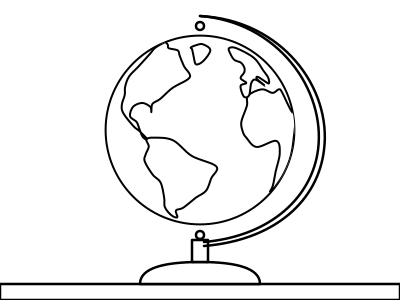
    Look at a globe. Most of it is blue. The blue parts are oceans. The other parts are land.

    The biggest pieces of land are called continents. There are seven continents: North America, South America, Europe, Asia, Africa, Australia and Antarctica. Asia is the largest. Australia is the smallest. The United States is in North America.

    Earth has five oceans: the Pacific, the Atlantic, the Indian, the Arctic and the Southern Ocean. The Pacific is the biggest and the deepest.

    Oceans are salt water, and they cover most of our planet. Many animals live in them, from tiny shrimp to giant blue whales.

    Antarctica is covered in ice. No one lives there all year, but scientists visit, and penguins make it their home. Find your continent on a globe. Which ocean is closest to you?

    A globe on a stand shows land and the big blue oceans of Earth.

    Word box

    continent:
    one of the seven largest areas of land on Earth
    ocean:
    a very large body of salt water
    globe:
    a round model of Earth
    planet:
    a large body in space, like Earth, that moves around the sun

    Questions

    1. What is the main topic of this text?
    2. How many continents are there? How many oceans?
    3. Which ocean is the biggest?

    Weekly check

    Math

    Weekly Check

    • I can add three or four two-digit numbers.
    • I can group numbers to make adding easier (like making a ten).
    1. 16 + 24 + 35 = ____
    2. 38 + 17 + 22 = ____
    3. 43 + 27 + 18 + 12 = ____
    4. 19 + 25 + 11 + 34 = ____
    5. Circle the two numbers you add first to make a ten: 23 + 45 + 17
    6. Omar read 21, 34 and 19 pages. How many pages in all?

    ELA

    Weekly Check

    • I can tell the main topic of a text.
    • I can read tricky words like said, were and because.

    Frogs

    Frogs have strong back legs. They use them to jump far. A frog catches bugs with its long, sticky tongue. Frogs can live in water and on land.

    1. What is the main topic?
    2. Write one detail.
    3. Circle the word that fits: We ____ go to the park.alwayswhich
    4. Circle the word that fits: ____ is your coat?WereWhere
    5. Circle the word that fits: They ____ at the game.werewhere
    6. Circle the word that fits: She ____ it was fun.saidsed

    Science

    Weekly Check

    • I can name plant parts and what each part does.
    • I can name some animal body parts and what they do.
    1. Which part takes in water from the soil?rootsleavesflower
    2. What does the stem do?
    3. What do leaves do?
    4. How does a duck use its webbed feet?
    5. Why does an eagle have sharp claws?

    Social Studies

    Weekly Check

    • I can name and find the 7 continents and 5 oceans.
    • I can find where I live on a map or globe.
    1. How many continents are there?
    2. How many oceans are there?
    3. Name two continents.
    4. Name the biggest ocean.
    5. Which continent is covered in ice?AfricaAntarcticaAsia
    6. Find where you live on a map or globe. What continent is it on?

    Specials

    Health · Food, Water and Energy · All Specials

    This Week's Specials Page

    Health · Week 8

    I can sort foods into food groups.

    Look: Five food groups

    1. fruits
    2. vegetables
    3. grains
    4. protein
    5. dairy

    Circle the food group for each food.

    1. applefruitsvegetablesgrainsproteindairy
    2. carrotfruitsvegetablesgrainsproteindairy
    3. ricefruitsvegetablesgrainsproteindairy
    4. eggfruitsvegetablesgrainsproteindairy
    5. milkfruitsvegetablesgrainsproteindairy

    Plate hunt.

    1. Look at one meal today. Draw it. Label each food with its food group.

    You need: grocery flyers or food pictures (optional)

    How did it go? Great Okay Tricky

    Home Connection

    This week at home

    • Math

      Finding partners makes adding many numbers easier

    • ELA

      The main topic is what a text is mostly about

    • Science

      Plant and animal parts each have a job

    • Social Studies

      Our world has seven continents and five oceans

    Three things to celebrate this week

    We did blank of 4 activities.

    Suggested Daily Schedule

    8:30–9:00 AM30 minMorning Meeting / Calendar / Read-Aloud
    9:00–9:30 AM30 minPhonics / Word Study / Spelling
    9:30–10:15 AM45 minReading Workshop
    10:15–10:35 AM20 minSnack and Outdoor Play / Movement Break
    10:35–11:05 AM30 minWriting Workshop
    11:05–11:50 AM45 minMathematics
    11:50 AM–12:35 PM45 minLunch and Free Play
    12:35–1:05 PM30 minScience OR Social Studies (alternating)
    1:05–1:35 PM30 minSpecials: PE / Art / Music / Health (rotating)
    1:35–2:00 PM25 minIndependent Reading / Enrichment