Week 14: One- and Two-Step Word Problems (Subtraction) · Comparing Two Versions of the Same Story

    Quarter 2 · Detailed day-by-day lesson plans · Days 66–70

    0 of 15 lessons done this week

    One- and Two-Step Word Problems (Subtraction) Comparing Two Versions of the Same Story

    Print

    Worksheets and answer keys

    Gather this week

    • Shop
    • Shop
    • Shop
    • Shop
    • Shop
    Everyday supplies (14)

    Writing prompt

    • Write about something hard you learned. How did you keep going?
    Week 14 writing prompts

    Parent note

    This week's parent digest

    Specials this week

    Supplements

    This week at a glance

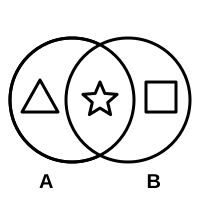
    Week 14 focuses on subtraction word problems — comparison, take-away, and unknown-position. Readers compare two versions of the same story and write a Venn-diagram response.

    Parent tip

    Read two retellings of a fairy tale and chart what's the same and different.

    Materials this week

    Two versions of a fairy tale, Venn diagram, math journal

    Mathematics

    One- and Two-Step Word Problems (Subtraction)

    Operations & Algebraic Thinking · 2.OA.A.1

    Assessment: Solve comparison and take-away word problems with bar models

    ELA

    Comparing Two Versions of the Same Story

    Phonics: Compound words

    Writing: Compare and contrast writing using a Venn diagram

    Science

    Engineering Design & Testing

    K-2-ETS1-1, K-2-ETS1-2, K-2-ETS1-3

    Social Studies

    Civics, Government & Citizenship

    Monday — Day 66

    140 minutes of instruction

    Math

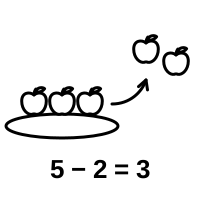
    Students will solve take-from word problems with the result unknown by drawing a bar model with the part taken away crossed out and writing a subtraction equation (2.OA.A.1).

    Standards Addressed

    Activities

    10 min

    Warm-Up

    Spiral from Week 13: read one add-to problem, 'Priya had 28 beads and got 14 more. How many now?' (42). Then say, 'Now flip it. Priya had 42 beads and gave away 14. How many are left?' Have your child predict the answer before drawing (28).

    15 min

    Mini-Lesson

    Read: 'There were 52 cookies on the tray. The family ate 27. How many cookies are left?' Draw one bar labeled 52 across the top, split it into a part labeled 27 with a big X through it and a part labeled ?. Write 52 - 27 = ? and solve two ways: count up from 27 to 52 (3 to 30, 22 more, so 25) and subtract with tens and ones. Name it a 'take-from' problem.

    15 min

    Practice

    Your child solves: 'Diego had 45 balloons. 18 floated away. How many are left?' (27) and 'A parking lot had 70 cars. 36 cars drove off. How many cars are still there?' (34). For each, draw the bar, cross out the part, write the equation with ?, and check by adding the answer back to the part taken (27 + 18 = 45).

    5 min

    Wrap-Up

    Ask, 'Why does adding the answer back to the part you took away give the starting number?' Add take-from to the word wall.

    Materials Needed

    whiteboard or large paperpaperpencildried beans

    English Language Arts

    Students will retell the events of a classic Cinderella tale and identify its main characters and setting (RL.2.2, RL.2.3).

    Standards Addressed

    Activities

    15 min

    Read-Aloud

    Read 'Cinderella' by Marcia Brown (the Perrault version with the pumpkin coach) straight through. Remind your child that last week poets used sound to make meaning; this week they will see how different tellers change the same story. Ask: 'Who helps Cinderella, and what does she lose at the ball?'

    Cinderella by Marcia Brown
    10 min

    Mini-Lesson

    Draw a story map with five boxes labeled Character, Setting, Problem, Helper, Ending. Fill it in together for Marcia Brown's version (Cinderella; a kingdom in France long ago; her stepsisters keep her from the ball; a fairy godmother; the glass slipper fits). Keep this map for Wednesday's comparison.

    paperpencil
    15 min

    Guided Reading

    Reread the pages where the fairy godmother transforms the pumpkin, mice, and rat. Your child reads the transformation list aloud and you list each 'before' and 'after' on paper (pumpkin to coach, six mice to six horses). Ask which change they think is the funniest and why.

    Cinderella by Marcia Brownpaperpencil
    15 min

    Writing Workshop

    Your child writes a five-sentence retelling of Marcia Brown's Cinderella using the words first, next, then, after that, and finally. Model the first sentence aloud: 'First, Cinderella's stepsisters went to the ball and left her at home.'

    writing paperpencilfolder
    10 min

    Phonics: Compound Words

    Explain that a compound word is two small words glued into one. Write and read: sunshine, bedroom, cupcake, football, rainbow, birthday, doghouse, sailboat, popcorn, fireplace. Your child draws a line between the two little words in each and tells what the big word means.

    index cardsmarker

    Materials Needed

    Cinderella by Marcia Brownpaperpencilwriting paperfolderindex cardsmarker

    Science

    Students will ask questions and make observations to define a simple problem that people want to change (K-2-ETS1-1).

    Standards Addressed

    Activities

    5 min

    Science Question of the Week

    Ask: 'How do engineers figure out exactly what the problem is before they start building?' Read the sticky-note problems from last Friday's reflection and choose one family problem to solve this week, or use this one: 'Crayons roll off the table and break.'

    20 min

    Investigation

    Play detective. Put five crayons on a table, nudge the table, and watch what happens; then try it on a tablecloth, a plate, and a folded towel. Record on a chart with three columns, 'surface', 'how many rolled off', and 'what I noticed'. Ask 'who, what, where, when, why' questions about the problem and write the three best ones in the Engineering Notebook ('Where do crayons roll the most? When does it happen? Who gets upset?').

    5 crayonstablecloth or dish towelplatefolded towelEngineering Notebookpencil
    5 min

    Wrap-Up

    Write a problem statement together in one sentence: 'Crayons roll off flat tables, and that breaks them.' Explain that a clear problem statement is step one of the design process, and tape it to the notebook cover.

    Materials Needed

    5 crayonstablecloth or dish towelplatefolded towelEngineering Notebookpenciltape
    Open Monday on its own page
    Social Studies

    Reading About Our World: Three Levels of Government

    Read it aloud first while your child follows along. Then read it together, and let your child read the parts they can. Talk about the words in the word box.

    A government is a group of people who make laws and take care of a place. In the United States, there are three main levels of government.

    The local government takes care of a town or city. It is often led by a mayor. It looks after things like parks, libraries and trash pickup. Firefighters and police officers often work for the local government too.

    The state government takes care of a whole state. It is led by a governor. It builds many highways and makes laws for the state. Each state has a capital city.

    The national government takes care of the whole country. It is led by the President. It makes laws for everyone in the country. Our nation's capital is Washington, D.C.

    Your town is in a state, and your state is in the country. So you live under all three levels at once! Who is the mayor of your town?

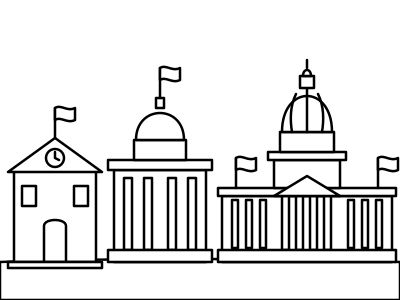
    Three government buildings: a small town hall, a bigger state capitol with a dome, and the large United States Capitol in Washington, D.C.

    Word box

    government:
    a group of people who make laws and take care of a place
    mayor:
    the leader of a town or city
    governor:
    the leader of a state
    capital:
    the city where a state or country's government meets

    Questions

    1. Who leads the state government?
    2. What is one thing the local government takes care of?
    3. Find a compound word in the text and split it.

    Weekly check

    Math

    Weekly Check

    • I can solve taking-away and comparing stories.
    • I can draw a bar model to show a story problem.
    1. Nia had 64 stamps. She gave away 37. How many are left?
    2. Aaron has 52 blocks. Beth has 35 blocks. How many more blocks does Aaron have?
    3. Some cookies were on a plate. 18 were eaten. 26 are left. How many were there at first?
    4. Max has 41 coins. Lily has 16 fewer. How many coins does Lily have?
    5. A bag had 70 marbles. Some fell out. Now 48 are in the bag. How many fell out?
    6. Draw the bar model for the block problem.

    ELA

    Weekly Check

    • I can compare two versions of the same story.
    • I can read compound words and contractions.

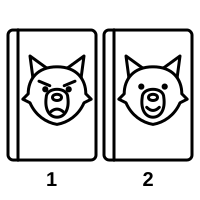
    Two Seed Stories

    Story 1: A hen finds a seed. She asks the cat, the dog and the pig to help her plant it. They all say no. The hen does the work, and she eats the bread by herself. Story 2: A duck finds a seed. She asks her friends to help. They say, "We're too busy!" The duck does the work. At the end, she shares the bread, and her friends help the next time.

    1. Who finds the seed in Story 1? Who finds it in Story 2?
    2. How are the two stories the same?
    3. How are the endings different?
    4. Find the contraction in Story 2. Write it and its two words.
    5. bed + time = ____
    6. Split the compound word: snowball

    Science

    Weekly Check

    • I can describe a problem in one clear sentence.
    • I can ask questions to learn more about a problem.
    1. Which is a clear problem sentence?Stuff is bad.Our dog's water bowl tips over and spills.I like dogs.
    2. Shoes pile up by the door and people trip. Write the problem in one clear sentence.
    3. Write one question you could ask to learn more about the shoe problem.
    4. Who could you interview about the shoe problem?
    5. What do engineers do first?find out what the problem ispaint the finished thingthrow it away

    Social Studies

    Weekly Check

    • I can name the three levels of government.
    • I can match a leader to the level of government they lead.
    1. Name the three levels of government.
    2. A mayor leads which level?localstatenational
    3. A governor leads which level?localstatenational
    4. The President leads which level?localstatenational
    5. A streetlight on your block is broken. Which level would fix it?localstatenational
    6. Which level is in charge of the smallest area?localstatenational

    Specials

    Music · Instruments & Tone Color · All Specials

    This Week's Specials Page

    Music · Week 14

    I can name the four instrument families.

    Look: Instrument families

    1. Strings: you pluck or bow the strings (violin, cello).
    2. Woodwinds: you blow air (flute, clarinet).
    3. Brass: you buzz your lips (trumpet, tuba).
    4. Percussion: you hit, shake or scrape (drum, triangle).

    Circle the family for each instrument.

    1. violinstringswoodwindsbrasspercussion
    2. trumpetstringswoodwindsbrasspercussion
    3. flutestringswoodwindsbrasspercussion
    4. drumstringswoodwindsbrasspercussion

    Listen with a grown-up to a recording of an orchestra.

    1. Draw one instrument you heard. Write its family.

    Challenge

    • Which family could a pot and spoon join?
    How did it go? Great Okay Tricky

    Home Connection

    This week at home

    • Math

      Taking away and comparing in story problems

    • ELA

      Same story, told in different ways

    • Science

      Engineers describe a problem before they solve it

    • Social Studies

      Local, state and national government leaders

    Three things to celebrate this week

    We did blank of 4 activities.

    Suggested Daily Schedule

    8:30–9:00 AM30 minMorning Meeting / Calendar / Read-Aloud
    9:00–9:30 AM30 minPhonics / Word Study / Spelling
    9:30–10:15 AM45 minReading Workshop
    10:15–10:35 AM20 minSnack and Outdoor Play / Movement Break
    10:35–11:05 AM30 minWriting Workshop
    11:05–11:50 AM45 minMathematics
    11:50 AM–12:35 PM45 minLunch and Free Play
    12:35–1:05 PM30 minScience OR Social Studies (alternating)
    1:05–1:35 PM30 minSpecials: PE / Art / Music / Health (rotating)
    1:35–2:00 PM25 minIndependent Reading / Enrichment