Week 16: One- and Two-Step Word Problems (Mixed) · Author's Reasons and Evidence

    Quarter 2 · Detailed day-by-day lesson plans · Days 76–80

    0 of 15 lessons done this week

    One- and Two-Step Word Problems (Mixed) Author's Reasons and Evidence

    Print

    Worksheets and answer keys

    Gather this week

    • Shop
    • Shop
    • Shop
    • Shop
    Everyday supplies (12)

    Writing prompt

    • Design a robot pet. What can it do? What is its name?
    Week 16 writing prompts

    Parent note

    This week's parent digest

    Specials this week

    Supplements

    This week at a glance

    Week 16 mixes two-step word problems across operations. Readers identify the reasons and evidence an author uses, and writers present an opinion aloud with reasons.

    Parent tip

    Ask your child to argue for or against pizza for dinner — using two reasons.

    Materials this week

    Word-problem set, family audience, opinion notes

    Mathematics

    One- and Two-Step Word Problems (Mixed)

    Operations & Algebraic Thinking · 2.OA.A.1

    Assessment: Solve 4 two-step problems with mixed operations

    ELA

    Author's Reasons and Evidence

    Phonics: Use context clues to determine word meaning

    Writing: Speaking and listening

    Science

    Engineering Design & Testing

    K-2-ETS1-1, K-2-ETS1-2, K-2-ETS1-3

    Social Studies

    Civics, Government & Citizenship

    Monday — Day 76

    140 minutes of instruction

    Math

    Students will solve two-step word problems that combine addition and subtraction by drawing a model for each step (2.OA.A.1).

    Standards Addressed

    Activities

    10 min

    Warm-Up

    Spiral from Week 15: 1-minute burst of 15 facts within 20, then ask your child to name the strategy for 9 + 7 and 15 - 6. Say, 'Fast facts are the tools. Today we build with them.'

    15 min

    Mini-Lesson

    Read: 'Nora had 45 stickers. She gave 18 to her brother. Then she bought 25 more. How many stickers does Nora have now?' Model step one as a take-from bar (45 - 18 = 27) and step two as an add-to bar (27 + 25 = 52). Write both equations numbered. Say, 'One step subtracts, one step adds. Read carefully so you know which is which.'

    15 min

    Practice

    Your child solves: 'A pet store had 36 fish. It sold 19 and then got 30 new fish. How many fish now?' (36 - 19 = 17, 17 + 30 = 47). Then: 'Theo had 28 pennies. He found 15 more and then spent 20. How many pennies now?' (28 + 15 = 43, 43 - 20 = 23). Use pennies to act out the second problem and confirm.

    5 min

    Wrap-Up

    Ask, 'How did you decide whether each step was adding or subtracting?' Listen for 'gave, sold, spent mean subtract; bought, found, got mean add.'

    Materials Needed

    penniespaperpencilwhiteboard or large papertimer

    English Language Arts

    Students will identify the reasons a character gives to support an opinion and use context clues to figure out unknown words (RI.2.8, L.2.4a).

    Standards Addressed

    Activities

    15 min

    Read-Aloud

    Read 'I Wanna Iguana' by Karen Kaufman Orloff, doing Alex's letters in an eager voice and Mom's in a calm one. Remind your child that last week they gave reasons about sharks; this week they will study how a writer chooses reasons that actually work. Ask: 'Which of Alex's reasons would convince you?'

    I Wanna Iguana by Karen Kaufman Orloff
    10 min

    Mini-Lesson

    Make a T-chart labeled Alex's Reasons and Mom's Answers. Fill in three pairs from the letters (the iguana is quiet; it will grow six feet long). Say: 'A reason is why you think something, and a strong reason answers the other person's worry.'

    paperpencil
    15 min

    Guided Reading

    Reread three letters with your child reading Alex's parts. When they meet a tricky word, model the context clue strategy: read the sentence before and after, look at the picture, and try a word that makes sense. Note any words they solved on a Context Clue List.

    I Wanna Iguana by Karen Kaufman Orloffpaperpencil
    15 min

    Writing Workshop

    Your child chooses something they want to persuade you about (a later bedtime, a pet, a trip to the park) and writes a letter opening like Alex: 'Dear Mom, I think ____ because ____.' Keep it in the Writing Folder to build all week.

    writing paperpencilfolder
    10 min

    Phonics: Context Clues

    Write six sentences with a blank and a word bank of adorable, responsible, lonely, mature, compromise, tarantula (for example, 'The kitten was so ____ that everyone wanted to hold it'). Your child reads each sentence, picks the word that fits, and explains the clue that helped.

    paperpencil

    Materials Needed

    I Wanna Iguana by Karen Kaufman Orloffpaperpencilwriting paperfolder

    Science

    Students will build a physical prototype from their plan and record what changed between the drawing and the real object (K-2-ETS1-2).

    Standards Addressed

    Activities

    5 min

    Science Question of the Week

    Ask: 'Will our plan work the way we drew it?' Reread last Friday's worry from the notebook. Say: 'Engineers expect surprises; that is why they build a prototype before the real thing.'

    20 min

    Investigation

    Build the crayon holder from the plan using the materials kit, following the step list with your child doing the cutting and taping and you assisting only where asked. Every time you have to change something from the drawing, put a small star on the plan and write what you did instead ('lid too small, used cereal-box bottom'). Stop at 18 minutes even if unfinished and note where you are.

    materials kit from last weekscissorstapegluerubber bandsEngineering Notebookpencil
    5 min

    Wrap-Up

    Count the stars on the plan. Ask: 'Which change was the most surprising?' Put the prototype somewhere safe and write 'Test on Wednesday' at the top of a fresh notebook page.

    Materials Needed

    materials kit from last weekscissorstapegluerubber bandsEngineering Notebookpencil
    Open Monday on its own page
    Social Studies

    Reading About Our World: Why Voting Matters

    Read it aloud first while your child follows along. Then read it together, and let your child read the parts they can. Talk about the words in the word box.

    Voting is a way for a group to make a choice. Each person gets one vote. Then the votes are counted.

    I think voting is one of the most important things citizens do. Here are my reasons.

    First, voting is fair. Every vote counts the same. The mayor gets one vote. So does the person who delivers the mail.

    Second, voting lets people choose their leaders. In an election, citizens vote for people like the mayor, the governor and the President. In the United States, citizens who are 18 or older can vote.

    Third, voting helps solve disagreements in a calm way. People share their ideas, then they vote. In many elections, the choice with the most votes wins.

    Voting is often done in secret, on a paper called a ballot. That way, each person can choose freely. You can practice voting at home. What could your family vote on?

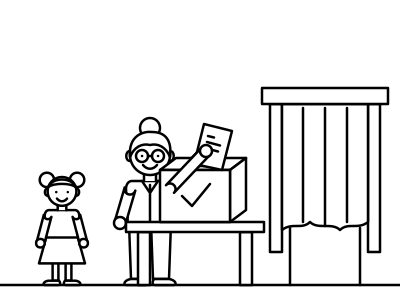
    A woman drops her paper ballot into a ballot box while a girl watches, with a voting booth behind them.

    Word box

    vote:
    to make a choice that is counted with other people's choices
    election:
    a time when people vote to choose leaders
    ballot:
    a paper or form used to vote
    citizen:
    a member of a community or country

    Questions

    1. What does the author think about voting?
    2. Name two reasons the author gives.
    3. Why is voting often done in secret?

    Weekly check

    Math

    Weekly Check

    • I can solve two-step story problems with adding and subtracting.
    • I can tell what to do first and what to do next.
    1. Gabe had 57 stickers. He gave 28 away and then got 16 more. How many stickers now?
    2. Ana has 33 shells. Raj has 19 more than Ana. How many shells do they have in all?
    3. A store had 90 apples. It sold 35 in the morning and 29 in the afternoon. How many are left?
    4. Lin read 24 pages and then 18 pages. Ben read 15 fewer pages than Lin. How many pages did Ben read?
    5. In the sticker problem, what did you do first? What did you do next?

    ELA

    Weekly Check

    • I can find the reasons an author gives for a point.
    • I can use clues in a sentence to figure out a new word.

    Our Town Needs a Dog Park

    Our town should build a dog park. First, dogs need a safe place to run. Now they run in the street, and that is not safe. Also, a dog park would help people meet their neighbors. Last, the dogs would stop making the school field muddy, full of wet dirt and holes. A dog park would make our town a cheerful place, happy for dogs and people.

    1. What does the author want?
    2. Write two reasons the author gives.
    3. Which reason is the strongest? Why?
    4. What does cheerful mean? Underline the clue.
    5. What does muddy mean? Underline the clue.

    Science

    Weekly Check

    • I can build a model of my idea.
    • I can test my model and tell what happened.
    1. Why do engineers build a model before the real thing?
    2. Tia built a cup holder. In her test, 3 cups tipped over. Her goal was no cups tip over. Did it pass?passfail
    3. What should Tia do next?
    4. Why write down numbers when you test?
    5. Put the steps in order: test, build, make it better

    Social Studies

    Weekly Check

    • I can explain how voting helps people make a choice.
    • I can tell why every vote is counted.
    1. How does voting help a group make a choice?
    2. Why is every vote counted?
    3. A class votes: 9 for tag and 6 for art. Which choice wins?tagart
    4. How many votes were there in all?
    5. What is an election?

    Specials

    Health · Feelings and Friendships · All Specials

    This Week's Specials Page

    Health · Week 16

    I can name my feelings and use a calm-down tool.

    Feelings thermometer. Color the thermometer: blue at the bottom for calm, yellow in the middle for a little upset, red at the top for very upset. Then write where each one lands for you.

    1. My block tower falls down: ____
    2. I read a book in a cozy spot: ____
    3. Someone takes my turn in a game: ____

    Belly breathing. Lie down with a stuffed animal on your tummy. Breathe in slowly through your nose. Watch it rise. Breathe out slowly. Do 10 breaths.

    1. How did you feel after 10 breaths? Circle one.calmerthe samesleepy
    2. Name one other calm-down tool you can use.

    You need: red, yellow and blue crayons, a small stuffed animal

    How did it go? Great Okay Tricky

    Home Connection

    This week at home

    • Math

      Two-step stories that add and subtract

    • ELA

      Good reasons help people agree with you

    • Science

      Build a model, test it, then improve

    • Social Studies

      Voting is a fair way to choose

    Three things to celebrate this week

    We did blank of 4 activities.

    Suggested Daily Schedule

    8:30–9:00 AM30 minMorning Meeting / Calendar / Read-Aloud
    9:00–9:30 AM30 minPhonics / Word Study / Spelling
    9:30–10:15 AM45 minReading Workshop
    10:15–10:35 AM20 minSnack and Outdoor Play / Movement Break
    10:35–11:05 AM30 minWriting Workshop
    11:05–11:50 AM45 minMathematics
    11:50 AM–12:35 PM45 minLunch and Free Play
    12:35–1:05 PM30 minScience OR Social Studies (alternating)
    1:05–1:35 PM30 minSpecials: PE / Art / Music / Health (rotating)
    1:35–2:00 PM25 minIndependent Reading / Enrichment