Week 26: Picture Graphs and Bar Graphs · Building on Others' Talk

    Quarter 3 · Detailed day-by-day lesson plans · Days 126–130

    0 of 15 lessons done this week

    Picture Graphs and Bar Graphs Building on Others' Talk

    Print

    Worksheets and answer keys

    Gather this week

    • Shop
    • Shop
    • Shop
    Everyday supplies (14)

    Writing prompt

    • If you could give your past self advice, what would you say?
    Week 26 writing prompts

    Parent note

    This week's parent digest

    Specials this week

    Supplements

    This week at a glance

    Week 26 draws and interprets picture and bar graphs and solves comparison problems. Children practice building on others' talk and use real-world word connections in writing.

    Parent tip

    Graph favorite cereals in the pantry as a quick bar graph.

    Materials this week

    Graph paper, pantry survey, conversation prompts

    Mathematics

    Picture Graphs and Bar Graphs

    Data & Geometry · 2.MD.D.9

    Assessment: Draw and interpret picture graphs and bar graphs; solve comparison problems

    ELA

    Building on Others' Talk

    Phonics: Review prefixes and suffixes

    Writing: Use real-world connections between words and their use

    Science

    Biodiversity & Interdependence

    2-LS2-1, 2-LS2-2, 2-LS4-1

    Social Studies

    Economics: Needs, Wants & Choices

    Monday — Day 126

    140 minutes of instruction

    Math

    Students will conduct a household survey with up to four categories and organize the results in a tally table (2.MD.D.10).

    Standards Addressed

    Activities

    10 min

    Warm-Up

    Spiral from Week 25: show last week's crayon line plot and ask, 'How many crayons were 5 inches?' Then ask, 'Could we make a line plot of favorite colors?' and let your child explain why not (colors are not numbers).

    15 min

    Mini-Lesson

    Explain that a survey is a question we ask many people. Write the question 'What is your favorite fruit?' with four choices: apple, banana, grape, orange. Model making a tally table, with one mark per vote and a slash across every fifth mark.

    15 min

    Practice

    Your child surveys everyone in the house and then calls or texts grandparents, cousins, or neighbors with adult help until they have at least 10 answers. They record each answer as a tally mark and write the total for each fruit.

    5 min

    Wrap-Up

    Ask, 'Which fruit got the most votes? How many people did you ask in all?' Have your child add the four totals to check that the sum matches the number of people surveyed.

    Materials Needed

    paperpencilphone for calling relatives with adult help

    English Language Arts

    Students will use sentence stems to build on a partner's ideas while discussing why the family in 'A Chair for My Mother' saves every coin (SL.2.1b, RL.2.3).

    Standards Addressed

    Activities

    15 min

    Read-Aloud: A Chair for My Mother

    Point to last week's Talking Together chart and say: 'This week we add a new skill, building on someone else's idea.' Read 'A Chair for My Mother' by Vera B. Williams, stopping at the big jar of coins, at the memory of the fire, and when the family finally sits in the new chair. Ask: 'Why does this family save every coin instead of spending them?'

    A Chair for My Mother by Vera B. Williams
    10 min

    Mini-Lesson: Sentence Stems for Adding On

    Add four stems to the chart: 'I agree with you because ...', 'I want to add on ...', 'That reminds me of ...', and 'I disagree a little because ...'. Model: you say 'I think the jar is important because it holds their hope,' and then show your child how to answer with 'I want to add on, the jar is also where Rosa puts her own coins.'

    chart papermarker
    15 min

    Guided Reading: Need or Want?

    Ask the question 'Was the chair a need or a want?' and hold a conversation where every turn must begin with a stem from the chart; keep a tally of stems used. Reread the pages about the burned apartment and the hard kitchen chairs so your child can point to evidence for either side.

    A Chair for My Mothersticky notespencil
    15 min

    Writing Workshop: Words at Work

    Start a 'Words at Work' page for words from the book: tips, coins, save, bargain. For each word your child writes what it means and one real-life place they have seen it (a tip left on a diner table, coins in a jar at home) and draws a tiny picture. Explain that this week's writing is about connecting words to real life.

    writing notebookpencilcrayons
    10 min

    Phonics: Prefixes un- and re-

    Word cards: unhappy, unlock, untie, unfair, unpack, unsafe, redo, reread, replay, refill, rebuild, return. Your child covers the prefix with a finger, reads the base word, then uncovers and reads the whole word, saying 'un means not' or 're means again.' Sort into two piles and write three of each.

    index cardsmarkerwriting notebook

    Materials Needed

    A Chair for My Mother by Vera B. Williamschart papermarkersticky noteswriting notebookpencilcrayonsindex cards

    Science

    Students will sort pictures of animals into groups by observable body features (fur, feathers, scales, shells, six legs) and explain their sorting rule (2-LS4-1).

    Standards Addressed

    Activities

    5 min

    Science Question of the Week

    Hold up last week's field guide page. Ask: 'If we found 100 living things instead of 10, how would we keep track of them all?' Explain that scientists sort living things into groups by features they can see, and that this is called classification.

    20 min

    Investigation: Animal Card Sort

    Make 16 animal cards from magazine cutouts, printouts, or quick sketches: dog, cat, horse, robin, penguin, owl, snake, lizard, turtle, frog, salamander, goldfish, shark, ant, butterfly, spider. First let your child sort them any way at all and explain the rule. Then give the scientist rules: fur or hair (mammals), feathers (birds), dry scales (reptiles), smooth wet skin (amphibians), fins and gills (fish), six legs (insects). Re-sort and glue each group onto its own labeled sheet.

    16 animal pictures6 sheets of paperglue stickmarker
    5 min

    Wrap-Up

    Ask the trick questions: 'A penguin cannot fly. Is it still a bird?' (Yes, feathers.) 'A spider has eight legs. Is it an insect?' (No, insects have six.) Post the six group sheets on the wall for the week.

    Materials Needed

    16 animal pictures6 sheets of paperglue stickmarkerfield guide page from last week
    Open Monday on its own page
    Social Studies

    Reading About Our World: Goods and Services

    Read it aloud first while your child follows along. Then read it together, and let your child read the parts they can. Talk about the words in the word box.

    A good is something people make or grow that you can touch. Apples, shoes, books and bikes are goods.

    A service is work that one person does for another. A barber cuts hair. A doctor helps sick people get well. A mail carrier brings letters. A bus driver takes people where they need to go.

    People pay money for goods and services. A family might buy goods, like milk and bread, at a grocery store. They might pay for a service, like getting the car fixed.

    Some places sell both. At a restaurant, the food is a good. Cooking the food and bringing it to your table is a service.

    Many people earn money by making goods or doing services. A farmer grows food to sell. A teacher helps children learn. Look around your community. Which goods can you see? Who is doing a service?

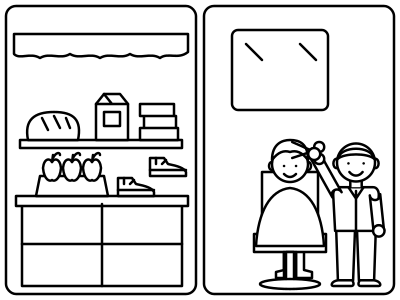
    Goods and services: a store sells bread, milk, books, apples and shoes, and a barber gives a boy a haircut.

    Word box

    good:
    something people make or grow that you can touch
    service:
    work that one person does for another
    community:
    a place where people live, work and play together
    grocery store:
    a store that sells food and things for the home

    Questions

    1. What is a good?
    2. Is a haircut a good or a service?
    3. At a restaurant, what is the good and what is the service?

    Weekly check

    Math

    Weekly Check

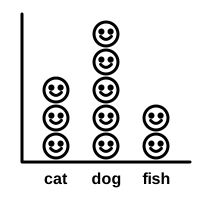
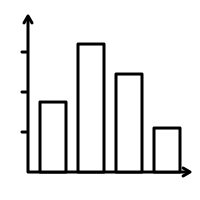
    • I can make a picture graph and a bar graph.
    • I can answer how many in all, how many more and how many fewer questions about a graph.
    1. Favorite seasons: spring 5, summer 8, fall 4, winter 3. Draw a picture graph. Each picture = 1 vote.
    2. Draw a bar graph of the same data.
    3. How many more votes for summer than winter?
    4. How many fewer votes for fall than spring?
    5. How many votes in all?
    6. Which two seasons together equal summer?

    ELA

    Weekly Check

    • I can add to what someone else said by linking my idea to theirs.
    • I can use prefixes and suffixes to figure out what a word means.

    The Helpful Bus Driver

    Mr. Cruz drives the bus in our town. He is careful and kind. He helps riders who are unsure of their stop. He smiles gladly at everyone.

    1. Kim says, "Mr. Cruz is kind." Write an add-on that links to her idea.
    2. Circle the best add-on.I agree, because he smiles at everyone.My shoes are red.
    3. What does careful mean?
    4. What does unsure mean?
    5. What does gladly mean?
    6. What does reopen mean?

    Science

    Weekly Check

    • I can sort animals into groups, like mammals, birds, fish, reptiles, amphibians and insects.
    • I can name a body feature for each group (fur, feathers, scales, six legs).
    1. A rabbit has fur. What group is it in?
    2. A parrot has feathers. What group is it in?
    3. An alligator has dry scales. What group is it in?
    4. A tuna has fins and gills. What group is it in?
    5. A ladybug has six legs. What group is it in?
    6. What body feature do amphibians like frogs have?

    Social Studies

    Weekly Check

    • I can tell the difference between goods and services.
    • I can name goods and services in my community.
    1. What are goods?
    2. What are services?
    3. a mail carrier bringing lettersgoodservice
    4. a loaf of breadgoodservice
    5. Name one good you can buy in your community.
    6. Name one service in your community.

    Specials

    Music · Music from Around the World · All Specials

    This Week's Specials Page

    Music · Week 26

    I can learn songs from different places.

    My World Music Passport. With a grown-up, find and listen to each traditional song. Stamp or color the box when you have heard it.

    SongWhere it comes fromLanguageHeard it
    1. "Frere Jacques" comes from France. What language is it sung in?
    2. "De Colores" is sung in Mexico and other places. What language is it sung in?
    3. "Sakura, Sakura" comes from Japan. Sakura means cherry blossom. Draw a cherry blossom.

    Think about it.

    1. Which song did you like best? Why?
    How did it go? Great Okay Tricky

    Home Connection

    This week at home

    • Math

      Picture graphs and bar graphs show survey answers

    • ELA

      Adding my idea onto what someone else said

    • Science

      Sorting animals into groups by their body parts

    • Social Studies

      Goods are things; services are jobs done for us

    Three things to celebrate this week

    We did blank of 4 activities.

    Suggested Daily Schedule

    8:30–9:00 AM30 minMorning Meeting / Calendar / Read-Aloud
    9:00–9:30 AM30 minPhonics / Word Study / Spelling
    9:30–10:15 AM45 minReading Workshop
    10:15–10:35 AM20 minSnack and Outdoor Play / Movement Break
    10:35–11:05 AM30 minWriting Workshop
    11:05–11:50 AM45 minMathematics
    11:50 AM–12:35 PM45 minLunch and Free Play
    12:35–1:05 PM30 minScience OR Social Studies (alternating)
    1:05–1:35 PM30 minSpecials: PE / Art / Music / Health (rotating)
    1:35–2:00 PM25 minIndependent Reading / Enrichment